Your creative vision is a masterpiece in your head, but without a strategy, it’s just an expensive hobby destined for the digital graveyard. Most indie projects fail not because of bad art, but because they lack a battle plan. Mastering game development project management for beginners is the difference between a forgotten prototype and a top-selling title. In a 2026 market projected to reach over $255 billion, you can’t afford to wing it. It’s time to trade the chaos of “just one more feature” for a professional production mindset that cuts through the visual noise.
You’ve likely felt the weight of scope creep or the crushing uncertainty of how to fund your dream studio. It’s a common struggle, but it doesn’t have to be yours. This guide promises to hand you the keys to studio leadership, resource management, and professional fundraising. We’ll explore the essential pillars of game production to turn your creative vision into a market-ready reality. You’re going to learn how to build a clear roadmap, gain confidence in leading your project, and finally understand how to pitch to investors. Let’s stop dreaming and start shipping.
Key Takeaways
- Bridge the gap between raw creativity and a finished product by adopting a high-stakes producer’s mindset.
- Follow a precise four-phase roadmap to transition your project from a visionary dream into a market-ready execution.
- Master game development project management for beginners to navigate the trade-offs between scope, budget, and talent.
- Identify and defeat common “boss fights” like perfectionism and scope creep that frequently derail emerging indie studios.
- Simulate real-world studio leadership and project strategy using the Studio Showdown board game to sharpen your competitive edge.
Mastering the Arena: What is Game Development Project Management?
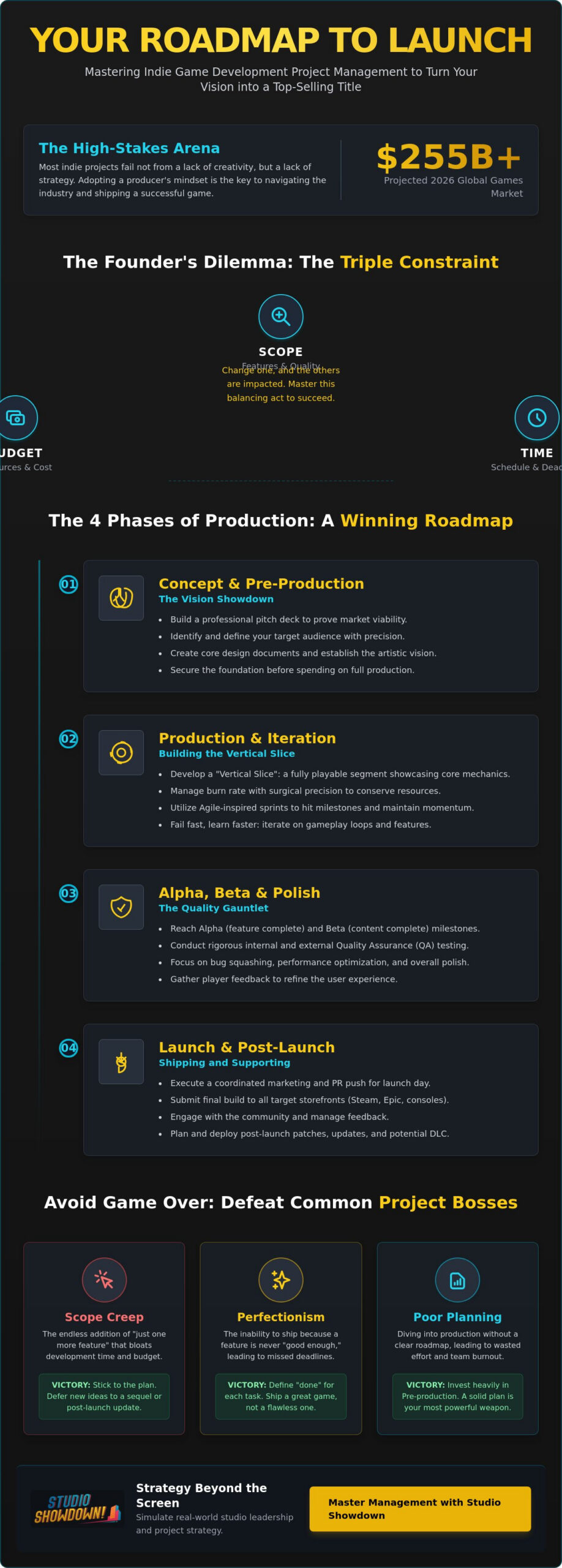
Project management is the bridge. It connects your wild, unrefined creative spark to a polished, market-ready reality. In the high-stakes world of 2026, where the global games market is projected to reach $255.03 billion, you can’t afford to get lost in the middle. Understanding game development project management for beginners means recognizing that your idea is only as good as your ability to ship it. It isn’t a bureaucratic chore. It’s the strategy for victory. It’s the difference between a prototype that rots on a hard drive and a game that dominates the charts.
Every project lives or dies by the ‘Triple Constraint’. This is the iron triangle of Scope, Time, and Budget. If you expand the scope, your budget explodes or your timeline shifts. If you cut the budget, you lose talent or features. Managing these trade-offs is where the real game is played. It’s a constant showdown between your ambition and your resources. You have to be the one to hold the line.
The Role of the Studio Founder
Beginners often make the mistake of thinking like a developer when they should be thinking like a founder. A developer builds the mechanics; a project lead builds the environment where those mechanics can thrive. You aren’t just coding or drawing. You’re managing talent, balancing vision against market expectations, and ensuring the team doesn’t burn out. It’s a leadership role that demands both empathy and iron-clad discipline.
Thinking like a studio owner from day one changes your priorities. You stop asking “is this feature cool?” and start asking “does this feature serve the launch?” The complexities of the game development process require a leader who can navigate technical hurdles while keeping the artistic soul of the project intact. It’s about authority, vision, and the guts to say no to distractions. You’re the captain of the ship, not just a sailor.
Why Projects Fail (and How to Win)
The industry is brutal. Most indie games fail before they ever reach a storefront. While exact numbers vary, industry veterans often point to poor scope management as the primary killer of small studios. Without clear structure, projects bloat. They bleed money. They lose momentum. Game development project management for beginners acts as a protective barrier around your artistic vision, preventing it from being crushed by the weight of its own ambition.
Success requires turning a massive, terrifying project into a series of winnable battles. By setting clear, achievable milestones, you maintain morale and prove progress to potential investors. This structure protects your creative freedom by ensuring you don’t run out of time or money before the masterpiece is finished. Winning doesn’t happen by accident. It’s the result of a disciplined, proactive approach that values execution as much as imagination.
The Four Phases of Production: Your Roadmap to Launch
The dream is over. Now, the execution begins. Every successful title follows a rigorous chronological sequence that turns abstract ideas into tangible assets. For anyone diving into game development project management for beginners, this roadmap is your primary defense against chaos. It’s a series of high-stakes showdowns where your vision meets reality. You must win every round to reach the finish line. Transitioning from dreaming to executing requires a shift in identity. You’re no longer just an artist. You’re a producer.
Phase 1: Concept & Pre-production
Pre-production is the architectural foundation upon which your entire studio’s success is built. This is the “Vision Showdown.” You aren’t just sketching characters or writing lore. You’re building a professional pitch deck that proves your project has a viable market niche. Identify your target audience with clinical precision. If you don’t know who is playing, you don’t know what you’re building. Map the vision without getting lost in the weeds of minor details. Secure your foundation before you spend a single cent on heavy production.
Phase 2: Production & Iteration
This is where the heavy lifting happens. Your primary objective is the “Vertical Slice,” a fully playable segment of your game that showcases every core mechanic in its final form. This phase tests your professional stamina. You must manage your burn rate, the speed at which you spend your resources, with surgical precision. As teams scale, mastering becomes vital to keep the momentum high. Use Agile-inspired sprints to hit milestones. Fail fast. Iterate faster. This is the heart of game development project management for beginners. Learning these phases is easier when you can simulate the pressure in a competitive studio environment.
Phase 3: Launch & Post-Production
The “Launch Showdown” is the final boss. Reaching the “Gold” milestone means your game is ready for the world, but the release logistics are a minefield. You need a plan for gathering player feedback and actionable data the second the game goes live. Post-production isn’t just about fixing bugs. It’s about managing community expectations and protecting your studio’s reputation. Every patch and update is a statement of your professional standards. Turn your launch into a lasting victory by staying engaged long after the initial hype fades.
The Founder’s Dilemma: Balancing Scope, Budget, and Talent
Ambition is your greatest asset and your deadliest enemy. As a founder, you face a constant, high-stakes trade-off between features and resources. This is the Founder’s Dilemma. You want a sprawling open world, but your bank account says you can afford a single room. Mastering game development project management for beginners means making the hard calls before the market makes them for you. It’s about strategic sacrifice. You don’t win by doing everything. You win by doing the right things with clinical precision.
Managing a project with zero budget isn’t an excuse for failure. It’s a test of your management grit. When capital is scarce, your primary currency is focus. You must allocate your “Action Points” with extreme care. Should you invest in breathtaking art, rock-solid code, or aggressive marketing? Spreading yourself too thin is a death sentence. To achieve market dominance, you need to over-deliver in one specific area that defines your brand. This level of strategic resource allocation is what separates professional studios from hobbyist daydreams. Every decision you make is a statement of your priorities.
The Art of Resource Allocation
Every hour your team spends on a minor mechanic is an hour stolen from the core loop. You must manage your team’s energy like a finite resource. Burnout is a project killer, often caused by poor leadership rather than hard work. Creative fundraising isn’t just about finding investors. It’s about bartering skills, building early community support, and creating “sweat equity” that translates into a polished product. You aren’t just managing tasks. You’re managing the pulse of your studio. You need to know exactly when to push and when to pivot. This agility is the hallmark of a true studio lead.
Mastering the Pitch
Project management doesn’t stop at the internal task list. It includes the vital skill of selling your vision to stakeholders. Whether you’re pitching to a publisher or a group of freelancers, you must communicate value with absolute confidence. A winning pitch deck is a management tool that aligns everyone’s expectations. It proves you have a plan, not just a dream. Fundraising is a project management skill. It requires milestones, deadlines, and clear deliverables. If you want to sharpen these instincts before risking your real-world capital, check out The Ultimate Business Board Game: Master Entrepreneurship in 2026 to see how high-stakes decisions play out in a simulated arena. Master the art of the showdown, and the funding will follow.
Avoiding the Game Over: Common Pitfalls for New Project Managers
Management is a psychological battleground. The biggest boss fights you’ll face aren’t technical; they’re mental. Fear of failure and perfectionism can paralyze a studio before it even ships its first build. Beginners often get trapped in a loop of endless polishing, convinced that one more tweak will guarantee success. It won’t. Success comes from shipping, not from being perfect. Mastering game development project management for beginners requires you to recognize when your own brain is sabotaging your progress. You have to be willing to release something “good enough” to get the data you need to make it great.
Scope creep is a catastrophic expansion of project goals that can bloat development timelines by over 50%, often exhausting a studio’s entire budget before the core gameplay loop is even finalized. It’s the silent studio killer. It starts with a small idea and ends with a cancelled project. To survive, you need a set of “Cheat Codes” to keep your project on track. These aren’t shortcuts; they’re the rules of engagement for a professional founder.
Defeating Scope Creep
Scope creep happens because it’s easier to dream than to finish. It’s the emotional attachment to “what if” that derails your production. The only antidote is the Minimum Viable Product (MVP) strategy. Strip your game down to its absolute essentials. If the game isn’t fun with gray boxes and zero special effects, more features won’t save it. You must learn the power of “No.” Every new feature request is a direct threat to your launch date. Protect your timeline with aggressive discipline. If a feature doesn’t serve the core loop, it doesn’t belong in the current sprint.
The Fundraising Trap
Running out of runway is a management failure, not just a financial one. Cash flow is a metric you must track with surgical precision. Many new managers fall into the trap of over-reliance on a single funding source, whether it’s a specific investor or personal savings. This creates a single point of failure that can end your studio in a week. Diversify your strategy. Understand that fundraising is about maintaining momentum. You can’t lead a team if you’re constantly worried about next month’s bills. For a deeper dive into why luck isn’t a business plan, read Beyond the Easy Money Game: Why Strategy Wins in 2026 to see how strategy beats fortune every time.
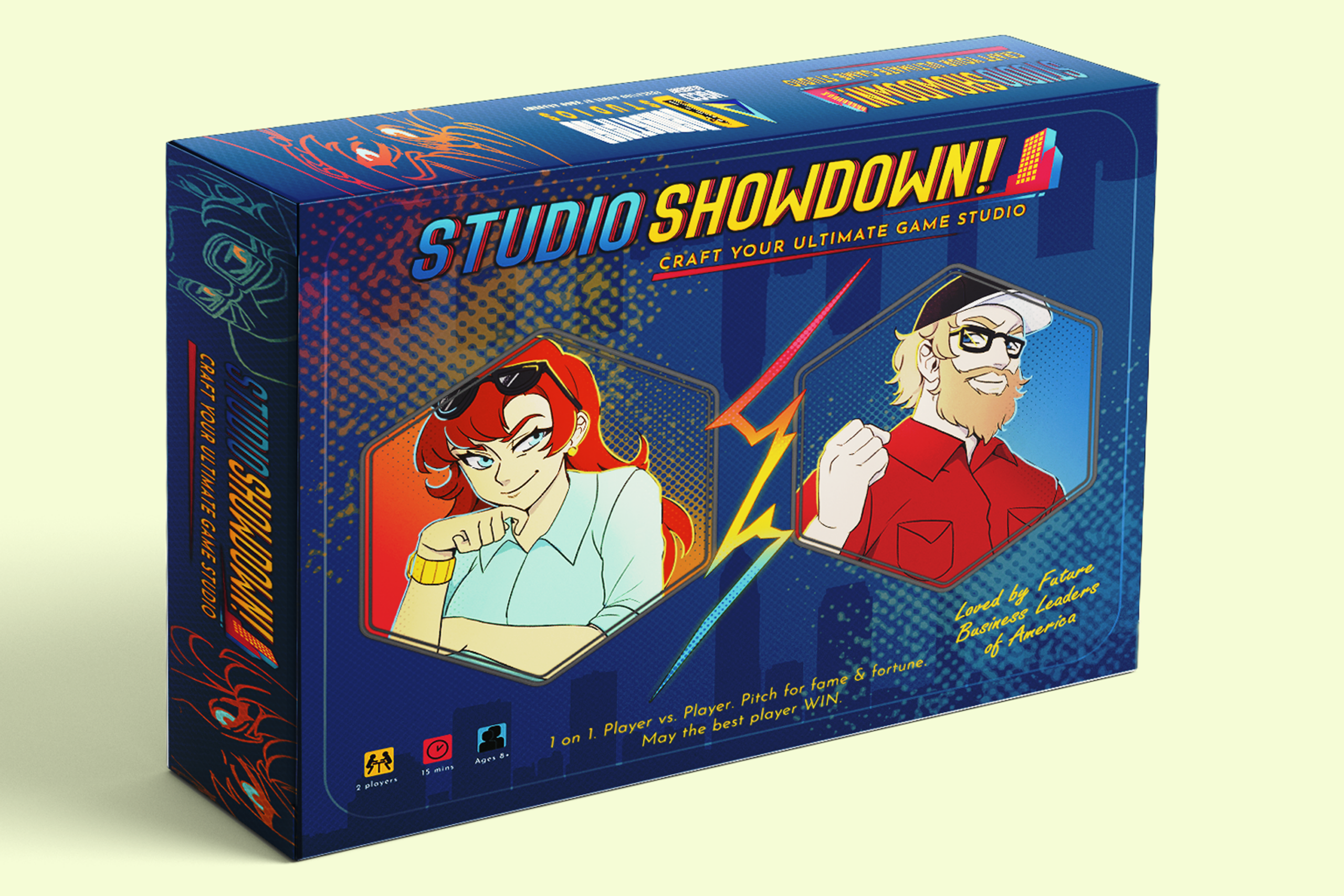
Don’t let these traps end your story before it begins. Sharpen your strategic instincts and learn to manage high-stakes trade-offs by playing Studio Showdown, the board game that simulates the real-world pressure of game production.
Strategy Beyond the Screen: Mastering Management with Studio Showdown
Theory serves as your map, but the board is where you learn to navigate the terrain. You’ve identified the phases of production and the psychological traps of perfectionism. Now, you need a high-stakes environment to test those instincts without risking real-world capital. Studio Showdown isn’t just a tabletop experience; it’s a professional simulation of the modern games industry. It takes the complex pillars of game development project management for beginners and turns them into a series of winnable battles. Here, every decision has an immediate impact on your studio’s survival.
The game mirrors the intense rivalry of the 2026 market. You’ll face the same challenges we’ve discussed: limited runways, talent acquisition, and the constant threat of a competitor seizing your niche. For students and aspiring leads, this is a laboratory for building business acumen. Educators use it to provide a hands-on look at the production machine that powers global hits. It’s about developing a proactive mindset that values execution as much as artistry. You learn to read the market, manage your team, and strike when the opportunity for dominance appears.
The Studio Showdown Experience
Every round in the Studio Showdown Board Game demands precise resource allocation. You must navigate the tension of fundraising and pitching while your opponents move to disrupt your production pipeline. This is the “Founder’s Perspective” in action. You’ll learn to balance your Action Points between art, code, and marketing, experiencing exactly why a lack of focus leads to a project failure. This format makes the high-pressure world of studio leadership both accessible and deeply engaging. To further sharpen your tactical edge, explore our guide to Mastering the Board: The 2026 Guide to Strategy Board Games.
Screen-Free Learning for Future Founders
Digital tools are vital for execution, but analog simulations excel at teaching core business logic. Stepping away from the monitor forces you to engage with the human element of leadership. You have to pitch your vision and defend your strategy face-to-face. This makes it an ideal tool for modern classrooms or competitive family game nights. The Studio Showdown: Educator Edition is built to help instructors turn a lesson on game development project management for beginners into a fast-paced, visual experience that sticks. For more strategies to build your skills away from the screen, check out our Screen-Free Activities for Teens and Families: The 2026 Strategy Guide. Stop reading about the industry. Start leading it.
Claim Your Victory in the Global Game Arena
The dream is now a battle plan. You’ve navigated the four phases of production and learned to hold the line against scope creep. You understand that the Founder’s Dilemma isn’t a wall; it’s a challenge to be overcome through strategic resource allocation. Success in game development project management for beginners isn’t about having the biggest budget. It’s about having the sharpest strategy and the guts to execute it. You’ve moved beyond the visual noise to see the underlying mechanics of studio success.
Now it’s time to put these concepts into practice. Developed by VGCD Academy and DEMYSTIFIED Studios, Studio Showdown offers hands-on learning for fundraising and pitching that you can’t get from a textbook. It’s the same tool used by educators to help students build professional portfolios and real-world business acumen. Don’t let your vision stay on the sidelines while others dominate the charts. Enter the arena and master the business of games with Studio Showdown today! Your studio’s success story starts with your first move. The market is waiting. Go out there and win.
Frequently Asked Questions
What is the most important skill for a game project manager?
Communication and strategic prioritization are the twin pillars of success. You must act as the bridge between raw creative vision and the cold reality of technical limitations. A great manager knows when to kill a feature to save the project. It’s about maintaining focus, managing expectations, and keeping the team aligned with the core loop at all times. You lead the charge.
How do I manage a game development project with no budget?
Focus on scope reduction and sweat equity. When you lack capital, your only currency is time. Use accessible engines like Unity 6.5 or Unreal Engine 5.8 to build a polished Minimum Viable Product. Prove your concept works with gray boxes before you even think about high-end assets. This lean approach to game development project management for beginners ensures you don’t burn out before reaching a playable state.
What is ‘scope creep’ and how do I prevent it?
Scope creep is the silent studio killer where features expand without extra time or money. It turns a six-month project into a three-year nightmare. Prevent it by creating a rigid design document and sticking to it. Every new “cool idea” gets sent to a backlog for post-launch updates. If it doesn’t serve the core mechanic, it doesn’t enter the production pipeline. Discipline is your only defense.
Do I need to know how to code to be a game project manager?
You don’t need to be a programmer, but technical literacy is mandatory. You must understand the logic of the development process to set realistic milestones. Knowing the difference between a minor bug and a fundamental engine limitation helps you lead with authority. Your job isn’t to write the code; it’s to ensure the code serves the launch date. You manage the process, not the syntax.
How long does the pre-production phase usually last for beginners?
Allocate roughly 20% of your total timeline to pre-production. For a small indie title, this usually means one to three months of intense planning and prototyping. This is where you validate the “fun” and build your roadmap. Skipping this phase to start “real work” is a rookie mistake that leads to massive technical debt and wasted resources later. Secure your foundation before you build the walls.
What is the difference between a Producer and a Project Manager in game dev?
Producers manage the vision, budget, and external stakeholders. Project Managers handle the daily tasks, schedules, and team workflows. In the world of game development project management for beginners, you’ll likely perform both roles. You’re the one who secures the funding and the one who ensures the daily scrums actually lead to a finished build. You own the strategy and the execution.
How can a board game teach real-world project management skills?
Analog simulations like Studio Showdown strip away the screen to focus on core business logic. They force you to make high-stakes trade-offs between art, code, and marketing in a competitive arena. You learn resource management, pitching, and market strategy through direct experience. It’s a low-risk way to develop the “Founder’s Mindset” before you spend a single dollar on a digital prototype. Practice the showdown before the real fight.
What should be included in a beginner’s game pitch deck?
Your deck must feature a compelling hook, a clear target audience, and a detailed budget roadmap. Investors don’t just buy games; they buy studios with a plan for market dominance. Show them your milestones, your competitive analysis, and exactly how you’ll reach the finish line. A professional deck proves you aren’t just a dreamer; you’re a leader ready to ship. Make your vision undeniable.