Most people think game production is a 40-hour week of playtesting and pizza. It’s actually a high-stakes battle where creative dreams meet the cold, hard wall of a $255 billion market reality. If you’ve ever wondered what a day in the life of a game producer really looks like, it’s less about the controller and more about the command center. It’s a relentless cycle of triage, negotiation, and vision-keeping.
You probably feel like the industry is an impenetrable maze of complexity. It’s frustrating to hear the job is “just playing games” when you know there’s a professional science behind the screen. We’re here to bridge that gap. This article promises to step you into the high-stakes world of production, showing you how to master the balance between creative ambition and business reality.
We’ll explore the actionable skills required to survive the digital showdown. You’ll learn how to build a portfolio that actually matters. Finally, we’ll reveal a way to simulate this intense experience before you commit your entire career to the grind.
Key Takeaways
- Understand the producer’s role as the project’s heartbeat, balancing creative vision against the rigid constraints of budget and time.
- Learn to navigate the midday grind by mastering resource allocation and the high-stakes art of technical firefighting.
- Gain insights into the afternoon pitch and discover exactly what it takes to secure a greenlight from investors and publishers.
- Explore the real day in the life of a game producer to see why leading people and managing psychological pressure is the ultimate strategy game.
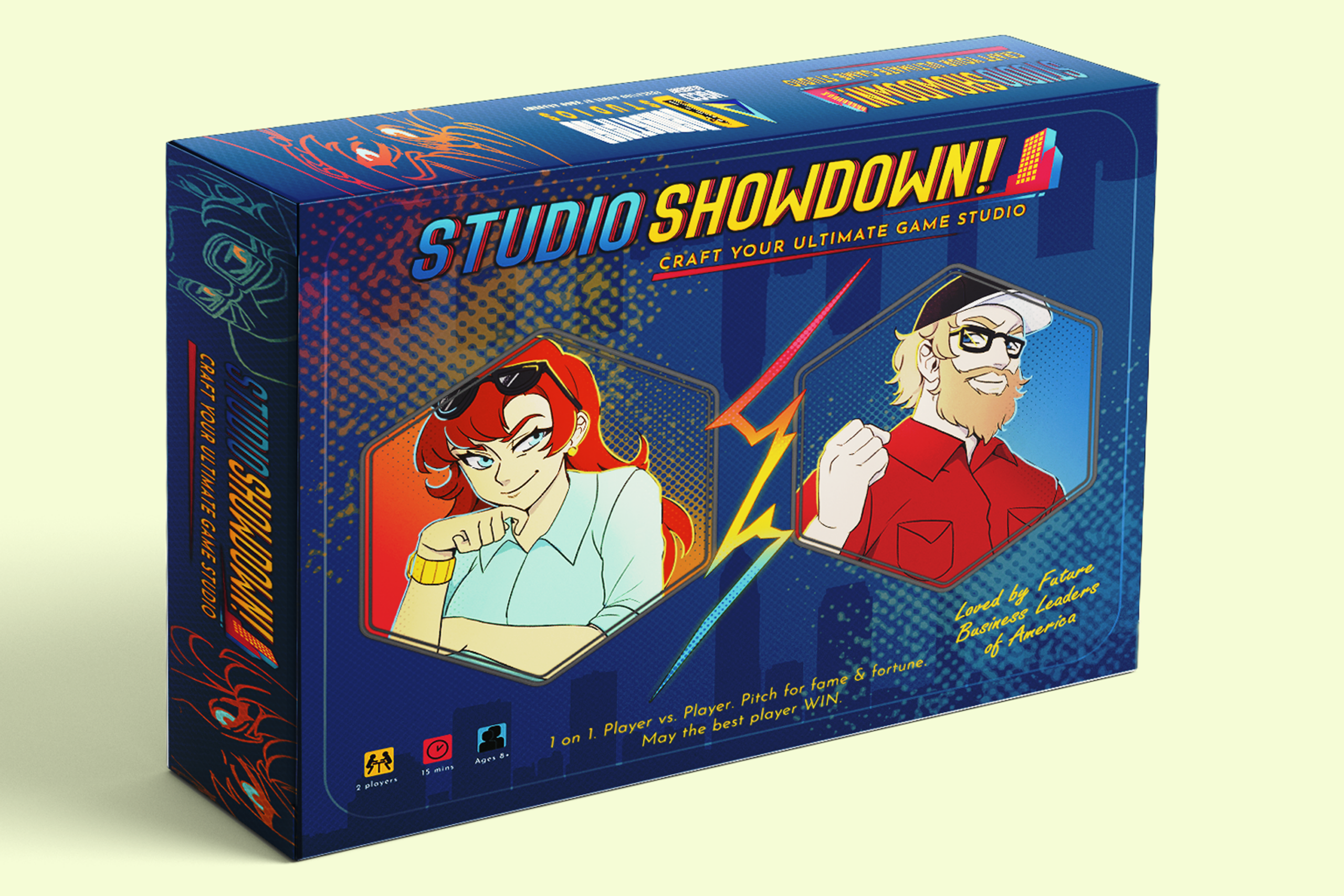
- Discover how the Studio Showdown Board Game provides a risk-free way to simulate the intensity of running your own digital studio.
What is a Game Producer? Defining the Architect of Digital Worlds
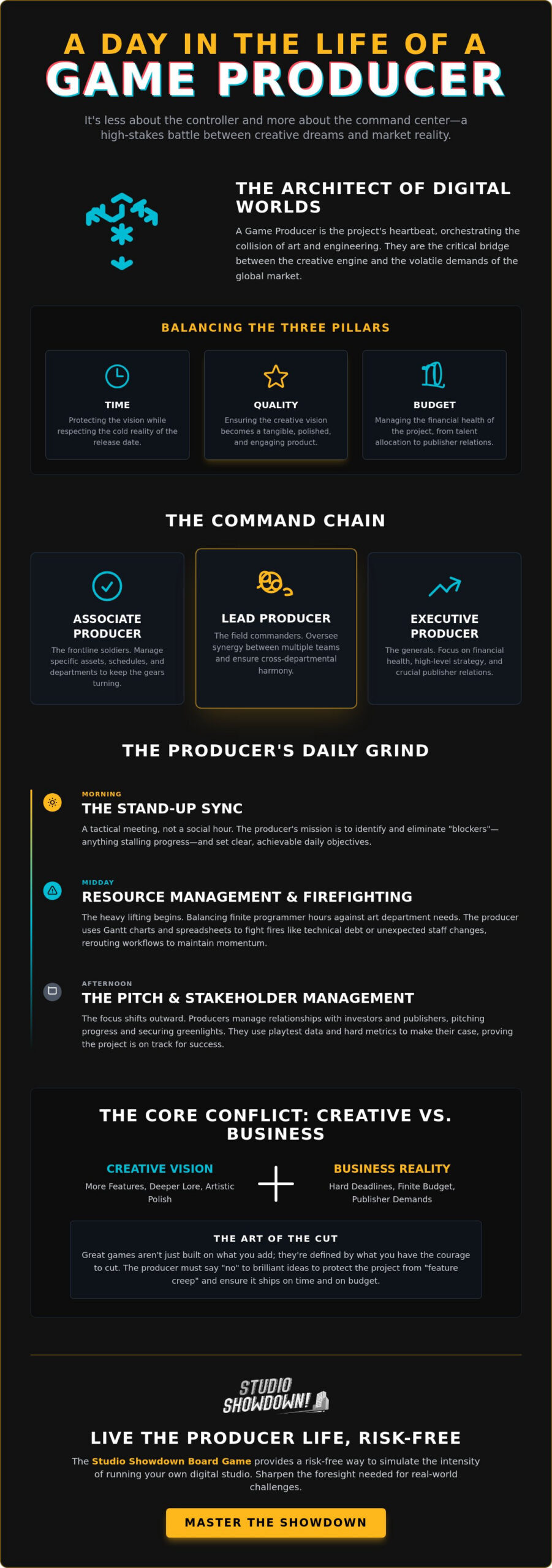
A game producer is the project’s heartbeat. They don’t just “make games”; they orchestrate the high-speed collision of art and engineering. This role requires a relentless balance between budget, timeline, and quality. If one of these pillars slips, the entire project risks a catastrophic crash. To truly understand What is a Game Producer?, you must view them as the architect of a digital world. They aren’t just managing tasks. They are managing human potential, creative ego, and technical limitations. It’s a role where the stakes are always high and the margin for error is razor thin.
The hierarchy defines the scope of the battle. Associate Producers are the frontline soldiers, managing specific assets, schedules, or departments. Lead Producers scale up, overseeing the synergy between multiple teams and ensuring cross-departmental harmony. Executive Producers sit at the executive level, focusing on the financial health, high-level strategy, and publisher relations. Regardless of the title, the core traits remain the same: resilience, strategic thinking, and the surgical ability to pivot when a build breaks. Seeing the day in the life of a game producer through these different lenses helps explain why the role is so multifaceted. The game producer serves as the critical bridge between the development studio’s creative engine and the volatile demands of the global market.
The Morning Stand-up: Setting the Tactical Pace
Every day in the life of a game producer starts with the stand-up. This isn’t a social hour. It’s a tactical synchronization of code, art, and design. You identify “blockers” immediately. If the lead animator is waiting on a rig, that’s a blocker. If the engine team hasn’t pushed the latest build, that’s a blocker. The producer clears the path. They set daily objectives that align with the next major milestone, ensuring the team stays on target without burning out.
Managing the Creative-Business Conflict
Conflict is inevitable. Designers want more features. Publishers want a sooner release. The producer is caught in the middle. You must often say “no” to brilliant ideas to save the project from “feature creep.” It’s a hard truth. Great games aren’t just built on what you add; they’re built on what you have the courage to cut. This art of compromise defines the high-pressure studio environment. You protect the vision while respecting the cold reality of the release date.
Navigating the Midday Grind: Resource Management and Firefighting
By noon, the tactical energy of the morning stand-up settles into the heavy lifting of resource allocation. You aren’t just moving boxes on a screen. You’re balancing the finite hours of a senior programmer against the urgent needs of the art department. Every decision has a price tag. If you over-allocate talent to a secondary feature, your core gameplay loop suffers. Resource management is the most critical skill for a studio founder because it dictates whether a creative vision becomes a tangible product or remains an expensive daydream.
The tools of the trade are less flashy than a game engine but just as powerful. Spreadsheets and Gantt charts are your primary weapons. They provide the visibility needed to handle “firefighting” moments, such as sudden technical debt or unexpected staff changes. A day in the life of a game producer involves re-routing entire workflows within minutes to keep the project from stalling. It’s about maintaining momentum when the unexpected strikes. You must be prepared to sacrifice a minor mechanic to save the overall stability of the build.
The Studio Founder’s Dilemma
Creativity doesn’t happen on a conveyor belt. High-stakes development phases can quickly lead to team burnout if the producer doesn’t manage energy levels with the same precision as the budget. You must keep the vision consistent even when technical limitations force you to scale back. It’s a mental chess match. Many professionals find that practicing with strategy board games helps sharpen the foresight needed for these real-world studio challenges. Protecting the team’s morale is just as important as protecting the code.
Data-Driven Decision Making
Gut feelings aren’t enough to ship a hit. Producers analyze playtest data to see where players get stuck or bored. This data informs design changes that can save a project from failure. You also monitor development velocity. If the team’s output drops, you need to know why before it impacts the milestone. Pivoting based on market trends or technical hurdles is a requirement, not an option. Efficiency is the difference between a launch and a cancellation. If you want to test your ability to handle these pressures, you can explore the Studio Showdown Board Game to see if you have what it takes to lead a studio to victory.
The Afternoon Pitch: Fundraising and Stakeholder Management
The afternoon shifts the battlefield from internal code to external capital. You step away from the Gantt charts and enter the boardroom. In the day in the life of a game producer, this is the moment of truth. You are the face of the studio. You must convince publishers and venture capitalists that your project isn’t just a creative masterpiece; it’s a viable financial engine. Securing the “greenlight” requires more than a flashy trailer. You need to prove market potential using hard data. With the global video game market projected to reach $255.03 billion in 2026, the competition for funding is brutal. Investors want to see a clear path to profit.
Managing stakeholder expectations is a delicate tightrope walk. You must promise a hit while protecting your team’s morale from unrealistic deadlines. This phase of the day in the life of a game producer is where the business reality of the $2.07 billion game development market becomes personal. It’s a high-stakes showdown. If you fail to secure the next round of funding, the project dies. You aren’t just a manager; you’re a shield. You absorb the pressure from the board so the developers can focus on the pixels. This entrepreneurial pressure is what separates a project manager from a true producer.
Mastering the Art of the Pitch
Success depends on the hook. You have three minutes to sell the “why” before the “how.” A producer must craft a narrative that highlights unique selling points while addressing the vital questions of ROI and monetization. With mobile gaming accounting for approximately $92 billion in revenue, you better have a strategy for that segment if it fits your genre. You must think like a founder. If you don’t believe in the numbers, neither will they. Every pitch is a performance where confidence is just as important as the pitch deck.
Networking and Market Dominance
Relationships are the currency of the industry. You build your network long before you need the cash. Analyzing competitor moves allows you to position your studio in a gap the giants missed. It’s about dominance, not just survival. Many successful producers hone these skills by engaging with business board game mechanics that simulate real-world market volatility. You learn to read the room, anticipate shifts, and strike when the opportunity is right. Mastery of the market is the only way to ensure your studio’s long-term victory.
Beyond the Screen: Why Producing is the Ultimate Strategy Game
Stop looking at the monitor. The real game isn’t happening in the engine; it’s happening in the breakroom, the Zoom calls, and the quiet moments between milestones. A common myth suggests that producers spend their time tweaking pixels. In reality, production is about people. You manage egos, settle disputes, and keep the creative fire from burning the studio down. Every day in the life of a game producer is a masterclass in psychology. You must recognize when a developer is on the edge of burnout and when a designer needs a push to reach greatness. Production is a human-centric strategy game where every decision impacts both the product and the people behind it.
The psychological toll is real. You carry the weight of a $123,552 average annual salary responsibility while balancing the needs of a team that relies on your stability. When a project hits a wall, you’re the one who stays calm. You translate technical failure into a strategic pivot. This high-pressure environment builds a level of business acumen that few other industries can match. You learn to see five moves ahead. You anticipate market shifts before they happen. It’s a relentless mental exercise that turns managers into leaders.
Building a Professional Portfolio
How do you prove you can lead if you haven’t shipped a AAA title yet? You focus on the “how,” not just the “what.” A professional production portfolio should showcase your ability to navigate conflict and manage resources. Highlight instances where you used empathy to resolve a team deadlock or negotiation to secure a better deal with a vendor. Use analog projects or small-scale indie collaborations to document your process. Showing that you can build a team is often more valuable than showing you can build a level. Soft skills are your most powerful career foundation.
The Future of Game Production in 2026
The industry is changing fast. As of June 2026, AI integration is accelerating asset production and forcing producers to manage complex, automated workflows. Remote work has become the standard, requiring new ways to maintain studio culture across time zones. With the independent game market projected to reach $5.54 billion this year, the rise of the “indie founder” is undeniable. To survive this 24/7 digital grind, you must learn to disconnect. Engaging in screen-free activities is essential for maintaining the mental clarity needed for high-level leadership. If you want to practice these high-stakes decisions without the financial risk, you can order the Studio Showdown Board Game to sharpen your strategic edge today.
Live the Producer Life: Mastering the Studio Showdown Board Game
Experience the adrenaline of studio ownership without the crushing financial risk of a failed launch. Most people read about a day in the life of a game producer and see only the overwhelming complexity. The Studio Showdown Board Game distills that chaos into a high-stakes tabletop experience. You aren’t just rolling dice. You’re fundraising. You’re pitching. You’re managing a team under fire. It’s a tactical simulation that mirrors the real-world pressures of the $255.03 billion gaming market. Every move counts. Every decision has a consequence. You learn to balance creative vision against the cold reality of a dwindling budget.
Transitioning from board game strategy to real-world studio success is a natural progression. You learn the rhythm of production through play. You understand the weight of a “no” and the value of a “greenlight.” By the time you step into a professional studio, the mechanics of leadership are already second nature. You’ve already faced the showdown. You’ve already won. This is where the theory of the day in the life of a game producer meets the practice of winning. It turns the abstract concepts of resource management into a tangible victory you can feel.
A Hands-on Learning Experience
Mastering the mechanics of the Studio Showdown Board Game is about more than just winning a round. It’s about developing a producer’s intuition. Students can use gameplay analysis to build portfolios that demonstrate strategic thinking and risk assessment. It’s a significant step beyond the easy money game where luck dictates the outcome. Here, strategy wins. You analyze your failures, pivot your tactics, and refine your approach to studio management. It’s a low-stakes environment that yields high-value professional insights.
Join the Showdown
The Studio Showdown: Educator Edition makes this professional training accessible to the next generation. Implementing the Classroom Bundle in your school allows students to experience the high-stakes world of game development firsthand. They don’t just study the $3.87 billion game development market; they compete in it. It prepares them for the ultimate studio founder showdown. They learn to lead, negotiate, and survive. Ready to lead your own studio? Order Studio Showdown today and start your journey toward industry dominance.
Dominate the Digital Showdown
Game production is a relentless strategic battle. It demands surgical precision in resource management and the courage to pitch in a $255 billion market. You’ve discovered that leading a studio isn’t about playing games; it’s about leading people. Every day in the life of a game producer is an opportunity to prove your vision can survive the reality of the grind. You are the architect, the shield, and the strategist. Success belongs to those who can bridge the gap between artistic ambition and financial survival.
The path to mastery doesn’t have to start with a multi-million dollar risk. You can sharpen your leadership edge right now. Developed by VGCD Academy experts and used in classrooms nationwide, our immersive business simulation puts you in the hot seat. It’s time to test your instincts and build your legacy. Stop watching from the sidelines and enter the arena today. Your studio is waiting for its founder.
Start your studio founder journey with Studio Showdown. The next great digital success starts with your first move.
Frequently Asked Questions
Do I need to know how to code to be a game producer?
You don’t need to be a master programmer, but technical literacy is non-negotiable. You must understand the limitations of your engine to set realistic deadlines and identify blockers. If you can’t speak the language of your developers, you’ll fail to recognize technical debt before it derails the project. Your job is to translate complex technical hurdles into strategic business decisions.
What is the difference between a game designer and a game producer?
A game designer focuses on the mechanics, story, and player experience. The game producer focuses on the budget, timeline, and team health. Designers define how the game is played; producers define how the game actually gets finished. It’s the difference between the architect dreaming of a skyscraper and the project lead ensuring the building is completed on budget and on time.
How much money does a game producer make in 2026?
As of June 17, 2026, the average annual pay for a Video Game Producer in the United States is $123,552 per year. Top earners in the industry can reach $126,000 annually. This reflects the high-stakes nature of a day in the life of a game producer where managing multi-million dollar budgets is standard. These figures vary based on studio size, location, and project scope.
What are the best tools for an aspiring game producer to learn?
Can playing board games really help me become a better game producer?
Absolutely. Strategic board games like Studio Showdown simulate the high-pressure loop of fundraising, team management, and resource allocation. They provide a risk-free environment to practice the psychological and tactical skills required in a real studio. You learn to read the room, anticipate market moves, and manage limited resources in a competitive setting before committing to a digital career.
Is the game producer role stressful?
It’s one of the most high-pressure roles in the creative industry. You’re responsible for the financial survival of the studio and the mental health of your team. A typical day in the life of a game producer involves constant triage and negotiation. You must remain the calm center of the storm when technical failures, staff changes, or missed milestones threaten the project.
What degree should I get to become a game producer?
Most producers hold degrees in Business Administration, Project Management, or Game Development. However, the industry values proven results over paper. Building a portfolio that showcases leadership, resource management, and a “shipped” mindset is often more important than a specific major. Practical experience in small indie teams or simulations provides the best foundation for a professional career in production.
How do I start my own game studio?
Start with a solid pitch and a core team of talented developers. You’ll need to secure fundraising from investors or publishers to navigate the $2.07 billion game development market. Focus on a unique hook that fills a market gap. Ownership is about more than just creative control; it’s about mastering the business reality of production and protecting your vision from financial collapse.