A publishing deal isn’t a paycheck; it’s a high-stakes strategic partnership where your studio’s survival is the ultimate prize. In 2026, the landscape has shifted, and understanding video game publishing deals means looking past the initial funding to the long-term equity of your IP. You’ve poured your soul into a prototype, but the wrong signature can turn your creative vision into someone else’s asset. Precision matters here. Every clause is a frame in your studio’s future success story.
You likely feel the pressure of complex financial terms and the constant fear of losing creative control. It’s a high-wire act where a single recoupment clause can determine if you’re a partner or just a contractor. We’re going to change that narrative. This guide will help you master the mechanics of modern agreements so you can secure a deal that protects your studio’s future while maintaining your artistic edge. We’ll break down the latest 2026 data on the 57.9% average revenue share, explain why 100% recoupment is finally a relic of the past, and give you the roadmap to negotiate with total confidence.
Key Takeaways
- Decode the high-stakes math of advances and revenue splits to ensure your studio remains profitable long after the launch party.
- Protect your creative legacy by securing IP ownership and sequel rights against aggressive publisher terms.
- Master milestone management to turn development deadlines into a sustainable roadmap rather than a crunch-driven survival race.
- Gain a competitive edge in understanding video game publishing deals by simulating high-stakes negotiations before you enter the boardroom.
- Shift your perspective from seeking a paycheck to building a strategic partnership that values your studio’s long-term equity.
What is a Video Game Publishing Deal?
A publishing deal is the ultimate strategic crossroads for any studio founder. At its core, it’s a high-stakes contract where a developer trades a portion of future revenue for the capital, marketing muscle, and distribution networks required to turn a build into a global hit. It’s the connective tissue between your code and the consumer’s console. In the 2026 landscape, these agreements have evolved. They’re no longer just about survival; they’re about scaling your creative vision without losing your soul.
To master the negotiation, you must first define the relationship. You need to ask: What is a video game publisher? In today’s market, they exist on a spectrum. Some act as glorified banks, providing a “service provider” model that offers cash but little creative synergy. Others are true “partners” who embed themselves in your process, offering artistic insight and long-term studio growth. Successful founders know that understanding video game publishing deals requires looking past the immediate cash injection to the ecosystem the publisher provides. You aren’t just signing for a check. You’re signing for a seat at the table of global gaming.
The Role of the Modern Publisher
The modern publisher provides the financial runway that keeps your lights on and your talent paid. They take on the burden of “Discovery,” fighting the relentless visual noise of digital storefronts with aggressive, data-driven marketing campaigns. Beyond the hype, they handle the heavy lifting of porting, QA, and localization. These technical services scale your reach across regions and platforms, ensuring your project meets international standards without draining your internal resources. They’re the engine that drives your creative vehicle into new territories.
Why You Can’t Just ‘Wing It’
The cost of a poorly understood clause is absolute. A single predatory recoupment term or an overlooked IP right can sink a studio before the first patch is even live. You can’t rely on luck. Establishing professional authority before you enter the boardroom is your only armor. There’s a massive difference between a “work-for-hire” deal, where you’re essentially a contractor, and a true partnership that respects your equity. In 2026, the market rejects old, rigid structures. Modern deals favor the bold. If you don’t understand the mechanics, you aren’t a partner; you’re just another line item in someone else’s quarterly report.
The Financial Mechanics: Advances, Recoupment, and Revenue Splits
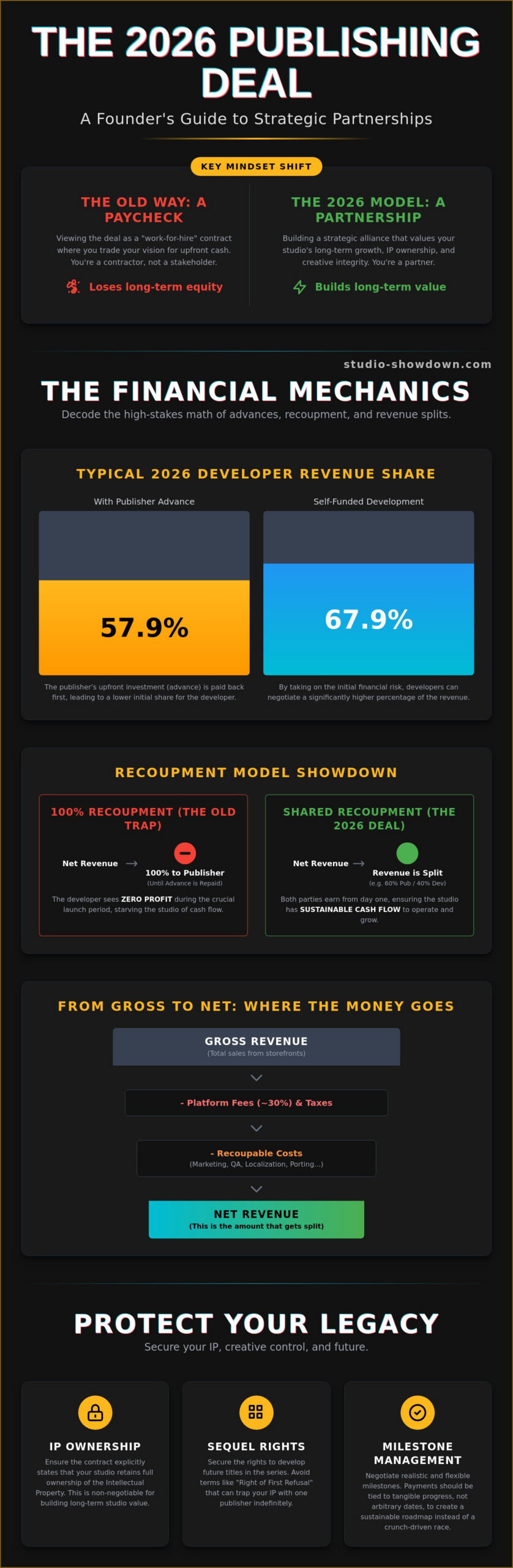
Money moves fast in this industry. You need to move faster. The advance is your fuel, but it’s also your debt. In the high-stakes arena of game development, the advance is often your first hurdle. It’s a loan, not a gift. Every dollar the publisher puts into your pocket today is a dollar they’ll take back with interest from your first sales. True mastery of understanding video game publishing deals starts with realizing that your revenue share is tethered to this initial capital. According to 2026 market data, developers with an advance see an average revenue share of 57.9%, while those who self-fund their development can command up to 67.9%.
Industry standards aren’t fixed. You’ll see 70/30, 60/40, or even 50/50 splits. These numbers look simple on a pitch deck, but they’re volatile. A 70/30 split in your favor sounds ideal until you realize it only triggers after the publisher has recouped 100% of their investment. External expenses are the silent profit killers. Marketing, QA, and localization are often recoupable costs. The publisher pays for them upfront but deducts them before you ever see a split. If you don’t audit these terms, you’re essentially paying for their marketing team out of your own potential profits.
Recoupment Models Explained
The recoupment trap is where most founders lose their footing. Under a 100% recoupment model, the publisher takes every cent of net revenue until their advance is repaid. You see zero profit during the most critical months of your game’s life. Modern, dev-friendly deals in 2026 now lean toward shared recoupment. Here, the publisher might take 60% of revenue while you receive 40% from day one. This keeps your studio’s cash flow alive while the debt is settled. When reviewing a model videogame publishing agreement, pay close attention to how these recoupment tiers are structured to avoid a post-launch drought.
Calculating Your Net Revenue
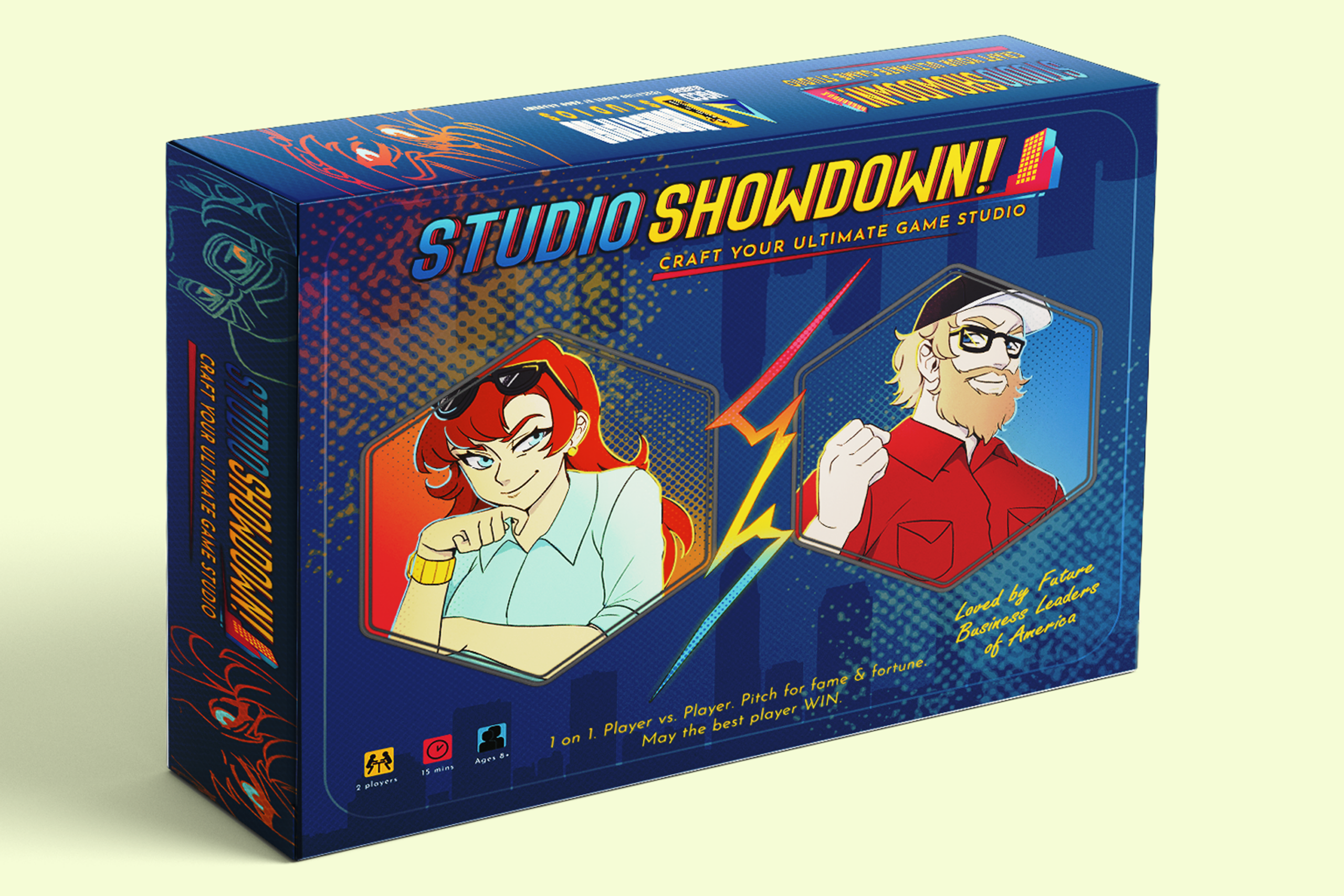
Gross revenue is a vanity metric. Net revenue is the reality. Net revenue is the amount remaining after platform fees and agreed-upon external costs are deducted. Platform fees, usually 30%, and taxes hit the gross first. Then comes the marketing spend. Without a marketing cap, a publisher could theoretically spend your entire profit margin on user acquisition without your consent. Navigating these financial minefields requires more than just reading; you need to feel the pressure of a bad split before it happens. You can sharpen your business instincts by playing Studio Showdown, where these financial trade-offs are part of the core strategy.
Protecting Your IP: Intellectual Property and Sequel Rights
Your IP is your legacy. Your world. Your characters. In the hunt for funding, founders often face a brutal trade-off. Give up the rights, get the cash. It’s a short-term win that can lead to long-term bankruptcy of the soul. Understanding video game publishing deals means recognizing that IP ownership is the primary driver of studio valuation. If you don’t own the world you built, you aren’t building a company. You’re just renting out your team’s talent to a landlord who keeps the keys.
Sequel rights and the “Right of First Refusal” (ROFR) are the industry’s golden handcuffs. A ROFR clause gives the publisher the power to match any offer for your next project. It sounds fair on paper. In practice, it can block other partners from bidding on your growth. You become a franchise factory for a single entity. Creative control is the final battleground. You need the final say on the “Gold Master” build. Without it, a publisher can force a premature launch or alter your vision to fit a marketing trend that will be dead by the time the game hits the store.
The Battle for Ownership
- Dev-Owned IP: By 2026, the power dynamic has shifted. Top-tier indie publishers now lead with models where the developer keeps the rights. They know motivated creators produce better hits.
- Perpetual Franchise Rights: Avoid these at all costs. These clauses act as a black hole for your creativity. They lock you into a single world forever.
- Creative Veto: Negotiate for veto power. You are the architect. The publisher is the distributor. Don’t let them rewrite your story in the final act.
Termination and Reversion
What happens if the publisher goes silent? What if they fail to market the game as promised? You need an escape hatch. Reversion clauses ensure that if a game is delisted or the publisher stops supporting it, the rights return to you. This prevents your hard work from becoming “abandonware” in a corporate vault. Precision in these clauses is the difference between studio survival and total erasure. An Audit Clause provides the legal right to inspect the publisher’s financial records, ensuring every dollar of earned royalty is accounted for and paid. Professional founders don’t rely on trust. They rely on transparency and the power to walk away when the partnership stops being a partnership.
Milestone Management: The Roadmap to Launch
Milestones are the heartbeat of your contract. They aren’t just calendar dates; they’re the triggers for your financial survival. No delivery means no paycheck. It’s that simple. A deep dive into understanding video game publishing deals reveals that milestones function as a high-stakes survival mechanic. They provide the rhythm for your studio’s runway. If you miss a beat, the cash flow stops. You must treat these deadlines with the same precision you apply to your game’s frame rate.
The “Kill Switch” is the ultimate threat. Most modern agreements include termination clauses triggered by missed milestones. This is the publisher’s insurance policy against a project that stalls or loses its way. Navigating the feedback loop between your dev team and the publisher’s producers is a constant battle for alignment. You need objective, ironclad exit criteria for every deliverable. If your “Definition of Done” is vague, your studio’s future is at the mercy of a subjective review. Professional founders eliminate ambiguity before the first line of code is written.
Structuring Your Development Schedule
Defining the transition from Vertical Slice to Alpha and Beta requires more than just a checklist. It demands clear exit criteria. You have to account for technical debt and the inevitable bug hunts that haunt the final stages of production. Scope creep is your primary enemy here. When a publisher asks for “just one more feature,” you must have the contractual authority to adjust the timeline or the budget. Padding your schedule isn’t a sign of weakness. It’s a sign of professional maturity. It’s how you avoid the crunch trap that destroys teams and projects alike.
The Role of Key Personnel
The “Key Man” clause is a legal reality that every founder must respect. If your lead designer or technical director leaves the studio, the publisher may have the right to terminate the entire deal. Your studio’s valuation is tied directly to your talent. Protecting your team’s autonomy while meeting institutional pressure is a delicate balancing act. This pressure often peaks during the final 10% of development, where the stakes are highest and the margins for error are thinnest. Managing these human and technical variables is the true test of studio leadership.
Mastering these high-pressure scenarios takes practice. You can sharpen your negotiation skills and learn to balance milestone demands by playing Studio Showdown, the strategy game designed to simulate the brutal realities of the gaming business.
Simulating the Showdown: Practicing Negotiations Before the Pitch
Precision is a weapon. In the boardroom, it’s the only one that counts. Reading about contracts is a passive exercise, but facing a publisher in a high-stakes negotiation is a contact sport. Theoretical knowledge often evaporates the moment the pressure builds. You need muscle memory for business. Understanding video game publishing deals requires more than just studying clauses. It requires the ability to outmaneuver rivals and secure resources in real-time. This is why analog simulation is the ultimate “flight simulator” for studio founders.
Studio Showdown isn’t just a tabletop experience. It’s a tactical training ground designed for the modern industry. It forces you to pitch, fundraise, and manage studio resources in a focused, screen-free environment. You learn to read people, not just spreadsheets. By stripping away the digital noise, you can focus on the core mechanics of entrepreneurship. It’s about building the intuition needed to spot a predatory clause before it’s too late. Analog play builds a level of business acumen that digital tutorials simply cannot replicate.
Mastering the Art of the Deal
High-stakes decisions shouldn’t be practiced for the first time with your studio’s actual future on the line. Studio Showdown allows you to fail safely and learn quickly. You can test aggressive negotiation tactics, explore different funding tiers, and see the immediate impact of a bad revenue split. This builds a robust “Founder’s Mindset” through competitive play. You learn when to push for more control and when to pivot your strategy. See how strategy board games prepare you for the competitive world of game dev by forcing you to think several moves ahead of your competition.
From Tabletop to Boardroom
The gap between technical development skills and professional entrepreneurship is often a chasm. Studio Showdown bridges it. It transforms abstract concepts like recoupment and IP rights into tangible game mechanics you can touch and manipulate. Using these simulations helps you build a professional vocabulary that resonates with investors. You don’t just talk about the business; you demonstrate a deep, practiced understanding of it. Publishers notice when a founder understands the entire ecosystem. It shows you aren’t just a developer with a dream. You’re a partner with a plan. Ready to dominate the market? Order the Studio Showdown Board Game and start mastering the business of game development today.
Own the Boardroom and Secure Your Studio’s Future
Winning in 2026 requires more than just clean code; it demands a founder who treats the boardroom like a level boss. You’ve now decoded the high-stakes math of revenue shares, shielded your IP from aggressive sequel rights, and turned milestones into a roadmap for sustainable growth. Success isn’t just about surviving the negotiation. It’s about building a strategic partnership where you keep the keys to your creative kingdom. Every clause is a move on the board. Make sure it’s one that advances your studio’s legacy.
True mastery of understanding video game publishing deals comes through experience, not just reading. You need to feel the pressure before the first pitch. Developed by VGCD Academy and DEMYSTIFIED Studios, Studio Showdown is the strategy-focused simulation used by educators to teach real-world entrepreneurship. It’s the ultimate training ground to sharpen your business instincts in a screen-free environment. It bridges the gap between artistic vision and commercial reality, ensuring you’re ready for the showdown.
Master the business of game dev with Studio Showdown and turn your vision into a sustainable powerhouse. The market is waiting for your next move. Make it a winning one.
Frequently Asked Questions
What is a standard revenue split for an indie game publishing deal in 2026?
The standard revenue share for developers receiving an advance currently sits at 57.9%, while those who self-fund their development average 67.9%. These benchmarks are essential for understanding video game publishing deals in the 2026 landscape. You should use these figures as your baseline during negotiations to ensure your studio remains competitive and capable of funding its next project without taking on excessive debt.
How does recoupment work in a video game contract?
Recoupment is the process where a publisher recovers their initial advance and agreed-upon external costs from the game’s net revenue before the developer receives their full split. In older models, publishers took 100% of sales until they were paid back. Modern 2026 agreements often use a 30% to 40% recoupment rate, allowing the developer to receive a portion of every sale from day one to maintain studio cash flow.
Should I give up my IP to secure a publishing deal?
You should prioritize keeping your Intellectual Property to protect your studio’s long-term valuation and creative freedom. Giving up your characters and world-building assets can prevent you from raising future venture capital or developing sequels independently. Most reputable indie publishers in 2026 have shifted toward developer-owned IP models because they recognize that creators who own their work are more motivated to produce high-quality hits.
What is a ‘Right of First Refusal’ clause?
A Right of First Refusal clause gives your current publisher the legal right to match any third-party offer you receive for your next project. It essentially locks you into a potential long-term partnership before you can test the open market. While it provides a sense of security, it can also act as a “golden handcuff” that limits your ability to leverage competing bids to increase your studio’s equity or funding.
Can a publisher take my game if I miss a milestone?
Yes, most contracts include a “Kill Switch” or termination clause that allows the publisher to cancel the deal if milestones are consistently missed. If you fail to deliver, the publisher may withhold further funding or, in some predatory cases, attempt to seize the assets already produced. This is why setting realistic, objective exit criteria and padding your development timeline for technical debt is a vital survival mechanic for any founder.
How much should I ask for as a development advance?
Your advance should cover your total production costs plus a 15% buffer for unexpected bugs and scope adjustments. In 2026, funding tiers generally fall into three brackets: under $250,000 for small projects, $250,000 to $1 million for mid-tier indie titles, and over $1 million for major indie productions. Only request the amount necessary to reach the Gold Master build to avoid lowering your eventual revenue share unnecessarily.
Do I need a lawyer to sign a publishing agreement?
You absolutely need a lawyer who specializes in the games industry to review every page of your agreement. Standard legal counsel often misses the nuances of recoupment tiers, platform deductions, and sequel rights specific to gaming. A specialized attorney is your only defense against hidden clauses that could cost your studio millions in lost royalties or result in the total loss of your creative vision.
What is the difference between a publisher and an investor?
Publishers are operational partners who provide a full ecosystem of services including marketing, QA, localization, and distribution. Investors typically provide capital in exchange for equity in your company or a share of profits but don’t involve themselves in the game’s launch or marketing. Understanding video game publishing deals means recognizing that you aren’t just looking for a bank account; you’re looking for a partner to help you fight the visual noise of the market.