Your business plan is the first playable prototype of your studio. It’s the core engine. In 2026, a winning video game studio business strategy requires more than a great hook. It demands a surgical balance of artistry, fiscal discipline, and raw ambition. You know the weight of the challenge. You’ve got the world-building perfected, but the corporate jargon and financial forecasting feel like a final boss you aren’t equipped to beat yet.
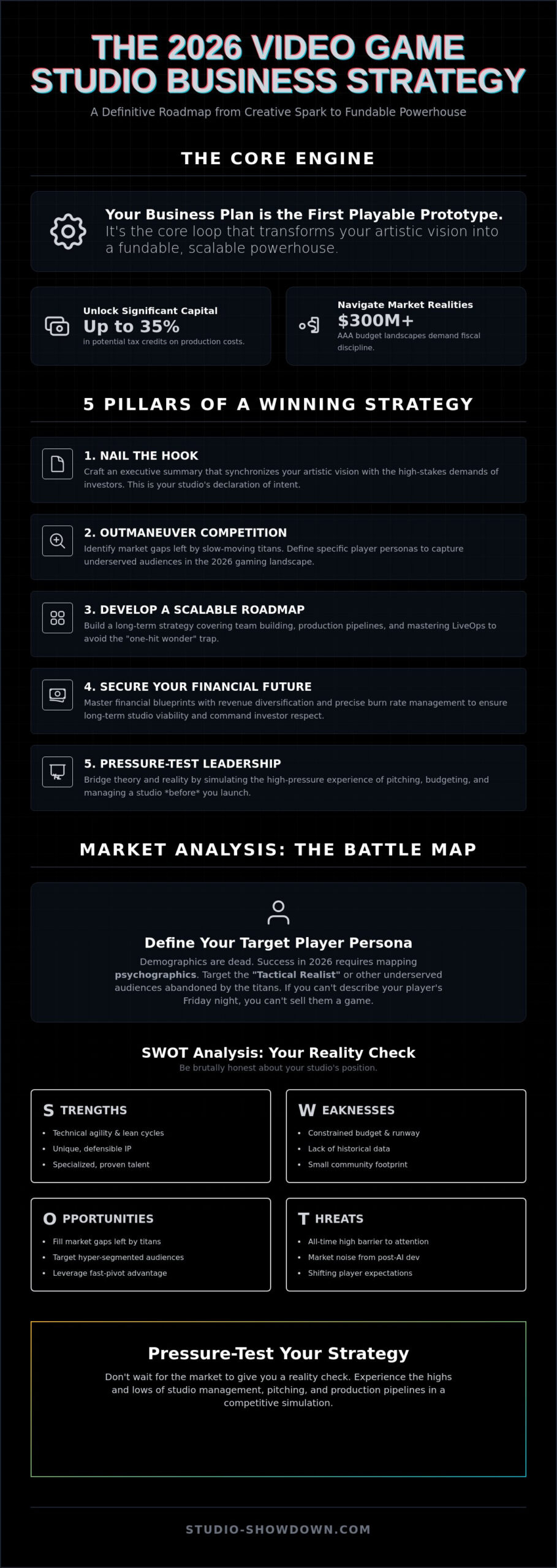
It’s frustrating to watch brilliant concepts stall because the spreadsheet didn’t match the storyboard. Your energy belongs in production, not buried under market data you can’t quantify. We’ll help you bridge that gap. This definitive 2026 guide transforms your creative spark into a fundable, scalable powerhouse. We’re stripping away the noise to deliver a clear roadmap for studio growth. You’ll learn to secure significant tax credits, potentially up to 35% of production costs, navigate $300 million AAA budget realities, and craft a document that commands investor respect. Let’s build something that lasts.
Key Takeaways
- Nail your studio’s hook with an executive summary that synchronizes your artistic vision with high-stakes investor demands.
- Outmaneuver the competition by identifying market gaps and defining the specific player personas driving the 2026 gaming landscape.
- Develop a scalable video game studio business strategy that covers everything from building your dream team to mastering long-term LiveOps.
- Secure your studio’s future by mastering financial blueprints, revenue diversification, and precise burn rate management.
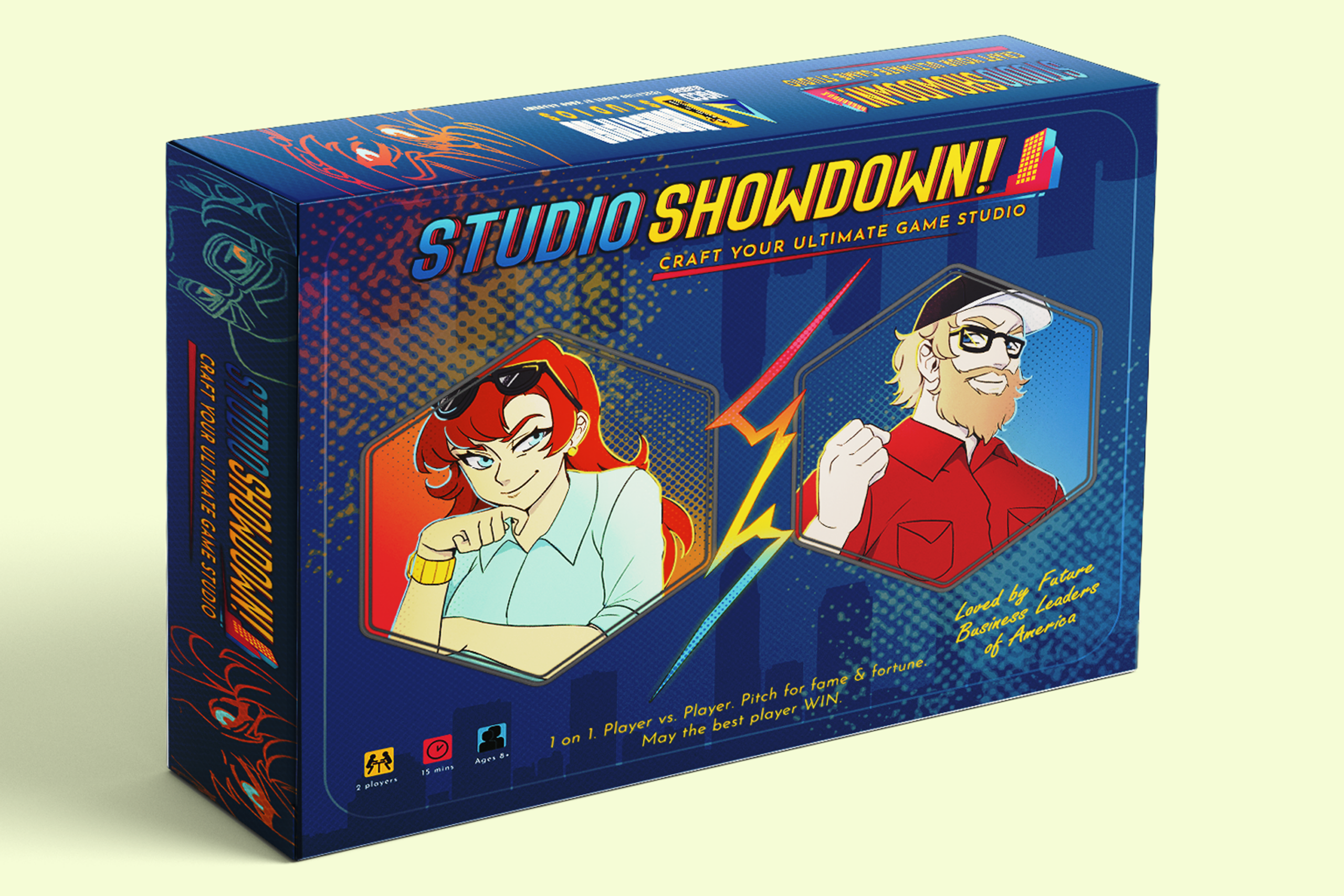
- Pressure-test your leadership skills with the Studio Showdown Board Game to experience the realities of pitching and studio management before you launch.
The Executive Summary: Your Studio’s High-Stakes Elevator Pitch
The executive summary is your studio’s first playable prototype. It’s the high-stakes hook. It’s the vertical slice of your ambition. In a 2026 market, investors don’t want generic promises. They want a vision they can feel. Your video game studio business strategy starts here, distilling raw creative energy into a clinical pitch. This isn’t just a summary. It’s a declaration of intent. It defines your identity, your tech, and your path to dominance.
Identify the friction. What’s broken in the current market? Too much noise. Not enough soul. You aren’t just making a title; you’re solving a player’s frustration. This is where you reveal your Secret Sauce. Proprietary procedural engines. Award-winning leads. Community-first development cycles. To understand the economic stakes and the scale of the competition, review a detailed overview of the video game industry. The scale is massive. The gaps are yours to fill.
Vision Milestone: By December 2026, our studio will establish itself as the premier developer of cross-platform tactical indies, achieving 500,000 active users and setting a new industry benchmark for narrative depth.
Crafting the Studio Identity
The Mission Statement vs. The Gameplay Loop
Business goals should mirror the gameplay. If your game is about freedom, don’t build a bureaucratic prison. Your mission statement must align with your creative identity and player-first values. Translate “fun” into “value” for every stakeholder. If players feel the thrill, partners see the profit. Set sharp KPIs for the first 12 months of operation. Prototype milestones. Community growth targets. Burn rate benchmarks. These aren’t constraints. They’re the guardrails for your creativity. Hit your marks. Keep the momentum. Win the market.
Market Analysis: Identifying Your Competitive Edge
Market analysis isn’t a static report. It’s a live-feed battle map. In 2026, the noise is deafening. To survive, your video game studio business strategy must cut through the static with surgical precision. You aren’t just looking for players. You’re hunting for gaps left by the “Titan” studios. These giants are often too slow to pivot; they’re too burdened by legacy IP to take creative risks. That’s your opening. You move fast. You hit harder.
Success starts with deep intelligence. According to recent video game market analysis, the industry is shifting toward hyper-segmented experiences. Trend-spotting is no longer about following the crowd. It’s about predicting the backlash to the crowd. In a post-AI development world, the barrier to entry has vanished. The barrier to attention has reached an all-time high. You need to know exactly who is holding the controller and why they won’t put it down.
Defining Your Target Player Persona
Demographics are dead. Age and location don’t buy games; motivations do. In 2026, you must map psychographics. Why do they play? Is it for social status, stress relief, or pure mastery? Stop targeting “gamers.” Target the “Tactical Realist” who feels underserved by mainstream arcade shooters. Identify the audiences the Titans have abandoned. Map their behavior. Find out where they congregate, which creators they trust, and how they evaluate value. If you can’t describe your player’s Friday night, you can’t sell them a game.
The Competitive Showdown: SWOT Analysis
A SWOT analysis is your reality check. Be brutal. Your strengths aren’t just “passion.” Maybe it’s a proprietary neural rendering pipeline or a team that’s shipped three hits together. Be honest about weaknesses. Limited runway. Technical debt. Small marketing reach. These are the variables you’ll navigate when you play the Studio Showdown Board Game to sharpen your business decision-making under pressure.
- Strengths: Technical agility, unique IP, specialized talent, lean production cycles.
- Weaknesses: Budget constraints, lack of historical data, small community footprint.
- Opportunities: Leveraging neural rendering, entering emerging markets, cross-platform simultaneous launches.
- Threats: Regulatory changes in monetization, platform fee shifts, market saturation.
Your video game studio business strategy must weaponize these insights. Don’t just react to the market. Own your niche. Build for the underserved. Win the showdown.
Operations and Production: Building the Roadmap to Launch
Execution is the ultimate filter. A brilliant video game studio business strategy is worthless without a relentless production engine. In 2026, the distance between concept and launch has grown. Development costs for AAA titles now frequently exceed $300 million, making every milestone a high-stakes survival check. You aren’t just making a game; you’re managing a complex manufacturing process where the raw material is human creativity. Efficiency is your only protection against the “indiepocalypse.”
Production follows a brutal, five-stage evolution. You start with the concept, move into pre-production, hit the main production sprint, transition to testing, and finally enter the era of long-term LiveOps. To master the business of gaming, you must understand that launch day is no longer the finish line. It’s the starting gun. Your roadmap must account for post-launch patches, DLC, and community management from day one. If you haven’t planned for month six after launch, you haven’t planned at all.
MVP Criteria: Our Minimum Viable Product delivers the core gameplay loop and two polished levels, demonstrating technical stability and player retention metrics to secure Series A funding.
The Development Roadmap
Pre-production is your foundation. Nail the Game Design Document (GDD) before a single line of code is written. Ambiguity kills budgets. During production, manage your sprint cycles with surgical precision. Avoid the burnout that plagues the industry. Post-launch success depends on your ability to pivot based on player data. LiveOps isn’t a luxury; it’s the heartbeat of modern revenue models. Keep the content flowing. Keep the players engaged. Keep the studio alive.
Talent Acquisition and Studio Culture
Building the “Dream Team” is a recruitment battle. You need a Lead Dev who can architect scalable code and a Community Manager who can turn a discord server into a cult following. Diversity isn’t just a buzzword. It’s a commercial advantage. Diverse teams build games that resonate with a global audience, expanding your market reach. In the hyper-competitive 2026 labor market, shared ownership and a clear mission are your best retention tools.
The Financial Blueprint: Revenue Models and Fundraising
Cash is the oxygen of production. Without it, your vision suffocates. In 2026, the financial side of a video game studio business strategy is about more than just surviving; it’s about weaponizing your capital. You need to understand your burn rate with surgical precision. How many months of runway do you have before the lights go out? If you don’t know the answer, you don’t have a business. You have a hobby.
Your revenue model dictates your design. Premium sales offer immediate cash flow, but subscriptions and F2P provide the long-term engagement investors crave. Be realistic about the “platform tax.” Steam takes a 30% base cut, though it drops to 25% after $10 million in sales. Epic Games and the Microsoft Store (PC) are leaner at 12%. Google Play offers a reduced 15% for your first $1 million. These percentages aren’t just numbers. They’re the difference between scaling up and shutting down.
Forecasting Revenue in an Uncertain Market
Projections are your map. Create two: a conservative “worst-case” and an aggressive “breakout” scenario. Investors value the realism of the former and the ambition of the latter. Track your Customer Acquisition Cost (CAC) against the Lifetime Value (LTV) of your players. If it costs more to find a player than they spend in your ecosystem, your strategy is broken. Balance the scales or watch your runway vanish. Don’t ignore the rising subscription prices, like Xbox Game Pass Ultimate at €20.99/month, which signal a shift in how players value content.
Securing Seed Funding
Investors in 2026 hunt for two things: traction and tech. A pitch deck with pretty concept art isn’t enough. Show them social proof. Show them a growing Discord community or a viral vertical slice. Choosing between equity and debt is a battle for control. Equity brings partners; debt brings obligations. Choose the path that preserves your creative soul while providing the muscle to ship. Whether you pursue Venture Capital or Crowdfunding, your pitch must prove that your studio is a machine built for profit, not just a passion project.
Every battle needs an end game. Are you building to be acquired by a Titan? Or are you aiming for a sustainable, independent legacy? Defining this within your video game studio business strategy ensures you aren’t just building a product, but a valuable asset. Define your exit early. It dictates every financial move you make today.
Master the art of the pitch and the pressure of the burn rate by playing the Studio Showdown Board Game, the ultimate simulation for aspiring studio leads.
Testing the Strategy: Bridging Theory and Reality with Studio Showdown
Passive reading is a slow death for ambition. You can’t learn to swim by reading a manual. You can’t learn to lead a studio by staring at a static document. A robust video game studio business strategy requires more than just ink on paper. It demands pressure testing. You need to see how your decisions ripple through a volatile market. Before you risk your first dollar of investor capital, you need to know how you’ll react when the market shifts or your lead developer walks out the door. This is where theory meets the pavement.
The Studio Showdown Board Game isn’t just a tabletop experience. It’s a high-fidelity business simulator. It forces you to navigate the same brutal choices you’ll face in the 2026 landscape. Fundraising rounds. Talent wars. Scope creep. Market saturation. By simulating these hurdles, you build a professional portfolio of experience. You learn to pivot. You learn to survive. You learn to win. It’s the difference between guessing and knowing.
Simulation as Professional Development
Practice high-stakes decisions in a risk-free environment. Before you make your first hire, you need to know how to manage them. Mastering the “Pitch Showdown” mechanic is essential for real-world success. It’s about winning the room. Educators are already weaponizing these tools. They’re integrating the Studio Showdown: Educator Edition into STEM and business curricula to help students build strategy board games skills. This isn’t just play; it’s professional preparation. It builds the muscle memory required for entrepreneurship.
From Tabletop to Boardroom
The mechanics of the game mirror real-world game development hurdles. When a competitor launches a surprise AAA title with a $300 million budget, you have to react. The game simulates these market shifts with clinical accuracy. Use your results to identify your personal leadership style. Are you a lean, agile founder? Are you a master of community engagement? Understanding your strengths now prevents disaster later. It’s the ultimate stress test for your video game studio business strategy. Don’t leave your studio’s future to chance.
Ready to lead? Master the business of games with the Studio Showdown Board Game.
Forge Your Legacy: From Vision to Market Dominance
Passive planning ends here. The 2026 landscape demands surgical execution and artistic courage. You’ve seen the blueprint. You’ve identified the market gaps. You’ve calculated the burn rate. Now, you must lead. A winning video game studio business strategy isn’t just a document; it’s a living engine that powers your studio through every production sprint and fundraising round. Every decision counts. Every milestone matters. The distance between a great idea and a fundable studio is bridged by the quality of your leadership.
Don’t wait for a real-world crisis to test your leadership skills. Developed by VGCD Academy experts and trusted by educators to teach real-world entrepreneurship, our simulation provides hands-on learning for aspiring founders. Master the mechanics of the industry in a risk-free environment. Build the confidence to command the boardroom and the production floor alike. The market is crowded, but the summit is open for those who prepare. Stop theorizing. Start building.
Start your studio journey with the Studio Showdown Board Game. The game is on. It’s time to win.
Frequently Asked Questions
What are the most critical sections of a game studio business plan?
The most critical sections include the executive summary, market analysis, operational roadmap, and financial blueprint. Your video game studio business strategy must also define a clear exit strategy to satisfy long-term investor goals. Each part works as a system to prove your studio isn’t just a creative whim but a fundable asset.
How do I calculate the budget for an independent game studio in 2026?
Calculate your budget by totaling your monthly burn rate across the entire development cycle, including a 20% buffer for scope creep. In 2026, mid-range indie PC games often cost between £50,000 and £200,000, while simple mobile titles range from £8,000 to £25,000. Don’t forget to leverage regional incentives like the New York State Digital Game Development Tax Credit, which offers 25% to 35% back on qualified work.
Do I really need a business plan if I’m a solo indie developer?
Yes, solo developers need a plan to avoid market saturation and manage limited resources. Without a structured video game studio business strategy, you’re just guessing at your runway and market fit. A plan forces you to confront the reality of platform fees and marketing costs before they drain your personal savings.
What monetization model is most attractive to investors this year?
Investors currently favor diversified revenue streams, particularly subscription-ready titles and games with strong LiveOps potential. While premium sales still exist, the rising influence of services like Xbox Game Pass, priced at €20.99/month in 2026, makes recurring revenue highly attractive. Show how your game stays relevant six months after launch to secure high-level interest.
How can I prove market demand for my game before it’s actually built?
Prove demand by showcasing verifiable social proof like Discord member counts, Steam wishlist velocity, or engagement on a viral vertical slice. Investors look for traction before they look at code. If you can’t build a community before you build the full game, you’re a high-risk gamble they’ll likely avoid.
What is the difference between a pitch deck and a full business plan?
A pitch deck is a high-impact visual summary used to win the initial meeting, while a full business plan is the exhaustive operational manual. Think of the deck as your trailer and the plan as your source code. You need the deck to spark interest and the plan to close the deal during the due diligence phase.
How long should a typical game studio business plan be to keep an investor’s attention?
Keep your full business plan between 15 and 25 pages to maintain professional focus. Investors value brevity and surgical precision over fluff. If you can’t explain your path to profit in 25 pages, you don’t understand your own business model well enough yet.