The most successful games on the market aren’t built on syntax. They’re built on logic, psychology, and relentless iteration. If you’ve ever felt paralyzed by a blinking cursor or feared that learning game development without coding was just a shortcut for amateurs, you’re looking at the wrong map. Coding is a tool. Design is the weapon. You don’t need to master C++ to understand the rhythm of a perfect jump or the tension of a complex upgrade tree. We know the pressure of overwhelming software interfaces and the anxiety that no-code tools won’t deliver a professional edge.
This strategic guide cuts through the noise of 2026’s tech landscape to show you how to dominate the industry using your vision instead of your typing speed. You will master the core principles of game mechanics, studio management, and design theory without writing a single line of code. We’ll explore the power of visual engines like GDevelop and Buildbox 4, tackle the business of running a studio, and prove that your creative intuition is your most valuable asset. It’s time to stop fighting the software and start winning the game.
Key Takeaways
- Understand why logic is the true language of game design, allowing you to build complex systems without touching a single line of code.
- Discover how visual scripting in engines like Unreal and Unity makes learning game development without coding a professional reality in 2026.
- Learn to define your game’s “verbs” and balance mechanics using mathematical logic to ensure engaging, high-stakes gameplay.
- Master the business side of the industry by refining your pitching and fundraising strategies to rise above the visual noise of the market.
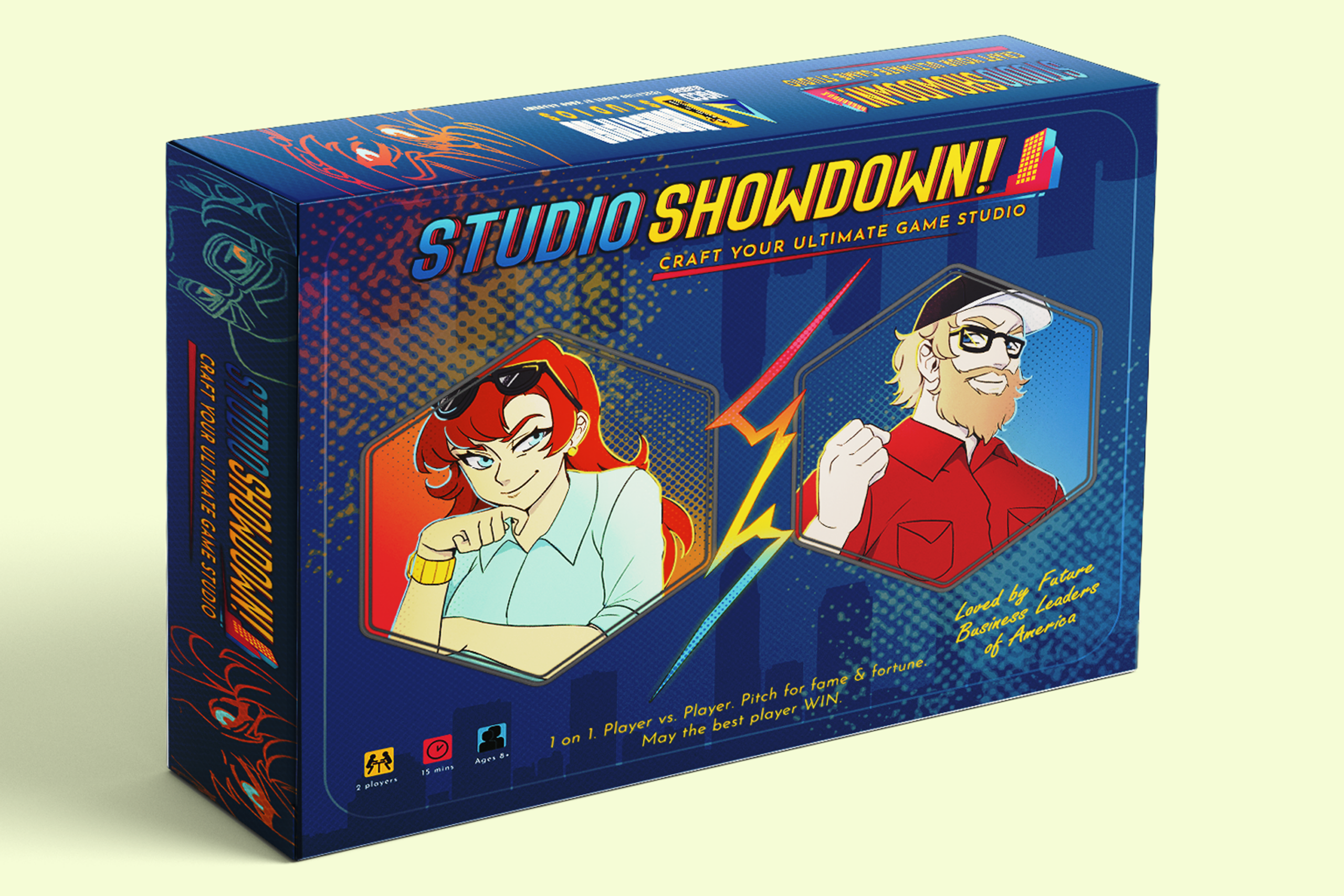
- Explore how the Studio Showdown board game serves as the ultimate analog engine for mastering studio scaling and competitive industry tactics.
What is Game Development Without Coding?
Game development is often mistaken for a typing contest. It’s not. It’s a battle of systems, psychology, and logic. Coding is simply a translation layer. It moves human intent into machine action. Learning game development without coding means you’re choosing to master the intent itself. You’re focusing on the architecture of the player’s journey rather than the syntax of a specific language.
In 2026, the industry has shifted. Creators don’t need to be poets of C++ to build a masterpiece. They need to be masters of mechanics. High-level creators focus on the “verbs” of their world. They build systems that react, challenge, and reward. This isn’t a shortcut. It’s a strategic decision to prioritize the core gameplay loop over the technical friction of traditional programming. You’re building the engine of the experience, not just the pipes.
Design vs. Programming: Finding Your Role
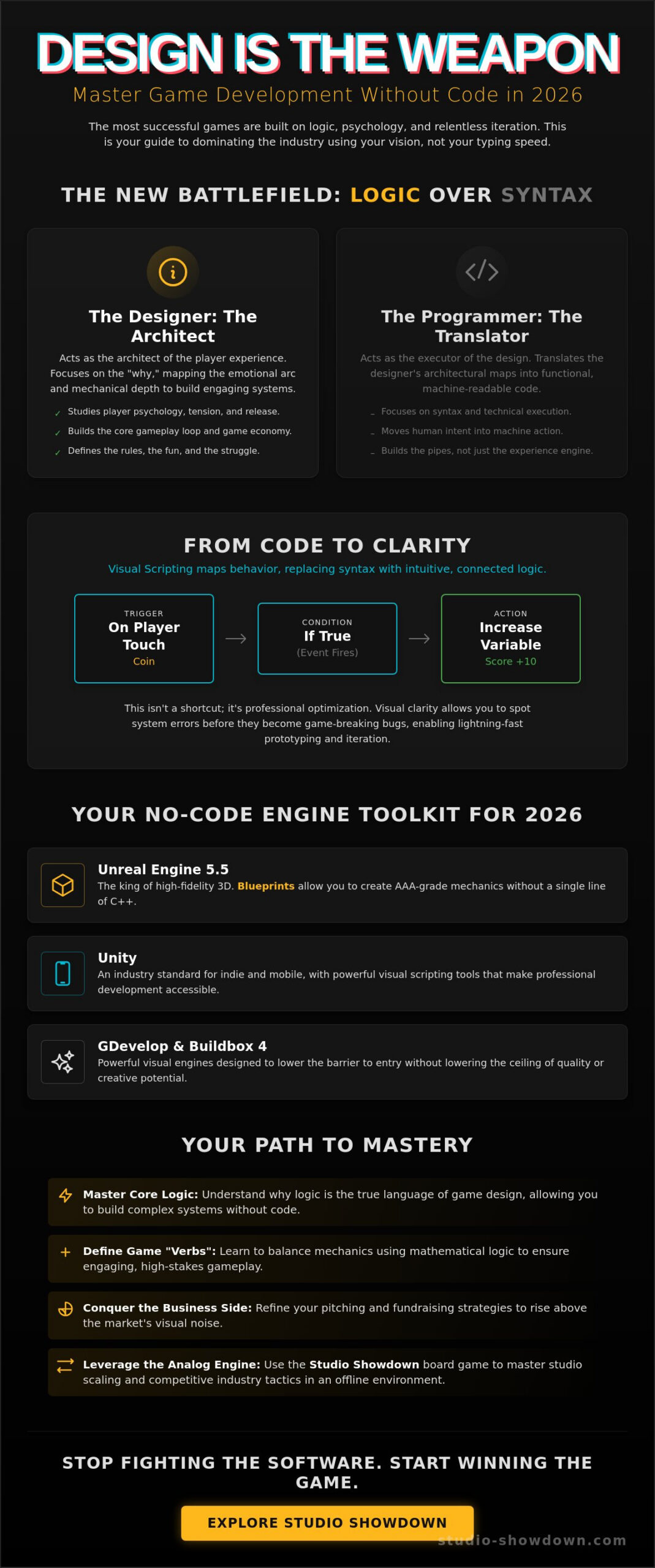
The distinction is simple. Game design is the set of rules. It’s the “why” behind every jump and the “how much” behind every reward. Programming is the execution. A designer acts as the architect of the player experience. They study player psychology. They understand tension and release. They know that a well-balanced economy is more important than a perfectly placed semicolon. They build the fun. They define the struggle.
- The Designer: Maps the emotional arc and mechanical depth.
- The Programmer: Translates those maps into code.
No-code tools bridge this gap. They allow for lightning-fast prototyping. You can test an idea, break it, and fix it in minutes. This speed is a competitive advantage. In a market saturated with visual noise, the studio that iterates fastest wins the fight for player attention. You aren’t limited by what you can type, but by what you can imagine.
The Evolution of No-Code Tools
We’ve moved beyond the era of simple block-builders. The tools of 2026 are powerhouses. Modern engines utilize a visual programming language to handle complex logic. Instead of writing lines of text, you’re connecting nodes in a visual web. It’s intuitive. It’s professional. It’s the standard for rapid development in major studios. It’s about flow and connectivity.
The industry is shifting toward these accessible tools because they lower the barrier to entry without lowering the ceiling of quality. Modern studios value logic-based thinking over rote memorization of syntax. They want creators who can build resilient systems. Whether you’re building a digital world or an analog experience like the Studio Showdown Board Game, the logic remains the same. You’re defining the rules of engagement. You’re the one in control. You’re the creator.
The Digital No-Code Landscape: Engines and Visual Scripting
Visual scripting isn’t a training wheel. It’s a high-performance engine. In 2026, the gap between writing text and connecting nodes has vanished. Industry veterans use these tools to bypass the friction of syntax. They focus on the architecture. They prioritize the flow. Learning game development without coding has evolved into a legitimate professional path where efficiency is the only metric that matters.
This isn’t “cheating.” It’s professional optimization. Even industry legends like Jordan Weisman have embraced the power of no-code game development to bring complex visions to life faster. When you drag a logic block, you aren’t avoiding work. You’re executing it with precision. As your studio scales, you might transition into low-code environments, but the foundational logic remains your strongest asset.
Visual Scripting Foundations
Logic nodes replace traditional code syntax with visual clarity. You aren’t memorizing brackets. You’re mapping behavior. Common patterns involve If/Then statements, variables, and triggers. If a player touches a coin, then the score variable increases by ten. It’s clean. It’s logical. You can build your first interactive loop without ever touching a keyboard. This visual clarity allows you to spot errors in the system before they become game-breaking bugs.
Choosing the Right Engine for Your Vision
Your choice of engine defines your battlefield. Each tool serves a specific creative intent. In 2026, the options are more powerful than ever:
- Unreal Engine 5.5: The king of high-fidelity 3D. Blueprints allow you to create AAA-grade mechanics without a single line of C++. Released in April 2026, this version pushes visual scripting to its limit.
- Unity 6: Updated in April 2026, Unity 6 offers refined UI Toolkit workflows and the Bolt visual scripting engine for versatile cross-platform projects.
- GameMaker: The gold standard for 2D indie hits. It offers a seamless bridge between visual blocks and GML code.
- Buildbox 4: A powerhouse for AI-assisted design. The February 2026 update introduced specialized AI tokens for rapid asset generation. While a free version exists, professional publishing on Steam or mobile requires a paid plan, with the Classic Beginner tier starting at $14.99 per month.
Before you dive into a digital engine, you need to master the underlying strategy. You can sharpen your competitive edge and learn to scale a production team through the Studio Showdown Board Game, which strips away the screen to focus on pure studio management and industry tactics.
Mastering Game Mechanics: The Core of Every Great Title
A game is not a story you watch. It is a system you manipulate. Every legendary title, from the simplest mobile puzzle to the most complex RPG, survives on the strength of its mechanics. These are the “verbs” of your game. Jump. Trade. Fight. Loot. When learning game development without coding, your primary weapon is logic. You must define the rules of engagement before you ever worry about the platform. If the rules are weak, the game fails. It’s that simple.
Balancing these mechanics is a game of math, not syntax. You don’t need a script to know that a weapon doing 100 damage against a 50-health enemy is broken. You need a spreadsheet. You need logic. Every great title relies on a “Core Loop.” This is the repetitive cycle that keeps players hooked: perform an action, receive a reward, and upgrade your capability. Master this loop, and you master the player’s attention. The best creators know that a game’s soul exists in its numbers and its flow, long before it reaches a digital engine.
The Anatomy of a Game Mechanic
Every interaction follows a rigid structure: Input, Process, and Outcome. The player acts. The system calculates. The world changes. This is the heartbeat of your design. To keep this heartbeat steady, you must implement effective feedback loops. When a player wins, the reward must feel earned. When they lose, the reason must be clear. This is where resource management comes into play. You aren’t just giving things away. You are teaching the player the value of scarcity. You are forcing them to make tactical choices. Every asset in your game world must have a purpose and a price. This is the foundation of professional systems design.
Prototyping Without a Screen
The most expensive mistake you can make is starting digital production too early. Screens hide flaws. Paper reveals them. Using dice, cards, and tokens allows you to test your game’s “fun factor” instantly. If your combat system is boring on a tabletop, it will be boring in 3D. Analog prototyping is the ultimate filter for mediocre ideas. It allows you to identify “broken” mechanics when the cost of fixing them is zero. You don’t need to recompile. You just need to change a number on a card. It’s about speed and clarity.
Iteration is your path to victory. Fail fast. Fail on paper. Redesign the logic. Test again. This relentless cycle of testing ensures that when you finally move to a no-code engine, you’re building on a foundation of proven fun. You aren’t guessing. You’re executing a strategy that has already won. This is why tools like the Studio Showdown Board Game are so effective. They strip away the visual noise and force you to master the core mechanics of studio scaling and competitive strategy. You learn to win the game of production before you ever touch a keyboard.
The Business of Games: Entrepreneurship and Studio Management
A masterpiece sitting on a hard drive is a failure. In the high-stakes world of 2026, the difference between a hobbyist and a professional is a business plan. Mastering the mechanics is only half the battle. The rest is pure strategy. When learning game development without coding, your studio management skills determine whether your project reaches the finish line or dies in development hell. You aren’t just a creator. You’re a founder. You’re a leader.
Investors don’t fund code. They fund vision, market viability, and team execution. If you can’t explain your path to profit, your technical skills won’t save you. You must understand the visual noise of the market and learn how to cut through it with precision. Building a professional portfolio means showing you understand the industry’s financial pulse as well as its artistic soul. It’s about ROI. It’s about impact.
From Creator to Studio Founder
Running a studio is a fight for resources. You must manage financial risks, oversee production timelines, and lead a team toward a singular goal. Pitching your vision to publishers requires a different set of muscles than designing a level. You need to speak the language of milestones and burn rates. Managing a team for maximum ROI means knowing when to pivot and when to push. You’re the architect of the studio’s culture and its commercial success. Every decision carries weight.
Strategic Thinking in the Gaming Market
Success isn’t an accident. It’s the result of analyzing market trends and identifying gaps where your game can dominate. You need a “Showdown” mindset. You’re competing for player attention, limited funding, and media coverage in a crowded industry. To win, you must outmaneuver rival studios through superior positioning and tactical timing. This level of professional acumen is best sharpened through practice.
Integrating business board games into your learning path allows you to simulate these high-pressure scenarios without the real-world cost of failure. You learn to scale, to pitch, and to survive. It’s the ultimate training ground for the modern entrepreneur. Ready to test your studio’s survival instincts? Grab the Studio Showdown Board Game and master the art of industry dominance before you launch your first title.
Studio Showdown: The Ultimate Analog No-Code Engine
Digital engines provide the canvas, but they don’t provide the gut. The most sophisticated visual scripting in the world won’t help you if you can’t survive a meeting with a publisher. Studio Showdown is the ultimate analog no-code engine. It’s a high-stakes simulation that strips away the screen to focus on the raw mechanics of the industry. Learning game development without coding becomes a physical, tactical experience. You aren’t just moving pixels. You’re moving capital, talent, and strategy.
This is where the creative idea meets the profitable studio. The game immerses you in the competitive reality of production cycles and market shifts. It forces you to make the hard calls that digital tutorials ignore. Educators and parents use Studio Showdown to build real-world skills because it demands logic, negotiation, and foresight. You learn to win the battle of the market before you ever open a software interface. It’s about building the founder’s mindset from the ground up.
A Hands-On Learning Experience
Launching a hit game is a minefield. Studio Showdown provides a safe environment to navigate these challenges. You’ll face the same setbacks that sink real-world studios: budget overruns, talent poaching, and shifting player trends. By navigating these obstacles on the board, you build the professional logic required for digital success. You learn to anticipate the “if/then” scenarios of the business world. This is why strategy board games are the best training for future founders. They teach you to think three moves ahead of the competition. They turn theory into muscle memory.
The Studio Showdown Advantage
The advantage is clear: business acumen. While others are stuck debugging a script, you’re mastering the art of the pitch. Studio Showdown forces you to perfect your delivery and defend your strategy against rival players. You learn to scale your studio, manage your Classroom Bundle resources, or lead an entire team in the Educator Edition. It’s a training ground for high-stakes competitive play. You’ll emerge with a deeper understanding of how to turn a mechanic into a brand. Don’t wait for a digital crash to learn these lessons. Order Studio Showdown today and start building your empire. The industry is waiting for leaders, not just users. It’s time to take your place at the top.
Dominate the Industry with Logic and Strategy
The landscape of 2026 demands more than just technical literacy. It requires a designer’s intuition and a founder’s grit. You’ve seen how visual scripting removes the friction of syntax and why mastering the core loop is the heartbeat of any successful title. By learning game development without coding, you’re choosing to lead the production rather than get lost in the weeds of a script. You’re focusing on the systems that drive player behavior and the business strategies that ensure studio survival.
Don’t leave your success to chance. Developed by VGCD Academy and DEMYSTIFIED Studios, the Studio Showdown Board Game offers the ultimate hands-on experience in fundraising, pitching, and studio scaling. It’s the same tool used by educators to help students build professional portfolios that stand out in a crowded market. You’ve got the vision. Now, get the tactical experience to back it up. Start your game dev journey with the Studio Showdown Board Game and prove you have what it takes to rise above the noise. The next hit title isn’t waiting for a coder; it’s waiting for a creator like you.
Frequently Asked Questions
Is it really possible to make a professional video game without coding?
Yes, it’s absolutely possible to launch a professional title without writing text-based code. Modern engines use visual scripting to handle complex interactions, allowing you to focus on systems architecture and player experience. Many successful indie hits and AAA prototypes are built entirely using these logic-based visual systems to bypass technical friction.
What are the best no-code game engines to use in 2026?
Unreal Engine 5.5 and Unity 6 lead the high-end market for 3D development. For indie creators, Flowlab offers a powerful browser-based editor with Indie plans currently at $9 per month. If you’re building retro adventures, RPG Playground provides a one-time $19 premium tier for total control. These tools ensure that your creative vision isn’t limited by your technical background.
Does ‘no-code’ mean I don’t have to learn logic?
No, logic is the core of all game design. While learning game development without coding removes the barrier of syntax, you still need to master the “if/then” structures that govern every player action. You’re trading the frustration of semicolons for the power of systems thinking. Logic is the universal language that connects digital engines and analog prototypes.
How do game designers make money without being programmers?
Designers generate revenue by acting as studio founders, creative directors, and systems architects. They focus on monetization strategies, IP management, and leading specialized teams to execute a vision. Success in the gaming industry is driven by compelling mechanics and business strategy rather than just technical implementation. You’re the architect of the studio’s commercial soul.
Can I use a board game to learn about video game development?
Yes, analog tools are the most effective way to test your game’s “fun factor” before spending a cent on production. Board games strip away the visual noise and force you to balance mechanics, math, and player psychology. If your game’s core loop isn’t engaging on a tabletop, it won’t survive the transition to a digital screen.
What skills do I need to be a game studio founder?
A founder needs sharp business acumen, leadership skills, and the ability to analyze market trends. You must master the art of the pitch to secure funding and learn how to manage production cycles for maximum ROI. Your primary job is to outmaneuver the competition and lead your studio to a profitable release through strategic positioning.
Is visual scripting better than traditional coding for beginners?
It’s significantly more intuitive because it allows you to visualize the flow of your game’s logic. Visual scripting reduces the barrier to entry and lets you iterate on ideas much faster than traditional text-based coding. It’s a professional-grade shortcut that keeps your focus on the creative design and player journey rather than technical syntax errors.
How does Studio Showdown help me become a better game developer?
Studio Showdown provides a high-stakes simulation of the real-world gaming industry. You’ll practice the essential skills of fundraising, pitching, and scaling a studio in a competitive environment. It builds the strategic muscle memory you need to turn a creative idea into a profitable business venture. You learn to win the battle of production before you launch.