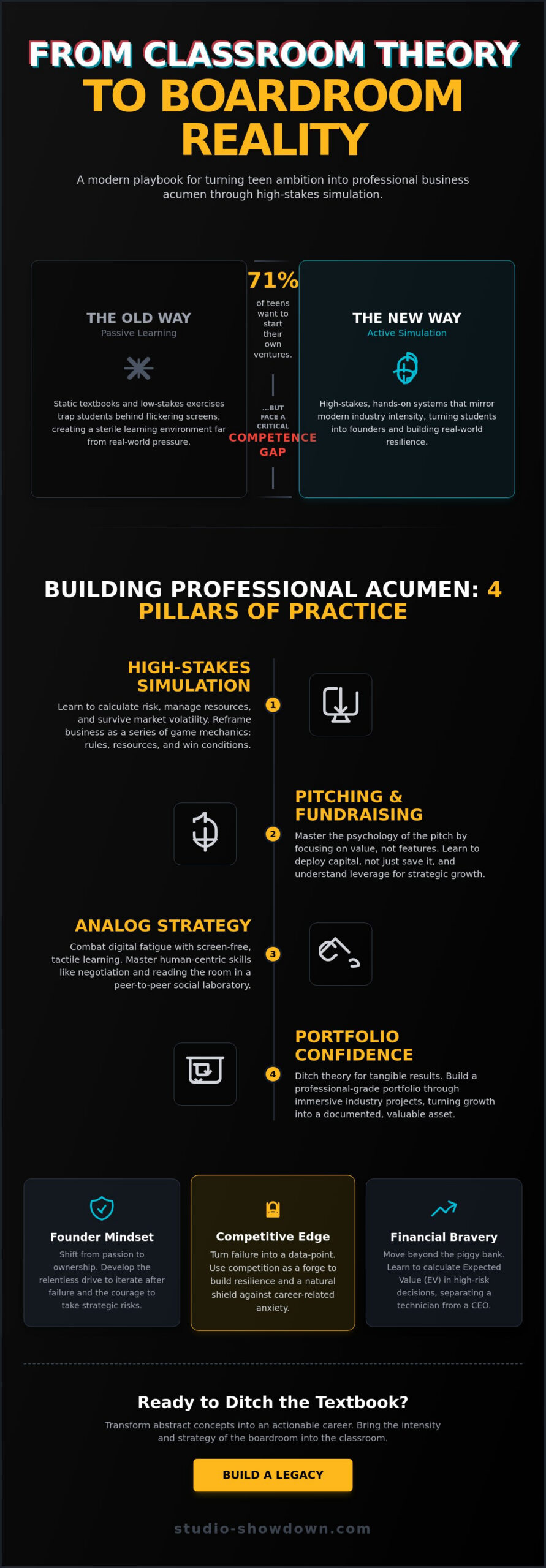
Recent research reveals that 71% of teenagers aspire to start their own ventures, yet most are still trapped behind flickering screens or buried in textbooks that feel like relics. Real business isn’t a lecture. It’s a battle for market share. A hunt for capital. A test of raw intuition. You’ve seen the screen fatigue and the lack of engagement when the stakes don’t feel real. It’s time to cut through the visual noise and bring the grit of the boardroom into the classroom.
We’re here to transform abstract business concepts into actionable professional expertise. By using high-stakes, hands-on simulations, you can bridge the gap between classroom theory and the reality of a modern production studio. These specific activities to teach teens business skills focus on tangible results, professional portfolios, and the creative bravery required to win in 2026. We’re breaking down five dynamic methods, from competitive pitch wars to immersive board game simulations, that turn students into founders. No filler. No fluff. Just the tools to build a legacy.
Key Takeaways
- Ditch static textbooks for dynamic, high-pressure systems that mirror the intensity of the modern tech industry.
- Discover strategic activities to teach teens business skills that prioritize hands-on experimentation over passive classroom theory.
- Master the mechanics of pitching and fundraising to learn how to manage resources and communicate high-stakes value.
- Turn failure into a competitive edge by using simulations as a safe, data-driven space for financial and strategic growth.
- Build a professional-grade portfolio early through immersive industry simulations that bridge the gap between education and career.
The Shift from Passive Learning to Strategic Business Competence
The lemonade stand is a relic. It’s a low-stakes exercise in nostalgia, not a blueprint for a career. Modern teenagers don’t want cute; they want impact. They want to understand how a high-end production studio balances its books, manages its talent, and scales its vision. Traditional education often creates a “Competence Gap” where students can define a profit margin but can’t survive a market crash. We must move beyond the safety of the textbook. Real growth happens in the friction of high-stakes execution. It’s about moving from being a spectator to being the person who calls the shots.
Effective Entrepreneurship education in 2026 must be built on resilience. Competition isn’t a dirty word here. It’s the forge. When teens compete for limited resources or market dominance, they develop a natural shield against career-related anxiety. They stop fearing the unknown. They start calculating it. By reframing business as a series of game mechanics, we strip away the boredom. Rules. Resources. Win conditions. This is the language of the future. It turns a dry subject into a dynamic, visual, and high-octane challenge that demands total focus.
The Difference Between a Hobby and a Founder Mindset
A hobby is about passion. A founder mindset is about ownership. It’s the relentless drive to iterate after a failure and the courage to take a strategic risk when the data is hazy. Most “safe” learning environments are too sterile. They remove the pressure, which effectively removes the learning. We define strategic competence as the ability to navigate complex systems with precision and poise. It’s about seeing the entire board, not just the piece in your hand. Using immersive activities to teach teens business skills ensures they aren’t just playing; they’re preparing for the visual noise and chaos of the real market.
The Power of Analog Strategy in a Digital World
Digital fatigue is a silent killer of creativity. While coding is vital, the core of business remains human. It’s negotiation. It’s reading the room. Screen-free learning environments force a different kind of cognitive retention. You can’t alt-tab out of a physical negotiation. This tactile approach to activities to teach teens business skills creates a social laboratory. Peer-to-peer negotiation in a physical setting builds a level of professional acumen that digital simulations simply can’t touch. For more ways to disconnect while leveling up, explore our curated screen-free activities for modern families. It’s about being present, being sharp, and being ready to win.
Mastering the Ecosystem: Pitching, Fundraising, and Market Mechanics
Real business isn’t about what you have. It’s about what you can influence. High-stakes business skills involve managing resources you don’t yet own. This is the essence of leverage. While traditional advice focuses on small-scale services, modern youth entrepreneurship resources emphasize the need for systemic thinking. Teens need to understand venture capital not as “free money,” but as high-octane fuel for strategic growth. Market dominance requires more than a good product. It requires a relentless analysis of rival strategies. If a competitor pivots, you must be ready to counter-move. This isn’t just theory. It’s the difference between a studio that thrives and one that disappears in the visual noise. This is why we focus on activities to teach teens business skills that simulate real-world volatility.
The Psychology of the Pitch
Features are boring. Value is magnetic. Teaching teens the art of the pitch means moving them away from lists of specifications. They need to solve a specific problem. A “30-second studio pitch” forces clarity. It strips away the fluff. Repeated exposure to peer feedback is the only way to kill the fear of “no.” Every rejection is just a data point. By documenting the evolution of these ideas, students build “Portfolio Confidence.” They see their own growth as a tangible asset, proving they can handle the heat of a real production environment. It’s about showing the work, not just the result.
Financial Literacy Beyond the Piggy Bank
Saving is a passive act. Investing in production assets is a strategic one. We need to shift the narrative from hoarding pennies to deploying capital. Teens should learn to calculate “Expected Value” (EV) in high-risk decisions. This mathematical bravery separates a technician from a CEO. Will this new equipment pay for itself? Is the risk of this market entry worth the potential reward? These activities to teach teens business skills transform abstract math into a survival tool. Engaging with complex strategy board games provides a risk-free environment to test these theories. It’s the perfect training ground for the real world. If you’re ready to see how these concepts play out in a competitive arena, check out our latest game-based learning tools designed for the next generation of founders.
Why Simulation Games Outperform Traditional Business Textbooks
Textbooks are dead weight in a pörgős market. They offer static definitions for a world that changes every hour. A simulation game, however, is alive. It provides the “Game Over” advantage. In a classroom, a mistake is a grade. In a simulation, a mistake is a data point. It’s a strategic lesson delivered in real-time. This creates a safe space for high-stakes financial experimentation where teens can burn through virtual capital to find a winning formula. Doing beats reading. Every single time. When you’re choosing activities to teach teens business skills, prioritize the ones that force a decision. Passive consumption doesn’t build founders. Action does.
Cognitive retention skyrockets when the stakes feel personal. Rivalries in a game aren’t just for fun; they mirror the brutal reality of market competition. When a peer captures your target audience, you feel the heat. That emotional engagement cements the lesson. You don’t just remember what a “pivot” is; you remember the exact moment you had to execute one to save your studio from bankruptcy. It’s about the visceral experience of the win and the cold reality of the loss.
The Feedback Loop of Strategy Games
Game mechanics provide instant consequences. There’s no waiting for a mid-term to see if your strategy worked. If your pricing is too high, your inventory sits. If your marketing is weak, your rivals win. This immediate feedback loop encourages strategic pivots. It teaches teens to be agile. They learn that a path to failure isn’t a dead end but a prompt to change direction. For a deeper look at why complex systems beat simple luck, explore our guide on why strategy wins in 2026. It’s about outthinking the competition, not just outspending them.
Gamification as a Professional Training Tool
This isn’t just play. It’s professional development. Fortune 500 companies have used simulations for executive training for decades. They know that a controlled environment is the best place to forge leaders. By participating in these activities to teach teens business skills, students can translate board game victories into resume-worthy accomplishments. Leading a team through a “Showdown” environment builds social leadership and negotiation skills that are impossible to teach via a worksheet. It’s about proving you can handle the pressure before you even step into a real boardroom. You’re not just playing a game; you’re building a professional legacy.
5 Hands-On Activities to Build Professional Business Acumen
Forget the solo blog or the Etsy shop. Those are hobbies. True business acumen is forged in the showdown between rivals. To bridge the competence gap, we need high-octane activities to teach teens business skills that demand collaboration, risk, and strategic vision. Here are five ways to elevate the classroom into a production studio.
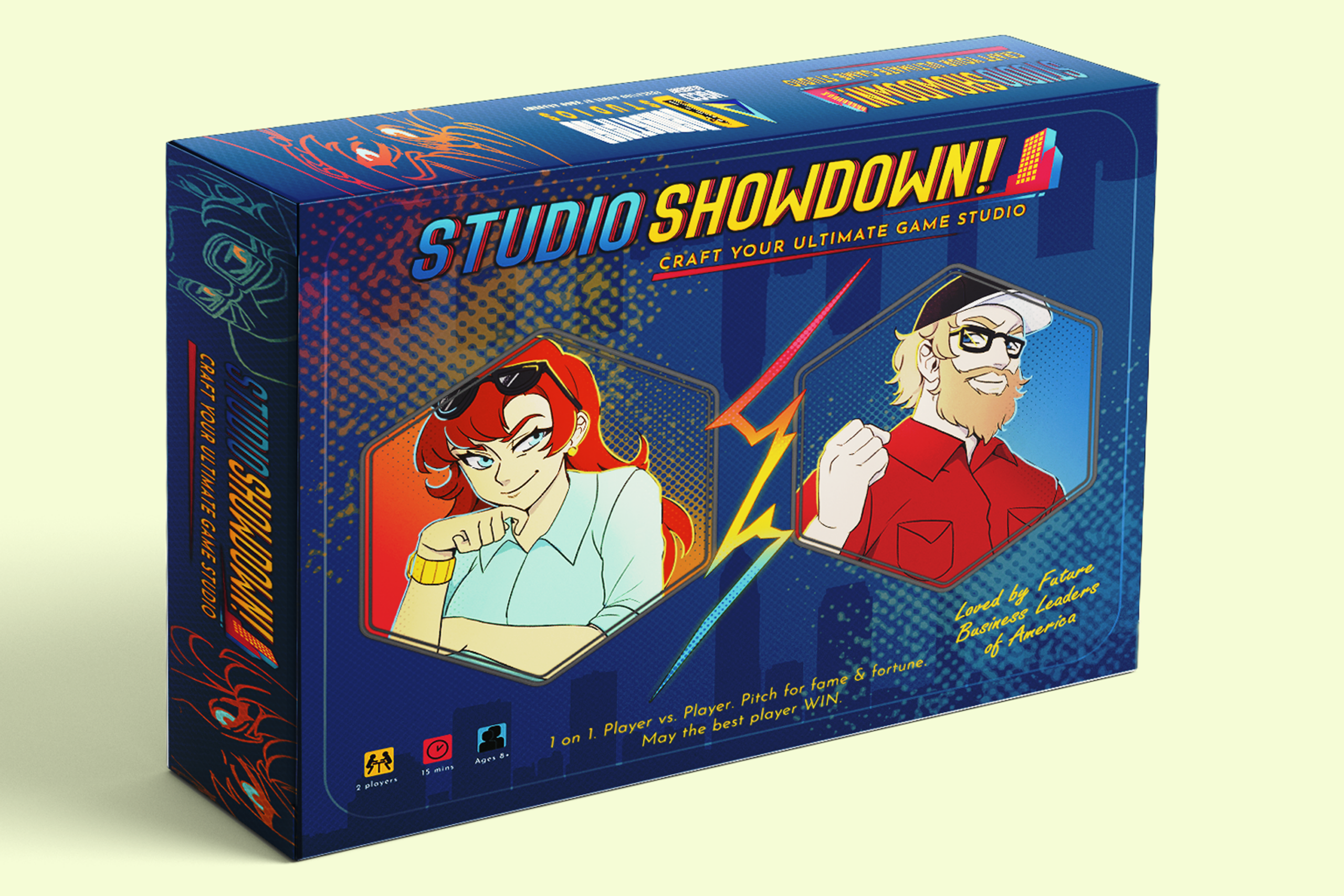
- Activity 1: The Studio Showdown Board Game. This is the anchor. It’s a comprehensive industry simulation where teens manage a video game studio. They don’t just learn about resources; they fight for them. It translates the visual noise of the tech world into a tangible, high-stakes tabletop battle.
- Activity 2: The Peer-to-Peer Shark Tank Pitch Night. Students present their studio concepts to a panel of their peers. It’s not about a grade. It’s about securing “Production Tokens” from the audience.
- Activity 3: Collaborative Prototyping and Dev Log Documentation. Every strategic move is recorded. This isn’t a diary. It’s a professional record of iteration and growth.
- Activity 4: Market Research Sprint. Teams analyze rival “studios” within the game or classroom. They identify weaknesses. They exploit gaps. They pivot.
- Activity 5: The Fundraising Role-Play. Teens must secure virtual “Seed Funding” by proving their studio has a viable path to market dominance.
Ready to bring this level of intensity to your curriculum? Secure your copy of the Studio Showdown Board Game and start building the next generation of industry leaders today.
Setting Up a High-Stakes Pitch Night
Organizing a pitch night requires more than just a podium. You need a high-stakes environment. Use “Production Tokens” to represent real investment. When peers have to choose where to spend their limited tokens, the feedback becomes visceral. Seeing a “Studio” idea gain market traction among friends provides a massive confidence boost. It proves that their vision has value. It’s the first step toward professional authority. These activities to teach teens business skills work because they mirror the pressure of a real production house.
The Dev Log: Building a Professional Portfolio
A “body of work” is the ultimate anchor for professional self-esteem. We teach teens to document their strategic decisions as they play or build. Why did they hire that developer? Why did they pivot to a new genre? This documentation becomes a Dev Log. It’s a tangible asset they can show to future employers or investors. It proves they didn’t just get lucky; they were strategic. If you want to see how this works in practice, explore our guide on the ultimate business board game and how it masters entrepreneurship. It’s about creating a legacy, one move at a time.
Launching a Career with the Studio Showdown Board Game
The gap between playing a game and building an empire is narrower than you think. Most career advice for teens relies on elusive internships or dry theory that fails to stick. Studio Showdown changes the narrative. It’s a direct immersion into the high-stakes world of video game entrepreneurship. By engaging in these specific activities to teach teens business skills, students aren’t just passing time. They’re simulating a career path in the most pörgős industry on the planet. This tabletop experience bridges the technical side of gaming with the brutal reality of market strategy. It turns players into producers.
Mastering a professional portfolio doesn’t happen in a vacuum. It requires a body of work built on strategic decisions and calculated risks. Through strategic tabletop play, teens learn to justify their moves. They document their growth. They build a narrative of success. This isn’t just about winning a round; it’s about proving you have the intuition to lead a production house. In a world of visual noise, this level of professional clarity is a superpower. It’s the ultimate anchor for a young founder’s self-esteem.
Become a Studio Founder
Success isn’t accidental. It’s engineered. Launching a hit game requires more than a good idea; it requires a founder who can navigate a saturated market. Studio Showdown forces players to outmaneuver rival studios through sharp negotiation and aggressive fundraising. This isn’t a digital loop. It’s an analog showdown. The tactile nature of the game ensures every decision has weight. You feel the tension of the deal. You see the impact of a strategic risk. It’s the ultimate training ground for real-world business acumen. You aren’t just learning. You’re executing.
The Institutional Advantage: Classroom Bundles
Educators need tools that cut through the noise. The Studio Showdown: Educator Edition and our Classroom Bundles are designed to scale this impact across entire schools. Bulk licensing allows institutions to transform standard classrooms into pörgős production houses. It’s about more than business; it’s about integrating game mechanics into STEM and leadership curricula. These activities to teach teens business skills provide a structured, competitive framework that students actually want to master. It’s time to stop teaching business from the past and start building it for the future. Ready to dominate the market? Get the Studio Showdown Board Game today!
Forge the Founders of 2026
The era of passive learning is over. Strategic competence isn’t found in a textbook; it’s earned in the heat of a market showdown. We’ve explored how moving from theory to high-stakes execution creates a natural shield against career anxiety. By integrating competitive activities to teach teens business skills, you provide the tools for real-world market dominance. Failure becomes a data point. Negotiation becomes a survival skill. The transition from student to studio founder starts with a single move.
Developed by VGCD Academy and DEMYSTIFIED Studios, the Studio Showdown Board Game is a professional training tool used by educators to build raw business acumen. It strips away the visual noise of the classroom and focuses on the grit of fundraising, pitching, and market dominance. Don’t just prepare them for the industry. Let them lead it. Master the Business of Gaming with the Studio Showdown Board Game today. The future belongs to those who build it.
Frequently Asked Questions
What are the best business activities for shy teens?
Structured roleplay and strategy board games are ideal for shy teens because they provide a defined framework for interaction. Instead of the pressure of an open ended networking event, teens focus on game mechanics and objective goals. This allows them to practice negotiation and leadership within the safety of a character’s objectives. It builds social confidence through repeated, low stakes exposure to professional scenarios.
How do strategy board games specifically teach business skills?
Strategy games function as living systems where every action has an immediate, logical consequence. They force players to manage limited resources, anticipate rival moves, and pivot when market conditions change. These activities to teach teens business skills turn abstract economic theories into tangible survival challenges. It’s about learning the internal rhythm of a market through direct, competitive experience rather than passive reading.
Can a board game really help a teen build a professional portfolio?
Yes, when the game is used as a springboard for documentation. By keeping a Dev Log or a strategic journal of their decisions during a game of Studio Showdown, teens create a record of their analytical thinking. This body of work demonstrates their ability to handle complex project management and resource allocation. It provides concrete proof of their professional intuition for future employers or admissions officers.
Why is screen-free business learning better than digital simulations?
Physical games demand a level of social presence that digital simulations can’t replicate. You have to read body language, negotiate face to face, and handle the tension of a real room showdown. Screen free environments also eliminate digital distractions, leading to higher cognitive retention of complex concepts. It’s about mastering the human element of business, which remains the most critical factor in any successful production studio.
How can I teach my teen about fundraising without a real budget?
Use roleplay scenarios where peers act as venture capitalists and invest using symbolic tokens or production points. This teaches the essential art of the pitch and the mechanics of equity without requiring actual capital. Teens learn to communicate value, justify their studio’s roadmap, and compete for limited resources. These specific activities to teach teens business skills focus on the strategy of capital, not just the currency itself.
What is the Founder Mindset and why is it important for Gen Z?
The Founder Mindset is defined by extreme ownership, resilience, and the ability to iterate after failure. For Gen Z, this mindset is a shield against an unpredictable job market. It shifts their perspective from being a passive employee to becoming a proactive creator. By seeing every challenge as a system to be optimized, they develop the artistic bravery needed to stand out in a crowded visual landscape.
How does Studio Showdown compare to games like Monopoly or Cashflow?
Studio Showdown moves beyond basic real estate or personal finance into the world of industry production. While classic games focus on rent or saving, Studio Showdown simulates the complexity of running a video game studio. It involves hiring talent, managing development cycles, and outmaneuvering rivals in a high tech ecosystem. It’s a modern professional simulation designed for the realities of the 2026 creative economy.
Are there specific business skills that help with college applications?
Admissions officers look for leadership, strategic thinking, and the ability to manage long term projects. Demonstrating that a student has mastered resource allocation or successfully led a studio through a market crisis shows a high level of maturity. These skills prove the student can handle the rigors of higher education and contribute a unique, professional perspective to their campus community.