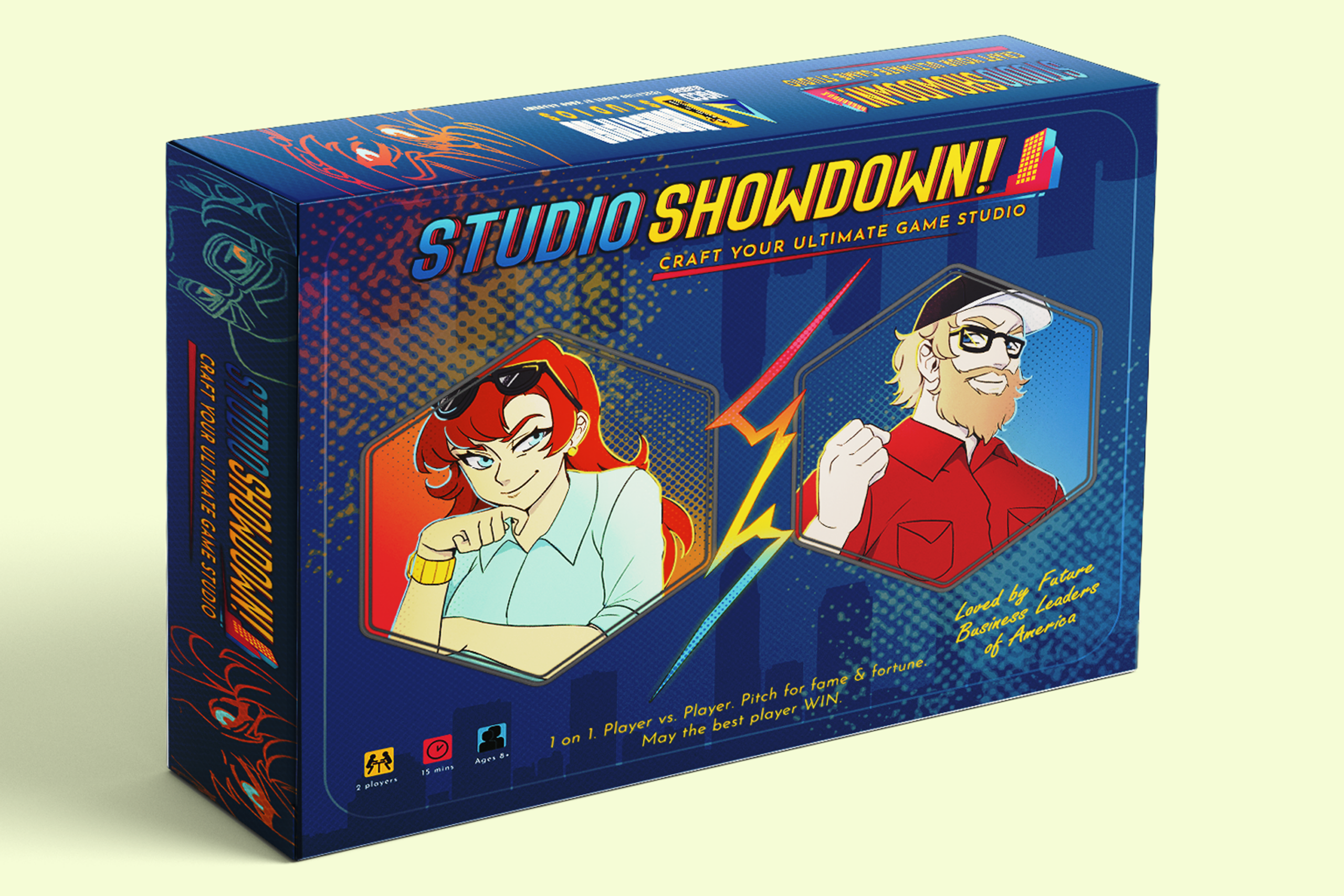
Market research isn’t a data collection task; it’s a survival skill for competitive entrepreneurship. You’ve seen the glazed eyes when you mention secondary data or census reports. Implementing the right classroom activities for market research is the only way to connect abstract theory to actual business success. Your students deserve a curriculum that keeps pace with a $94 billion online education market.
We understand the grind of trying to make primary data collection feel like a high-stakes mission. This guide delivers dynamic, hands-on strategies that transform dry theory into a ruthless competitive edge. We promise to show you how to bridge the gap between textbook definitions and real-world results. You’ll see how to turn passive learners into pro-grade founders who can build high-impact portfolios.
We are breaking down everything from handling FERPA privacy regulations to leveraging AI-powered sentiment analysis. You’ll learn how to move students from simple Google Forms to mastering the distinction between primary and secondary data. Let’s turn your classroom into a production floor for the next generation of business leaders.
Key Takeaways
- Stop teaching data entry. Start building a founder’s radar that navigates competitive landscapes.
- Deploy rapid-fire classroom activities for market research that bridge the gap between theory and high-stakes strategy.
- Leverage the power of tabletop simulations to force students to face the consequences of their research decisions.
- Execute a 5-step project workflow that transforms raw intelligence into professional-grade business pitches.
- Immerse your students in the competitive world of game development with the Studio Showdown simulation.
The Shift from Data Entry to Business Intelligence
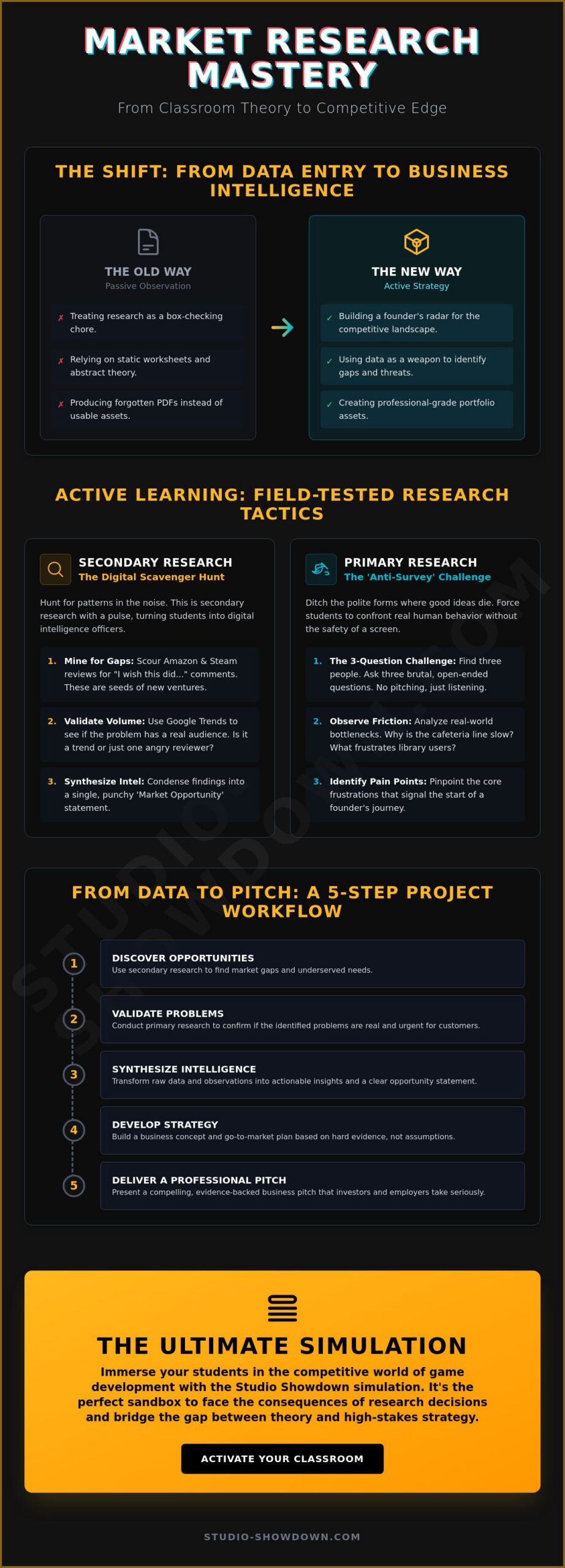
Data entry is for robots. Business intelligence is for founders. Most students treat market research as a box to check. They fill out a form; they submit a PDF; they forget it. That’s a failure of curriculum, not a lack of student talent. To engage the next generation, we must redefine the process. Research isn’t a chore. It’s a radar system designed to navigate a cutthroat competitive landscape.
Designing effective classroom activities for market research requires a total shift in perspective. It’s about moving from passive observation to active strategy. In the 2026 business environment, data moves at light speed. Static worksheets can’t keep up. They feel like a burden because they lack stakes. When students realize that market intelligence is the foundation of every successful pitch, the energy changes. Investors don’t fund ideas. They fund evidence.
This psychological pivot turns students into strategists. They begin to see data as a weapon. They use it to identify gaps, detect threats, and find their unique angle. We aren’t just teaching them to read charts. We’re teaching them to survive the market. Every piece of intelligence gathered is a step toward a successful launch or a winning fundraising round.
Why Real-World Context Beats Abstract Theory
Look at indie game development. Thousands of games launch every month; most fail within weeks. The difference isn’t always the code. It’s the market fit. Market research is a competitive weapon used to ensure you aren’t building something nobody wants. It’s the primary defense against the number one cause of startup failure. By using high-stakes industries as examples, students see the immediate value of their work. Theory becomes a toolkit for survival.
Connecting Research to Professional Portfolio Building
Modern classroom activities for market research should produce artifacts students can actually use. A well-executed focus group report or a competitive analysis dashboard is a professional-grade portfolio piece. These assets prove business acumen to future employers in data science or marketing. It’s about creating a proof of concept for their own ideas. They aren’t just students anymore. They’re analysts. They’re founders in training. Every project is a chance to build a reputation before they even graduate.
Active Learning: Primary vs. Secondary Data Activities
Labeling data types is a classroom relic. Using them is a modern necessity. Most classroom activities for market research stop at the definition. We’re going beyond that. We’re turning students into intelligence officers. They need to know when to scrape the web and when to look a customer in the eye. It’s about efficiency, accuracy, and the guts to ask the right questions.
Start with a 15-minute ‘Social Media Deep Dive’. Students shouldn’t just scroll; they should hunt. They’re looking for patterns in the noise. This is secondary research with a pulse. Evidence suggests that Active Learning Workshops significantly outperform traditional lectures in teaching these methodologies. It’s the difference between hearing about a tool and swinging the hammer yourself.
Secondary Research: The Digital Scavenger Hunt
Forget dry reports. Send your students to the front lines: Amazon and Steam reviews. Their mission is to find the gaps. They look for the “I wish this did…” or “Why is it so hard to…” comments. These are the seeds of new ventures. Pair this with Google Trends to validate the volume. Does anyone actually care about this problem, or is it just one angry reviewer? They must synthesize these points into a single, punchy ‘Market Opportunity’ statement. This is how you spot a trend before it becomes a headline.
Primary Research: The ‘Anti-Survey’ Challenge
Surveys are often where good ideas go to die. People lie to be polite. They click random boxes just to finish. We challenge students to ditch the long forms for the ‘3-Question Founder Challenge’. It’s a rapid-fire primary research activity. Go to the hallway. Find three people. Ask three brutal, open-ended questions. No leading. No pitching. Just listening. This forces them to confront real human behavior without the safety of a screen.
Observational research is the secret weapon. Have students analyze ‘customer friction’ in the school cafeteria. Where are the bottlenecks? Why is the library checkout system frustrating? Identifying these pain points is the first step in the founder’s journey. If you want to see these concepts applied in a high-stakes environment, the Studio Showdown: Educator Edition provides the perfect sandbox for testing these tactical skills.
Comparing cost-efficiency is the final step. Digital analytics are fast and free. Face-to-face interviews take time and courage. A founder must balance both. We use ‘Source Showdowns’ to teach them to spot bias. If a secondary source is funded by a competitor, it’s compromised. They learn to trust, but verify. This isn’t just about data. It’s about developing the intuition to know which data actually matters.
Simulating the Market: Why Gaming Trumps Worksheets
Worksheets don’t win markets. Games do. If you want to ignite a classroom, you have to raise the stakes. Traditional classroom activities for market research often fail because they lack consequence. A student can ignore a trend on a PDF and still get an A. In a simulation, ignoring that same trend means losing the game. This shift from “What would you do?” to “What will you do to win?” changes the entire pedagogical energy. It’s about moving from a passive observer to an active strategist.
We’re moving beyond the simple data collection mentioned in previous sections. Gaming forces students to live with the results of their analysis. If they misread a competitor’s move, their “startup” loses market share in real time. This isn’t just about learning; it’s about outmaneuvering. We introduce “Rival Intelligence” as a core mechanic. Students don’t just study the customer. They track their peers. They watch for pivots. They learn that market research is a constant, living process of adjustment. They see the board and react.
Risk-Taking in a Safe Environment
Games provide a safe harbor for high-speed failure. A bad research decision in a simulation leads to a quick iteration, not a bankrupt bank account. This builds a founder’s resilience. It turns research from a static task into a dynamic feedback loop. The dopamine hit of a successful “market win” creates a lasting memory. When a student uses data to crush a rival’s strategy, they aren’t just completing an assignment. They’re winning a battle. This competitive edge is what keeps the next generation of founders engaged long after the bell rings. They learn to trust their gut because they’ve backed it up with data.
Traditional Case Studies vs. Immersive Simulations
Case studies are post-mortems of someone else’s success. Simulations are the operation itself. Retention rates skyrocket when students are the ones making the calls. Static business cases can’t account for the unpredictable nature of human rivals. Social interaction forces students to defend their strategies and adapt to the “visual noise” of a high-velocity market. It’s here that strategy board games prove their worth. They don’t just teach facts; they build the critical thinking required to survive. Unlike the “Bookends” approach used by some competitors, immersive simulations ensure that every decision has a visible, immediate impact on the board.
By using tools like the Studio Showdown: Educator Edition, you’re not just giving a lecture. You’re providing a production floor for business strategy. Students learn to synthesize primary and secondary data because their survival depends on it. They become creators who don’t just follow a curriculum, but actively shape their own path to victory. The classroom becomes a laboratory for real-world success.
From Data to Pitch: A 5-Step Classroom Project
Data is dead weight if it doesn’t close the deal. Most academic frameworks stop at interpretation. They leave students with a pile of charts and no clear path forward. Effective classroom activities for market research must bridge this gap. We’ve built a 5-step pipeline that moves students from raw intelligence to a high-stakes investor pitch. It’s about conversion, not just collection. Every step is designed to build a founder’s resilience.
- Step 1: The Founder’s Problem. Define what you need to know to survive. This isn’t a generic inquiry. It’s a targeted strike to identify the biggest threat to your business model.
- Step 2: Intelligence Gathering. Deploy the primary and secondary tactics we’ve discussed. Mix digital scraping with face-to-face friction analysis to build a complete picture.
- Step 3: The Showdown Analysis. This is where the rivalry begins. Students compare their data against the plans of rival studios in the room. Who has the better angle? Who is missing a critical trend?
- Step 4: The Strategic Pivot. Market reality is often harsh. Students must adjust their product based on the data they’ve found. If the research says no, the founder must pivot or perish.
- Step 5: The Investor Pitch. The final showdown. Every business decision must be justified by the intelligence gathered in Step 2. Data becomes the shield and the sword.
Synthesizing Data into a Winning Strategy
We teach students to kill the data dump. An investor doesn’t care about 50 pages of raw survey results. They care about the insight. We use the So What? Test. Every chart must answer one question: How does this change our business action? If it doesn’t drive a decision, it stays out of the pitch. Visualizing this research is about clarity and impact. High-impact charts should scream the opportunity, not whisper the statistics. It’s about production value in every slide.
The Pitch: Defending Research Under Pressure
The pitch is a combat zone. We role-play a Shark Tank style Q&A where students must defend their findings under pressure. What happens when two data points conflict? How do you handle a rival who found a different trend? This pressure forces students to know their data inside and out. It’s about developing the confidence to stand by your intelligence. Utilizing business board games is a proven way to master this pitch environment before the lights go on. Ready to bring this level of intensity to your curriculum? Get the Classroom Bundle today and transform your next session.
Studio Showdown: The Ultimate Market Research Simulation
Theory provides the map. Studio Showdown is the terrain. This simulation takes the intelligence gathering tactics discussed in previous sections and puts them into a live, high-stakes environment. It isn’t just a learning tool; it’s a production floor where data determines survival. Students step into the role of studio founders. They don’t just study the market. They live it. They manage budgets, analyze rivals, and pitch for funding. Every turn is a test of their founder’s radar.
Most classroom activities for market research lack a definitive finish line. Studio Showdown provides that destination by turning raw data into a competitive resource. It forces students to use game mechanics to master fundraising and rival analysis in a way that static worksheets never could. They are building a professional portfolio through the eyes of a studio leader. Every decision is a calculated risk. Every victory is backed by evidence. This is where the next generation of founders proves they can navigate the visual noise of a real industry.
Mastering the Game Development Lifecycle
Success in the video game industry requires more than just a creative spark. It requires hit potential. Students must research the market before they spend a single resource on production. They have to navigate market dominance and counter rival studio maneuvers in real time. We use ‘Market Feedback’ cards to simulate the unpredictable nature of consumer behavior. These cards force a strategic pivot. They demand immediate action. Students learn that market research isn’t a one-time task. It is a constant cycle of intelligence and adjustment. It is the ultimate validation of their research tactics.
Classroom Integration and Educator Support
We know the modern schedule is tight. The Educator Edition is a turnkey solution designed for the fast-paced classroom environment. It fits seamlessly into a standard curriculum block without requiring hours of prep. We’ve handled the logistics so you can focus on the coaching. For schools looking to level up their entire entrepreneurship program, the Classroom Bundle offers a scalable solution for multi-unit institutional use. It is a complete package for a professional, high-energy learning environment.
We also provide professional development opportunities for teachers using the platform. We want you to be the authority in the room. This simulation isn’t just about teaching facts; it’s about changing how students perceive business challenges. By the time the final bell rings, your students won’t just have a grade. They will have the mindset of a founder. They will have the guts to lead. They will have the data to back it up. Let’s raise the stakes together.
Level Up Your Classroom Strategy
Passive learning is a relic. Your students don’t want worksheets; they want the tools to win. By implementing high-impact classroom activities for market research, you’re giving them more than a grade. You’re giving them a founder’s radar. We’ve moved from simple data entry to a world where market intelligence is a survival skill. The shift from observer to strategist is where real growth happens.
It’s time to bridge the gap between theory and the high-stakes world of production. Studio Showdown, developed by VGCD Academy and DEMYSTIFIED Studios, is the strategy-first tabletop experience designed to build real-world business acumen. It’s the ultimate simulation for any educator ready to cut through the visual noise of traditional curriculum. Educators are already using these mechanics to transform classrooms into innovation hubs. Every session is an opportunity to prove that data drives success.
Ready to change the game? Bring the Showdown to your classroom with our Educator Bundle. Let’s turn your students into the leaders they were meant to be. The market is waiting for their next move. Don’t just teach the future; build it.
Frequently Asked Questions
What are the most effective market research activities for high school students?
Mystery shopping at local businesses or conducting competitor price audits are highly effective. These tasks force students to observe real-world operations and pricing strategies first-hand. It moves them beyond the screen and into the local economy. They learn to identify value propositions by comparing how different brands solve the same consumer problem.
How do you explain primary vs. secondary market research to a beginner?
Primary research is data you collect yourself; secondary research is data someone else already gathered. Think of secondary research as reading a map and primary research as exploring the actual terrain. Beginners should start with secondary sources to understand the big picture. They then use primary methods like interviews to fill in specific gaps that the maps missed.
Can board games really teach professional market research skills?
Board games teach professional market research skills by forcing players to make decisions under pressure with imperfect information. Simulations like Studio Showdown require players to analyze rival moves and adjust their strategy in real time. This mimics the high-stakes environment of a production studio. It turns abstract data into a tangible resource for winning market share.
How long does a typical classroom market research simulation take?
A standard classroom market research simulation usually fits into a 60 to 90 minute block. This timeframe allows for an initial briefing, the core gameplay phase, and a short debrief. Some intensive projects can span multiple days. However, a well-designed simulation provides immediate feedback within a single class period to keep the momentum high.
What tools do students need for digital market research activities?
Students need access to Google Trends, Statista, and basic social media platforms for effective digital classroom activities for market research. These tools provide real-time data on consumer behavior and global trends. Educators should also consider platforms that allow for sentiment analysis. Having a reliable device and a structured research template is essential for converting digital noise into actionable business intelligence.
How do I grade a student’s market research project fairly?
Grade based on the depth of the insight extraction rather than just the volume of data collected. A fair rubric rewards students who can explain the logic behind their findings. Look for clear connections between their research and their final business decisions. This approach values the strategic thinking process over simple data entry or spreadsheet formatting.
Is market research relevant for students who don’t want to be entrepreneurs?
Market research is a foundational skill for any career involving data literacy or strategic planning. Even if a student doesn’t want to be a founder, they’ll need to analyze trends and understand audience behavior in fields like healthcare or tech. These classroom activities for market research build critical thinking. They teach students how to verify information and make evidence-based arguments in any professional setting.
What is the difference between market research and marketing research in a classroom context?
Market research focuses on the people and the competition within a specific industry. Marketing research is broader; it analyzes the effectiveness of specific promotional tactics and the overall brand strategy. In a classroom, students usually start with market research to define the opportunity. They then use marketing research to test if their specific messaging or pricing actually resonates with that identified group.