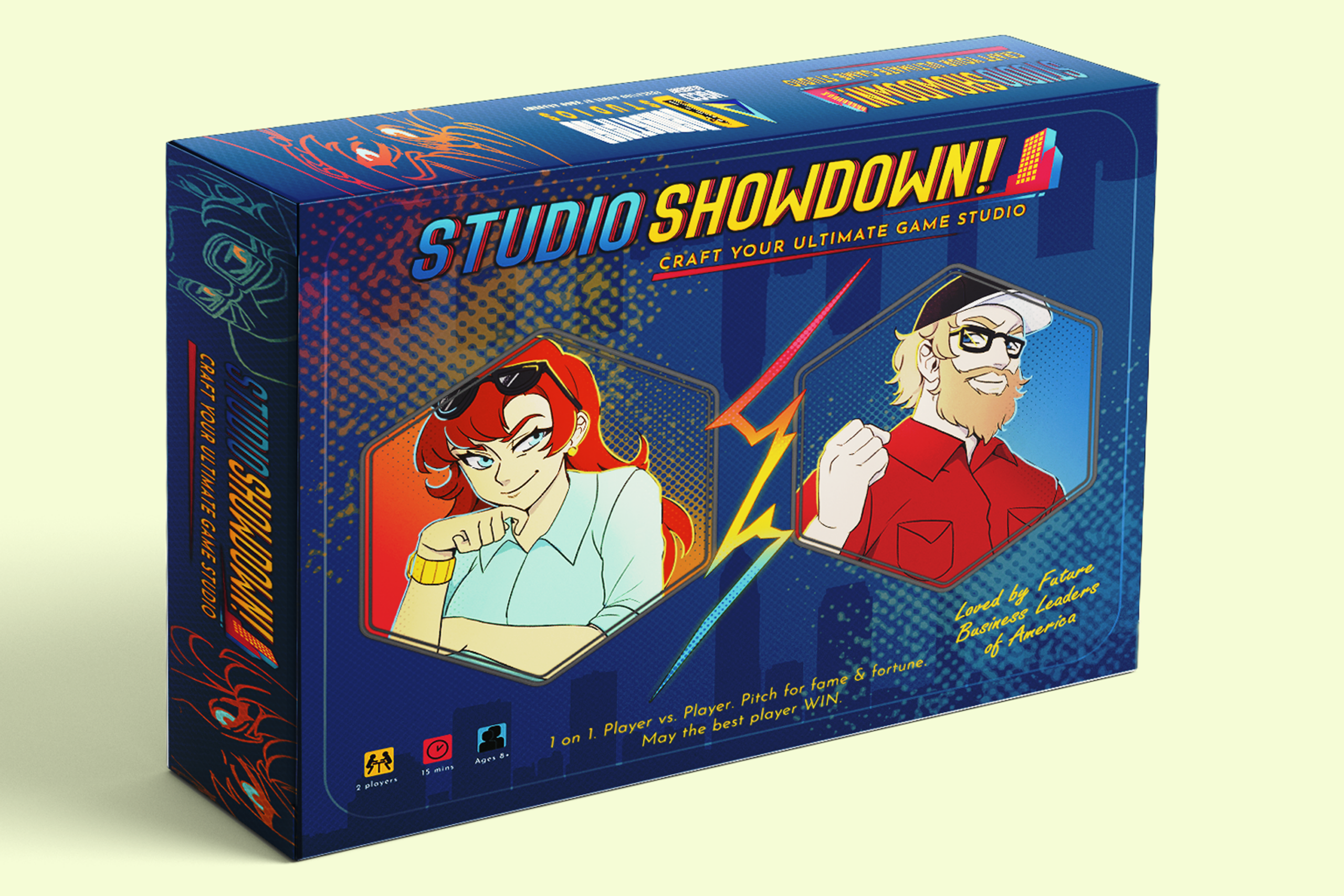
What if the secret to shipping your next breakout hit isn’t hidden in a C++ compiler, but on your dining room table? You’ve likely spent twelve hours today staring at Unreal Engine 5.8 or Godot 4.6.3. Your eyes ache. Your brain feels like static. You already know that more screen time won’t fix a broken game loop or a weak business strategy. Finding productive hobbies for aspiring game developers is no longer just about taking a break; it’s about strategic cross-training for your creative mind.
It’s easy to feel like every minute away from the keyboard is a minute lost. In reality, the most successful developers in 2026 are systems-thinkers who master digital complexity through analog play. You’re about to discover how to build a high-impact hobby stack that sharpens your design instincts and business acumen without burning out on code. We are exploring how tactile mechanics, market analysis, and physical prototypes like the Studio Showdown Board Game can transform your technical skills into a unique, market-ready portfolio. Stop grinding. Start building your unfair advantage.
Key Takeaways
- Shift your focus from syntax to systems by identifying productive hobbies for aspiring game developers that sharpen your design instincts.
- Use tabletop design to strip game engines to their bare mechanics, making balance and power curves intuitive rather than abstract.
- Develop the “Game Studio Founder” mindset to master the business of play, from managing burn rates to perfecting your pitch.
- Apply the 70/20/10 rule to your schedule to ensure your portfolio demonstrates technical skill, design depth, and commercial awareness.
- Experience the pressure of real-world studio management through the Studio Showdown Board Game to build resilience before you ship.
Why Your Hobbies Should Do More Than Just Teach You Code
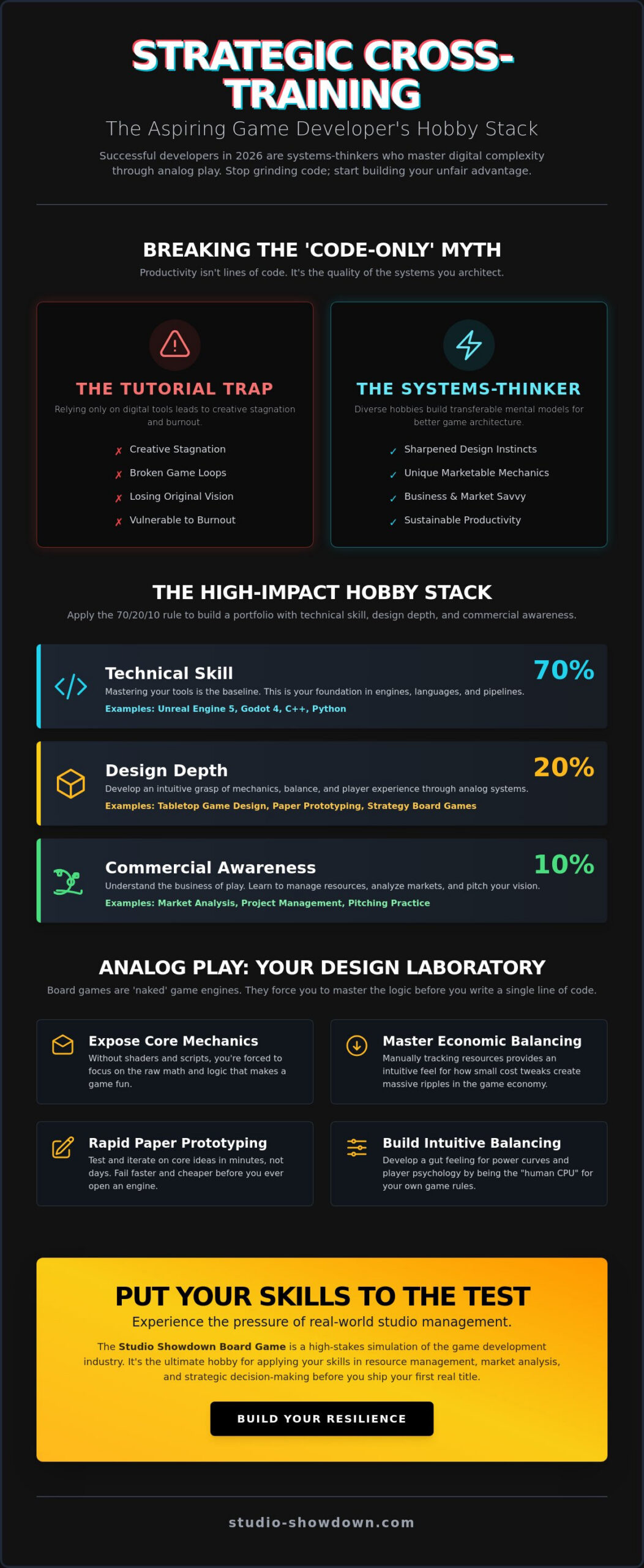
Productivity isn’t a measurement of how many lines of code you pushed before midnight. It’s the quality of the systems you architect. For many, the search for productive hobbies for aspiring game developers ends at another Python course. This is a mistake. A productive hobby isn’t just “more work” in a different language; it’s an activity that builds transferable mental models for game architecture. You need to step away from the screen to see the board. Code is the tool. Vision is the weapon.
Tutorials teach you how to follow. They don’t teach you how to lead. When you rely solely on digital guides, you fall into the “Tutorial Trap.” You gain technical proficiency but lose original vision. Diverse hobbies provide the raw materials for unique mechanics that no AI or scripted video can replicate. In 2026, the industry has shifted. Technical skills are the baseline; business savvy is the differentiator. With over 1,200 indie titles hitting Steam every month, your ability to understand the foundational principles of game design and market positioning is what keeps your studio afloat. Cross-training for creators means using analog mediums to solve digital problems.
Breaking the ‘Code-Only’ Productivity Myth
Twelve hours of coding isn’t a badge of honor. It’s a recipe for creative stagnation. Diminishing returns set in long before the sun goes down. Science points toward “diffuse thinking” as the key to breakthrough moments. Your brain needs “away-from-keyboard” time to subconsciously untangle complex bugs. Innovative studios in 2026 don’t just hire coders. They hire thinkers with diverse interests. They want creators who can bring fresh perspectives to the production pipeline, not just another keyboard operator.
Identifying Transferable Skills in Game Design
Systems thinking is the ability to see how game variables interact within a cohesive whole. It’s the pulse of every successful project. Mastering this requires stepping back from the syntax to look at the logic.
- Resource management: Balancing scarcity and power.
- Player psychology: Mapping the emotional journey and reward loops.
- Economic balancing: Ensuring every choice has a cost and a consequence.
These are high-stakes concepts. Learning them while fighting a compiler is inefficient. Analog environments, like tabletop games or strategic simulations, allow you to test these theories in a low-stakes setting. You master the logic before you write the first line of script. This is how you build a portfolio that shows you aren’t just a coder, but a designer who understands the business of play.
Mastering Game Mechanics Through Analog Play and Tabletop Design
Code hides logic. Paper exposes it. When you look at a digital engine, thousands of lines of script mask the underlying systems that make a game fun. Board games are “naked” game engines. Every mechanic is manual; every calculation is visible. You are the CPU. This forced transparency is why tabletop design remains one of the most productive hobbies for aspiring game developers. By removing the distraction of shaders and physics bugs, you focus entirely on the math of the experience.
Playing deep strategy games builds an intuitive understanding of balancing and power curves. You begin to see how a small tweak in resource cost can ripple through an entire economy. These are the same core gameplay design principles that define global hits. If you can’t make a mechanic engaging with a handful of tokens and a sheet of paper, no amount of 4K textures will save it. Designing your own board game acts as a rapid paper prototype for digital concepts, allowing you to fail fast and iterate before you ever touch a keyboard.
Board Games as a Design Laboratory
Analyzing winning strategies in complex board games reveals “optimal play” loops. You learn to identify where players feel empowered and where they feel frustrated. Paper prototyping is significantly faster than jumping straight into Unity or Godot. You can rewrite a rule in seconds. Deconstructing a board game’s economy teaches you digital resource management by forcing you to track every transaction manually. If you want to test your ability to manage a real team and a real budget, the Studio Showdown Board Game offers a high-stakes simulation of the industry itself.
The Dungeon Master’s Guide to UX and Narrative
Running a tabletop RPG is a masterclass in real-time playtesting. As a Dungeon Master, you are the lead designer, the writer, and the UX researcher. You manage player agency and narrative branching on the fly. This hobby teaches you how to create emotional beats and manage player expectations without the crutch of a screen. You build world-consistency through verbal and written systems, ensuring that every player action has a logical consequence. It is the purest form of systems thinking. You learn to pivot when players break your world, a skill that is vital when designing for the unpredictable nature of digital audiences.
The ‘Game Studio Founder’ Mindset: Entrepreneurship as a Productive Hobby
Shipping a masterpiece requires more than just a clean repository. It demands a founder’s perspective. In 2026, the gap between a hobbyist project and a commercial success is defined by market awareness. Treating entrepreneurship as a hobby is one of the most productive hobbies for aspiring game developers because it prepares you for the ‘Game Over’ screen that tutorials never mention: running out of cash. Great code is the engine, but business logic is the fuel. If you don’t understand how to keep the lights on, your technical skills remain an expensive pastime.
Game development is a high-stakes business. By treating the industry itself as a “meta-game,” you gain a massive edge over developers who only focus on syntax. This involves studying market trends, analyzing player demographics, and understanding how fundraising changes the way you design your game’s scope. When you know that an indie studio’s monthly running costs average $31,500, you stop over-scoping and start designing for efficiency. You learn to manage burn rates and pitch ideas through simulation and play before a single dollar of your $78,000 estimated startup capital is at risk.
Simulating the Studio Lifecycle
Aspiring developers must study the ‘business of fun’ to avoid the common pitfalls that sink 35% of self-funded indie projects. Practicing the art of the ‘Pitch’ transforms a clever mechanic into a marketable product. You need to communicate value to investors and players alike. Understanding game development business basics like ROI and market positioning ensures you aren’t just building a game, but a sustainable career. This mindset allows you to see your project through the eyes of a stakeholder, forcing you to justify every feature against its potential return.
Competitive Analysis as a Creative Tool
Market research should be a hobbyist pursuit. Spend time looking at Steam charts and identifying genre gaps where innovation is lacking. Learn to ‘read’ a game’s success or failure from a financial perspective. Why did one title outperform a AAA release while another vanished? Using strategy board games to simulate studio rivalries and market dominance is a powerful way to sharpen these instincts. It turns the cold data of the gaming market into a competitive challenge. You aren’t just watching the industry; you are learning to dominate it.
How to Balance Your Hobby Stack for Maximum Portfolio Impact
Stop collecting tutorials. Start building a stack. Most developers treat their free time as a recovery phase, but the most productive hobbies for aspiring game developers act as a force multiplier for their career. You must audit your current activities. Are they purely passive consumption, or are they active skill-builders? If you spend four hours a night playing an FPS without analyzing the map flow, you are just a consumer. If you deconstruct the spawn logic, you are a developer in training. Balance is not about equal time; it is about strategic distribution.
Adopt the 70/20/10 Rule to dominate your growth. Dedicate 70% of your effort to coding and technical execution. This is your engine. Allocate 20% to analog design, where you strip away the digital noise to master pure logic. The final 10% belongs to business strategy. This ensures you aren’t just building a game, but a product that can survive the 2026 market. Documenting your analog designs, such as board game rules or TTRPG maps, turns “play” into “Design Docs.” These artifacts prove you can think through a system before you touch a line of code.
Building a Multi-Dimensional Portfolio
Your GitHub shouldn’t be a graveyard of unfinished Unity projects. Recruiters in 2026 hunt for systems thinkers who understand strategy board games and the underlying math that drives player engagement. Include PDFs of your analog prototypes in your repositories. This demonstrates high-level design thinking that code alone cannot convey. Business acumen is the missing section on most junior resumes. Show that you understand scope, burn rates, and market positioning. To prove you can handle the pressure of studio management, master the systems within the Studio Showdown Board Game and list it as a tactical training tool.
Scheduling for Long-Term Growth
Burnout kills more indie dreams than bad code does. Rotate your hobbies to keep your creative engine firing during long development cycles. If you spent all day debugging C++, spend your evening on tactile prototyping or market analysis. Set learning milestones for your non-coding activities just as you would for a sprint. A Dev Journal serves as the tactical bridge where you record how a specific mechanic from your analog play solved a bottleneck in your digital build. This practice turns every hobby into a documented professional gain. You aren’t just playing; you are preparing for the showdown.
Studio Showdown: Turning Game Development Strategy Into a Competitive Hobby
Execution is the only currency that matters. You have explored analog mechanics. You have sharpened your business mindset. Now, you need a theater to test your instincts. Studio Showdown emerges as the ultimate choice among productive hobbies for aspiring game developers who refuse to be just another cog in the machine. It is more than a game. It is a high-octane simulation of the 2026 gaming market. You aren’t just rolling dice. You are fighting for survival in an industry where only the strategically elite prevail. This is where theory meets the pavement.
This business board game forces you to confront the brutal realities of studio management. You will navigate the crushing pressure of fundraising. You will perfect your pitch under fire. You will manage the volatile cycles of production while your rivals hunt for your market share. It strips away the comfort of the code editor. It leaves you with nothing but your wit and your strategy. This is the fastest way to learn industry dynamics. It is the pulse of the market in a box. You master the logic that tutorials ignore.
Mastering the Business of Games Through Play
Experience the complete “Studio Founder” journey without the $78,000 financial risk of a real-world startup. Studio Showdown provides a safe harbor to fail, iterate, and conquer. You learn to outmaneuver rivals and secure vital funding through tactical tabletop play. It bridges the gap between being a student and becoming a studio owner. You don’t just read about market dominance; you achieve it. Every session sharpens your ability to make high-stakes decisions when the burn rate is climbing and the deadline is looming. You aren’t playing a game. You are practicing your career.
Join the Showdown Community
Networking is the silent engine of success. Use Studio Showdown in classrooms or dev groups to build professional alliances that last. It is a social laboratory. You develop the critical “soft skills” of negotiation and leadership through competitive mechanics. You learn to read your opponents. You learn when to pivot and when to push your advantage. These are the traits of an industry leader. Technical skills get you in the door. The founder mindset keeps you in the room. Don’t just watch the industry from the sidelines. Ready to dominate the industry? Get your copy of Studio Showdown today.
Master the Meta-Game and Build Your Legacy
Coding is your delivery mechanism; strategy is your ultimate edge. You have seen how stepping away from the screen allows you to master pure logic and systems thinking. By deconstructing mechanics through analog play and adopting a founder’s mindset, you transform from a technical operator into a visionary creator. The most productive hobbies for aspiring game developers in 2026 are those that bridge the gap between building a project and launching a successful business. Don’t let your technical skills be your only strength. Diversify your talent stack and prepare for the commercial reality of the industry.
If you’re ready to test your instincts under fire, it’s time to enter the arena. Master the Business of Game Dev with Studio Showdown. Developed by VGCD Academy experts and trusted by educators to teach entrepreneurship, this experience features immersive strategy mechanics designed specifically for aspiring founders. It’s the tactical cross-training you need to outmaneuver the competition and secure your studio’s future. The industry is waiting for leaders, not just followers. Take the lead. Build your studio. Own the showdown.
Frequently Asked Questions
What are the most productive hobbies for someone who wants to be a game designer?
The most effective activities are those that force you to deconstruct systems without the crutch of a digital engine. Tabletop game design, dungeon mastering, and competitive market research stand out as the top productive hobbies for aspiring game developers. These pursuits build the systems thinking required to architect complex digital loops before you ever write a line of script. They prioritize logic over syntax.
Can playing board games really help me learn how to code video games?
Board games don’t teach specific syntax, but they master the logic that powers every script. Every time you execute a rule in a complex board game, you are running a manual “if/then” statement. Managing a tabletop economy or turn order manually builds a deep, intuitive understanding of variable management and conditional logic. This makes learning engines like Unreal Engine 5.8 or Godot much faster because you already understand the underlying math.
How do I show my ‘non-coding’ hobbies on a game dev portfolio?
Treat your analog projects as professional deliverables rather than just pastimes. Include high-quality PDFs of board game rulebooks or photos of physical prototypes in your GitHub repositories. Write a brief post-mortem for a tabletop session you designed to explain your intent and the outcome. This proves to recruiters that you understand the core mechanics of play independently of technical tools, marking you as a designer rather than just a programmer.
Is it better to focus on one hobby or have a ‘hobby stack’?
A hobby stack is superior because it provides a multi-dimensional perspective on the industry. While one hobby might sharpen your narrative skills, another builds your business acumen. Using a stack ensures you aren’t just a technical specialist. It transforms you into a well-rounded creator who understands design, logic, and commercial viability simultaneously. Diversity in your interests prevents creative stagnation and makes you a more resilient developer.
How can I learn the business side of game development as a beginner?
Start with competitive simulations that mimic the real-world gaming market. Playing games like Studio Showdown allows you to practice fundraising, pitching, and studio management in a low-risk environment. Combine this with regular analysis of Steam charts and industry reports to build the “founder mindset” necessary for commercial success. Understanding that development is a business is the first step toward building a sustainable career in 2026.
What are some screen-free activities that improve logic and problem-solving?
Strategy board games and tabletop RPGs are the gold standard for screen-free logic training. Mastering a complex set of rules or facilitating a game for others requires intense problem-solving and real-time system balancing. These activities prevent screen burnout while keeping your analytical mind sharp. They force you to solve problems through pure logic without the distraction of visual assets or technical bugs.
How many hours a week should I spend on hobbies versus actual game development?
Aim for a 70/30 split between active development and skill-building hobbies. If you spend 20 hours a week on your main project, dedicate 6 hours to productive hobbies for aspiring game developers like analog design or market research. This ratio ensures you maintain technical momentum while preventing the creative burnout that often kills indie projects. Your hobbies should fuel your work, not distract from it.
Can strategy board games help with project management skills?
Strategy games are essentially project management simulators. They force you to allocate limited resources, assess risks, and plan several steps ahead under pressure. These are the same skills required to manage a development sprint or a studio budget. You learn to prioritize high-value actions and mitigate catastrophic failures before they happen in your real studio. Mastering a board game’s systems prepares you for the logistical chaos of a real launch.