Most classroom projects are a decade behind the professional curve. They lack the grit, the aesthetic polish, and the entrepreneurial edge that defines modern industry. Finding high-impact STEAM activities for high schoolers in 2026 requires a shift from simple experiments to high-stakes visual and technical showdowns. You’re likely tired of seeing 18 year olds bored by “childish” science kits that ignore the “Art” and the business logic behind the tech.
It’s time to raise the bar. You deserve a curriculum that mirrors the intensity of a real production studio. This guide reveals how to bridge the gap between theory and industry success with professional-grade projects. We’ll dive into the 2026 landscape. We’ll cover the $6,300 FIRST Robotics registration requirements and the AI focus of the Girls Who Code challenge. You’ll learn how tools like the Raspberry Pi 5 and Fusion 360 transform a classroom into a high-performance lab. We’ll also explore how the Studio Showdown: Educator Edition brings a competitive, business-minded edge to every project, ensuring your students don’t just learn; they win.
Key Takeaways
- Move beyond basic science kits. High-stakes simulations are the only way to prepare students for the professional intensity of 2026.
- Reframe “Art” as strategic UX and UI design. Engineering the aesthetic is about solving complex digital problems through visual clarity.
- Master the math of the market. Integrating financial literacy through startup simulations turns abstract theory into a critical technical skill.
- Implement squad-based learning to build real-world portfolios. High-impact STEAM activities for high schoolers succeed when students own executive roles like CEO or Lead Designer.
- Transform your classroom with Studio Showdown: Educator Edition. It provides the ultimate framework for simulating the competitive world of game development.
Why STEAM Activities for High Schoolers Must Evolve in 2026
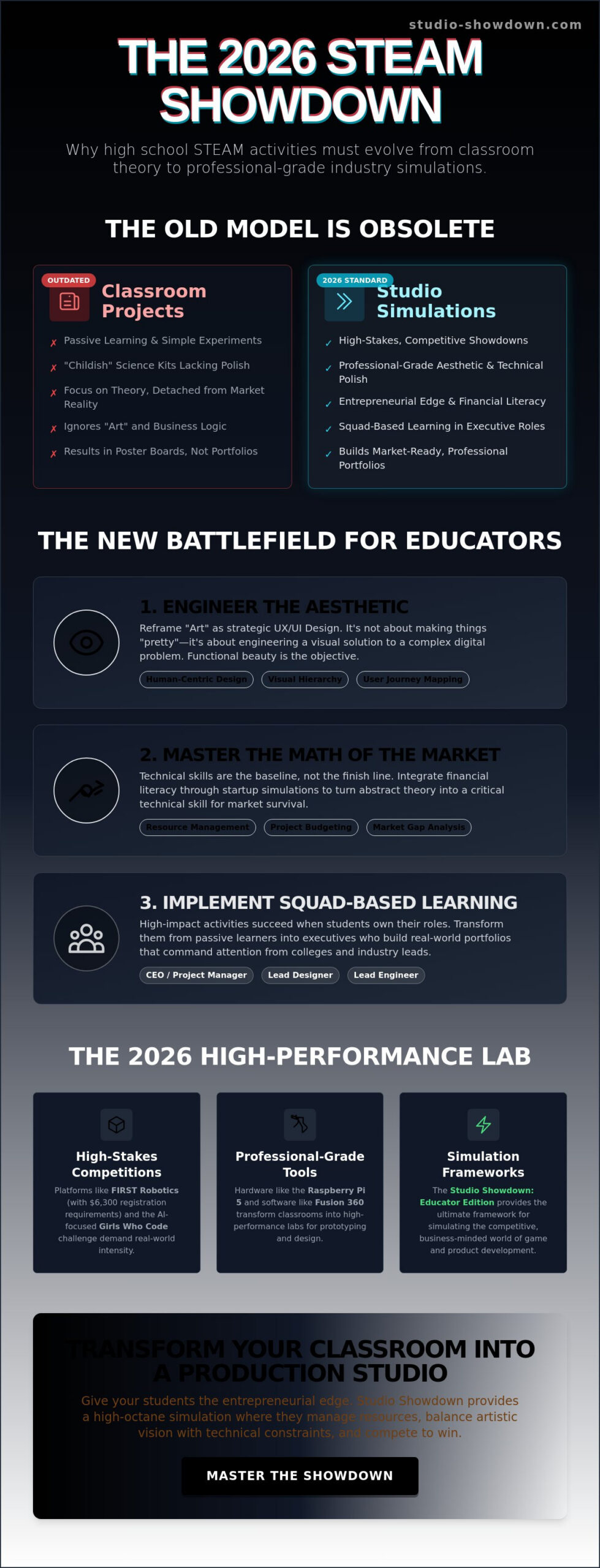
The old model of the high school science fair is obsolete. In 2026, students don’t need poster boards; they need prototypes. They don’t need “demonstrations” that work once in a controlled environment; they need high-stakes simulations that force them to fail, pivot, and eventually conquer. Effective STEAM activities for high schoolers must now act as a bridge between classroom theory and the high-pressure reality of the professional market. We are no longer just teaching facts. We’re building the next generation of creative strategists who can navigate a project from a raw concept to a market-ready win.
Modern industry doesn’t separate the “tech” from the “look.” Every successful product in the 2026 landscape is a result of technical rigor meeting creative strategy. If a project lacks aesthetic polish, it fails the user. If it lacks technical depth, it fails the mission. This intersection is the new battlefield for educators. We have to move past simple experiments and start asking students to build portfolios that actually command attention from college recruiters and industry leads.
The Shift from STEM to STEAM
Traditional STEM focused on the “how” of engineering. Adding the “Art” component focuses on the “who.” It introduces human-centric design. It turns a functional circuit into a desirable product. Industry giants like Apple and Tesla are the ultimate examples. They don’t just sell technology; they sell a visual experience and a lifestyle. This is the core of STEAM education in the modern era. Art isn’t an elective anymore. It’s a functional requirement for any product that hopes to survive the visual noise of the global market. The 2026 standard is a perfect fusion of aesthetic brilliance and technical utility.
Meeting the 2026 Career Landscape
The job market has shifted. Technical skills are now the baseline, not the finish line. Today’s employers hunt for critical thinking, the ability to pitch an idea, and the savvy to manage a project budget. Passive learning is a trap for 16-18 year olds. If they aren’t building a professional-grade portfolio now, they’re already behind the curve. High-impact STEAM activities for high schoolers must include the “business” of the tech. They need to understand resource management, market gaps, and the art of the pitch.
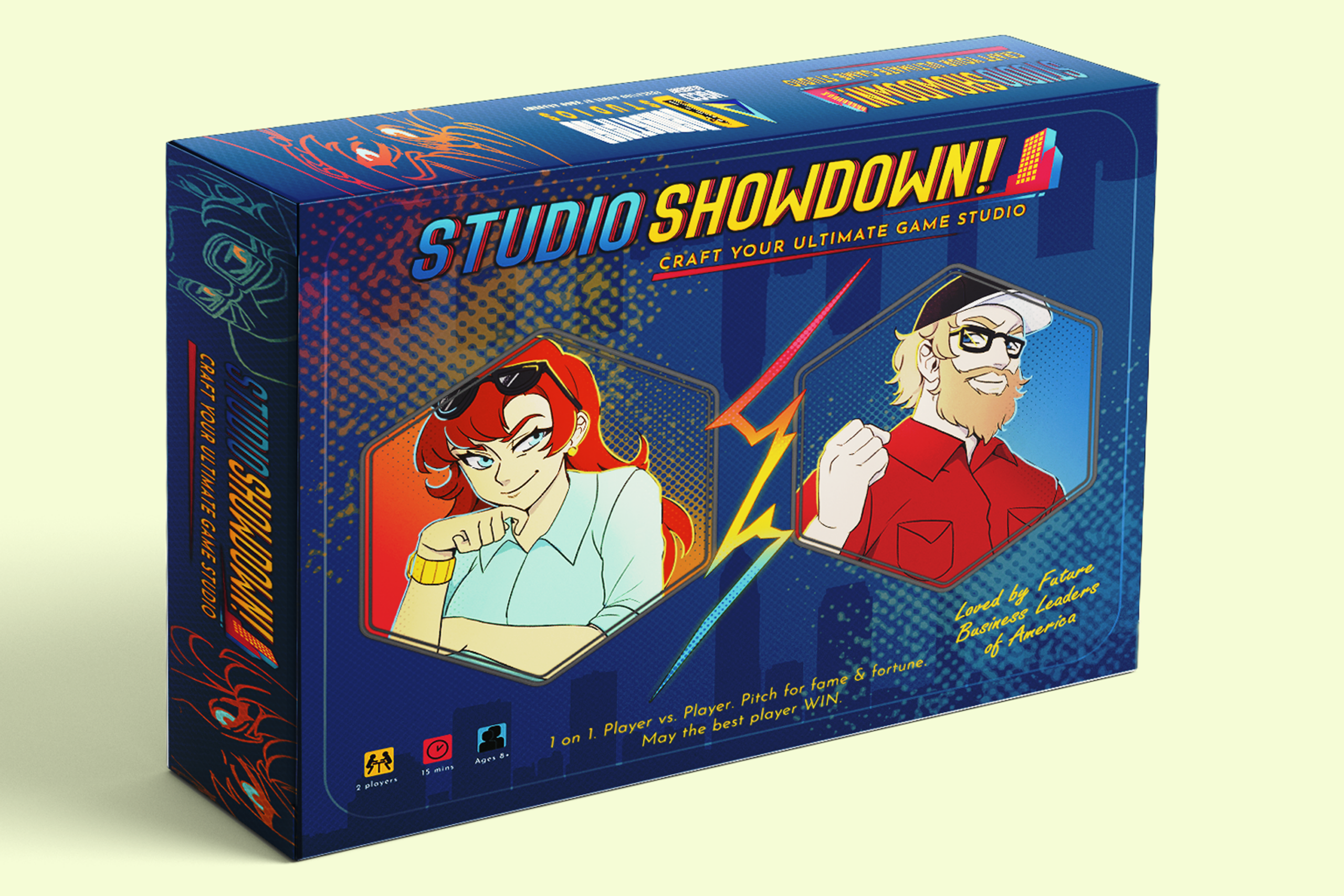
This is why tools like the Studio Showdown: Educator Edition are becoming essential in the classroom. It isn’t just a game. It’s a high-octane simulation of the production world. It forces students to make the same hard choices as a studio lead. They manage resources. They balance artistic vision with technical constraints. They compete to win. By the time they reach college, they won’t just have a list of completed classes. They’ll have the mindset of a professional creator who knows how to rise above the noise.
Engineering the Aesthetic: Integrating Art into Technology
Art isn’t an ornament. It’s an engine. In high-level production, “pretty” is just the baseline; “functional beauty” is the real objective. For modern STEAM activities for high schoolers, we have to rebrand the ‘A’ as User Experience (UX) and User Interface (UI) design. This isn’t about subjective taste or “coloring in” a project. It’s about the technical precision of how a human interacts with a complex machine. When a student designs an interface, they aren’t just making art. They’re engineering a solution.
Integrating the physics of color and light is essential for digital production. Students should analyze how light wavelengths affect visibility across different screen types and environments. This is where optics meets aesthetics. Artistic intuition becomes a tool to solve engineering bottlenecks. If a user can’t navigate a system, the engineering has failed. By teaching students to use visual hierarchy to guide a user’s eye, we give them a professional edge that most standard science kits completely ignore.
One high-impact activity involves designing a physical interface for a complex digital problem. Challenge your students to think beyond the standard touch screen. How would they design a tactile control system for a deep-sea rover? They must account for the ergonomics of the human hand and the physics of the materials used. This forces them to balance artistic vision with the cold reality of technical constraints.
UX Design as a Technical Discipline
Mapping a user journey is a cocktail of psychology, art, and logic. It’s a technical blueprint for human behavior. Students should take a common household object and redesign it for maximum efficiency and high-end style. Every curve has a purpose. Every button placement has a cost. In 2026, students can leverage the free 1-year renewable educational license for Autodesk Fusion 360 to model these designs. They’ll quickly see that a design choice isn’t just a sketch; it’s a manufacturing variable that impacts production costs and user satisfaction.
Visual Storytelling in Product Development
Engineers who can’t tell a story don’t get funded. It’s that simple. Concept art isn’t just for movies. It’s a blueprint for reality. Students need to build a consistent “visual language” for their projects to stand out in a crowded market. This builds a brand. If you want to see how this competitive edge works in a high-stakes environment, the Studio Showdown board game provides a perfect simulation. It forces students to balance these artistic assets against tight production timelines and technical requirements.
The Math of the Market: Financial Literacy as a STEAM Core
Math isn’t just about calculating the load-bearing weight of a bridge or the resistance of a circuit. In the professional world, math is the language of survival. Most STEAM activities for high schoolers miss the mark because they ignore the “Math of Money.” They teach students how to build the tool but not how to fund the lab. Financial literacy is the hidden ‘M’ in STEAM. Some critics ask if business really belongs in a technical curriculum. The answer is simple. Business is the engine that funds the science. It’s pure data. It’s probability. It’s calculated risk. Without it, the most brilliant invention never leaves the drawing board.
Calculating the “Burn Rate” of a tech startup is a high-impact way to bring this to life. In this simulation, students start with a fixed seed investment. They have to account for server costs, manufacturing fees, and team salaries. They watch the numbers drop every month. It’s a race. They have to reach profitability or secure a new round of funding before the cash hits zero. This isn’t a dry lecture. It’s a high-stakes battle. If the math fails, the project dies. This is the ultimate reality check for any aspiring creator who wants to move beyond the classroom.
Entrepreneurship and Strategic Math
Technical rigor must meet market logic. Students should learn to calculate the Return on Investment (ROI) for every design choice. In the game industry, this math extends to balancing mechanics. They adjust variables to ensure the player experience is rewarding yet sustainable. It’s a complex equation of probability, time, and reward. For a deeper dive into how these systems function in high-stakes environments, check out our guide on Mastering the Board: The 2026 Guide to Strategy Board Games. Understanding these systems is a mandatory skill for the 2026 professional landscape.
Pitching and Fundraising Simulations
The “Pitch” is a scientific process. It’s about using hard data to eliminate investor doubt. A “Shark Tank” style showdown is one of the most effective STEAM activities for high schoolers. Students present their tech products to a panel of “investors.” They can’t just say their idea is “innovative.” They need the numbers to prove it. They must identify the market gap and justify their resource allocation. This simulation teaches the logistics of bringing a creative vision to market. It forces them to be architects of a business, not just builders of a product. In the 2026 economy, this dual-threat capability is the only way to win.
High-Stakes Collaborative Projects: Building Real-World Portfolios
Individual lab reports are a relic of the past. In the professional world, nobody works in a silo. Success is a team sport. High-impact STEAM activities for high schoolers must reflect this reality by utilizing “Squad-Based” learning. By assigning specific roles like CEO, Lead Designer, and Lead Engineer, you transform a classroom into a high-functioning production studio. This structure forces students to communicate across disciplines. The engineer must explain technical limitations to the designer. The CEO must balance the artistic vision with the project’s “burn rate” and deadlines. It’s messy. It’s difficult. It’s exactly what the industry demands.
Building a professional-grade portfolio requires a structured, four-step offensive. First, students must identify a complex market problem or a genuine tech gap. Second, they prototype a solution using their cross-disciplinary skills. Third, they enter the testing phase. Documentation of the failure and success cycle is critical here; a portfolio that shows how a student pivoted after a technical crash is far more valuable than one that only shows a perfect result. Finally, they present a polished piece that proves they can handle the pressure of a real-world project.
Simulating the Studio Environment
Setting up a “Development Studio” in the classroom changes the stakes. Deadlines are no longer just dates on a calendar; they are production milestones. Students must learn to kill “feature creep,” the tendency to add unnecessary bells and whistles that drain resources. Peer review sessions should be rebranded as professional critique sessions. This isn’t about being nice. It’s about being effective. Learning to give and take hard, technical feedback is a mandatory skill for any student aiming for a top-tier career in 2026.
Analog Prototyping for Digital Success
The best digital systems often start on paper. Paper prototyping is a high-level technical skill that allows for rapid iteration without the overhead of code. It’s faster. It’s smarter. An excellent activity is having students create a board game version of a complex digital system. This forces them to define the logic and mechanics of their project before a single line of code is written. For more ways to integrate these tactile methods, explore our Screen-Free Activities for Teens and Families guide. Once the analog logic is solid, the digital execution becomes a precision strike. If you’re ready to bring this level of professional intensity to your students, the Studio Showdown Classroom Bundle is the ultimate tool for simulating these high-stakes showdowns.
Mastering the Studio Showdown: A New Era of STEAM Learning
Innovation isn’t found in a textbook. It’s forged in the heat of competition. Studio Showdown represents the next evolution of STEAM activities for high schoolers. It isn’t just a board game. It’s a high-octane simulation of the global game development industry. In 2026, the gap between “play” and “professional acumen” must vanish. While traditional labs focus on isolated technical skills, this platform forces students to integrate art, tech, and business into a single, cohesive strategy. It’s about more than just building a product. It’s about dominating a market.
The game strips away the safety net. Students must master fundraising to keep their production lights on. They must execute strategic outmaneuvering to beat rival studios for limited market share. They face the same brutal pressures as real-world founders. This experience transitions seamlessly from the game board to a professional business portfolio. Through these STEAM activities for high schoolers, students learn that market dominance isn’t an accident. It’s the result of technical precision meeting bold, artistic vision. When a student can explain how they managed a production crisis or pivoted their design strategy to capture a market gap, they aren’t just a student anymore. They are a professional in training.
The Board Game as a Career Simulator
Think of this as a professional workshop in a box. Studio Showdown forces players to navigate the “Founder’s Dilemma” in real-time. Do you prioritize artistic perfection or technical stability? Do you burn through cash for a quick launch or play the long game? These are the questions that define a career. For those ready to dive deep into these mechanics, The Ultimate Business Board Game guide breaks down how to master these entrepreneurial skills. It’s about building the mental muscle required for the 2026 economy. It turns abstract business concepts into tangible, high-stakes decisions.
Bringing the Showdown to Your Classroom
Integration is seamless. The Studio Showdown: Educator Edition and our specialized Classroom Bundles are designed to fit directly into existing STEAM and Business curricula. We provide the technical framework. Your students provide the ambition. This isn’t just a minor addition to your lesson plan; it’s the centerpiece of a modern, portfolio-driven education. It provides a structured environment where students can test their theories without real-world financial ruin. They learn from failure. They iterate. They win. Stop teaching theory in a vacuum. Start simulating the real world. Equip your students for the ultimate challenge with Studio Showdown and watch them rise above the visual noise of the competition.
Conquer the Professional Frontier
The era of passive learning is over. High schoolers in 2026 need more than just theory. They need the grit of real-world production. We’ve explored how rebranding art as UX design and math as financial literacy transforms the classroom into a high-octane studio. These STEAM activities for high schoolers are the blueprints for building portfolios that demand respect from universities and industry leads alike. Every project must be a showdown. Every failure must be a lesson in iteration. It’s about moving past the “science fair” and entering the production house.
It’s time to bridge the gap between play and professional success. Developed by VGCD Academy and DEMYSTIFIED Studios, our tools are designed specifically for the competitive world of game development. Educators use these simulations to teach real-world business acumen through high-stakes strategy. Don’t let your curriculum fall behind the visual noise of the modern market. Equip your classroom with the intensity of a real production house and watch your students thrive.
Build Professional Portfolios with the Studio Showdown Classroom Bundle
Don’t just prepare your students for the future. Give them the tools to own it.
Frequently Asked Questions
What are the best STEAM activities for high schoolers without using screens?
Tactile prototyping is the gold standard for screen-free engagement. Students can design physical board games to model complex digital logic or build ergonomic control interfaces using clay and wood. This approach strips away the digital noise. It forces a focus on core mechanics and human-centric design. These projects prove that technical thinking doesn’t require a monitor to be professional.
How do you integrate ‘Art’ into a high school STEM curriculum?
Reframe Art as a functional technical requirement rather than an elective. Instead of “coloring in” a project, students should focus on User Experience (UX) and User Interface (UI) design. Every aesthetic choice must serve a specific technical purpose. This turns a simple engineering project into a market-ready product that speaks to the user through visual hierarchy and clarity.
Can board games really teach professional business and STEAM skills?
High-level strategy board games serve as elite simulators for the professional world. They force players to manage tight budgets, navigate resource scarcity, and execute complex project timelines. These STEAM activities for high schoolers bridge the gap between classroom theory and the high-stakes reality of the production studio. It is about strategic outmaneuvering, not just casual play.
What is the difference between STEM and STEAM for older students?
STEM provides the technical “how,” while STEAM introduces the critical “who” and “why.” For 16-18 year olds, the “Art” component represents the bridge to the market. It adds human-centric design and creative strategy to raw technical data. This shift ensures the output isn’t just functional. It makes the final project desirable and competitive in a professional landscape.
How can high schoolers build a professional portfolio through STEAM projects?
A professional portfolio must document the entire failure and success cycle of a project. Students should showcase their initial prototypes, the technical bottlenecks they encountered, and the specific pivots they made to succeed. High-impact STEAM activities for high schoolers result in tangible artifacts like 3D models or business pitch decks that prove their readiness for the industry.
Are there STEAM activities that focus on entrepreneurship and game design?
Studio simulations are the most effective way to combine these two disciplines. Students can identify a market gap in the current gaming industry and develop a full production plan. This includes calculating the “burn rate” of their simulated studio and pitching their concept to a panel. It’s a battle for market dominance that requires technical logic and business savvy.
How do I choose a STEAM project that is challenging enough for grade 12?
Select projects that mirror the complexity and pressure of the professional world. Grade 12 students need high-stakes simulations where failure has real consequences for the project’s success. Look for activities that require cross-disciplinary collaboration, such as those found in the Studio Showdown: Educator Edition. If the project doesn’t force them to balance a budget against a creative vision, it isn’t challenging enough.