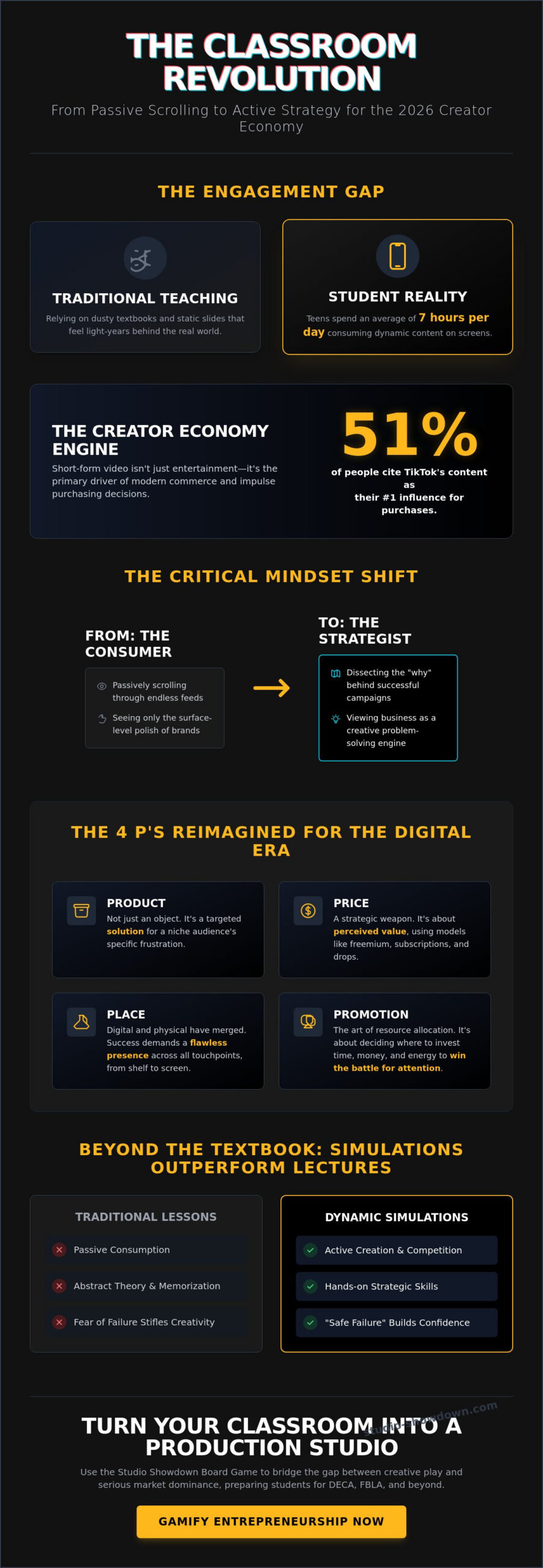
51% of people now cite TikTok’s short-form content as the primary reason for their impulse purchases. Teens aren’t just scrolling; they’re the fuel for the modern creator economy. Yet, many business classrooms still rely on dusty textbooks and static slides that feel light-years behind the real world. Teaching marketing strategy to teens requires more than a lecture on the four Ps. It demands a shift from passive consumption to active competition.
You know that keeping students engaged is a constant battle when their smartphones offer a more vivid reality than your curriculum. It’s tough to explain the “why” behind market positioning when students only see the surface-level polish of social media. This guide shows you how to transform abstract concepts into high-stakes strategic skills. You’ll discover how to use hands-on tools like the Studio Showdown Board Game to build professional portfolios, foster a founder mindset, and prepare your students for the 2026 DECA and FBLA competitive seasons. It’s time to turn your classroom into a high-octane production studio where every student learns to think like a creator and win like a CEO.
Key Takeaways
- Shift the classroom focus from passive consumption to proactive creation by treating marketing as a high-stakes resource allocation game.
- Master the art of teaching marketing strategy to teens using modern competitive intelligence and a tech-forward 4 Ps framework.
- Replace outdated textbooks with dynamic simulations to provide the “safe failure” environment necessary for building entrepreneurial confidence.
- Follow a precise two-phase workshop model to guide students from raw market research to a polished, professional strategy.
- Utilize the Studio Showdown Board Game to bridge the gap between creative play and serious market dominance.
Why Teaching Marketing Strategy to Teens is Essential in 2026
In 2026, marketing isn’t a side hustle. It’s the core language of the global economy. Most teens are already experts at consuming content. They spend an average of seven hours per day in front of a screen. But there’s a massive gap between liking a post and understanding the mechanics behind it. Teaching marketing strategy to teens bridges this divide. It moves them from the sidelines of the economy to the center of the arena. Strategy is no longer just for corporate boardrooms. It’s for anyone with a smartphone and an idea.
At its heart, strategy is the art of resource allocation. It’s about deciding where to put your time, money, and creative energy to achieve a specific goal. By mastering the core principles of marketing strategy, students learn to navigate competitive positioning. They stop seeing businesses as monoliths. They start seeing them as systems. This is where financial literacy meets creative execution. Positioning. Pricing. Promotion. Placement. These aren’t just words. They’re levers of power in a digital world where attention is the most valuable currency.
From Consumer to Creator: The Mindset Shift
Teens already know the brands they love. They don’t need a textbook to tell them which sneakers are trending. They need to know the “why” behind the hype. Why did a specific brand choose that creator? Why did they use that specific aesthetic? We need to flip the script. Instead of scrolling through an endless feed, students must learn to dissect it. This transition from “scrolling” to “strategizing” is transformative. It empowers students to view business as a creative problem solving engine. They aren’t just buying products anymore. They’re analyzing how products solve problems and capture markets.
The Competitive Advantage of Early Business Education
The 2026 job market doesn’t value what you’ve memorized. It values what you can build. Strategic thinking is the ultimate transferable skill. It fosters critical thinking. It sharpens data interpretation. When students learn to build a marketing plan, they’re building a professional portfolio before they even graduate high school. This is vital in a creator economy where 51% of people identify TikTok’s short-form content as their primary influence for purchases. Everyone is a brand now. Whether they want to be founders or high-level employees, understanding how to cut through the visual noise is their greatest weapon. It’s about impact, influence, and winning the battle for attention.
The Core Pillars of Modern Marketing Strategy for High Schoolers
The foundation of any successful venture isn’t luck. It’s structure. When teaching marketing strategy to teens, we must move beyond the surface level of viral trends. We need to look at the skeletal system of a business. It starts with Market Segmentation. Think about the gaming world. A strategy for a hardcore PC gamer looks nothing like one for a casual mobile player. They inhabit different ecosystems. They have different pain points. The same logic applies to fashion and tech. Understanding these micro-communities is the first step toward market dominance. It’s about finding your people and speaking their language.
Next comes the Value Proposition. This is the “why.” In a world of infinite choices, why should a customer pick your brand over a rival? It’s about solving a specific problem better, faster, or more creatively than anyone else. This leads directly to Brand Authority. You don’t just declare authority. You build it through consistent, high-quality execution. It’s the professional difference between a one-hit wonder and a legacy studio. Students need to see that every post, every product, and every price point is a brick in that foundation.
The 4 Ps Reimagined for the Digital Era
The traditional 4 Ps need a 2026 upgrade to stay relevant. Product is no longer just a physical object on a shelf. It’s a solution for a niche audience’s specific frustration. Price has evolved into a strategic weapon. We see freemium models, tiered subscriptions, and premium drops. It’s not just “cost plus” anymore; it’s about perceived value. Place and Promotion have effectively merged. A brand’s digital presence must reflect its physical reality flawlessly. Every touchpoint is a chance to win or lose the crowd. To see these dynamics in action, educators often use tools like the Studio Showdown: Educator Edition to bring these abstract concepts into the physical classroom.
Competitive Positioning: Winning the Market Showdown
Competitive Intelligence is your radar. You need to know exactly what rivals are doing. You don’t watch them to copy their moves. You watch them to outmaneuver them. This is how you find “Blue Ocean” opportunities. These are the gaps in the market where competition is irrelevant because your offering is unique. Pitching and fundraising are the high-stakes tools that turn this vision into a reality. They require a clear, punchy narrative that commands attention and secures resources. Competitive positioning is the unique space a brand occupies in the mind of the consumer. It is the territory you defend and the hill you’re willing to climb to win the battle for attention.
Beyond the Textbook: Why Simulations Outperform Traditional Lessons
Passive learning is a relic. Reading about competitive positioning in a textbook is like trying to learn how to drive by watching a documentary. It doesn’t work. When teaching marketing strategy to teens, we have to acknowledge that their world is interactive by default. Traditional lectures fail because they lack consequence. If a student ignores a market trend in a chapter summary, nothing happens. If they ignore that same trend in a high-stakes simulation, they lose their lead. This is the “Safe Failure” environment. It allows students to take risks, fail fast, and iterate without real-world financial ruin.
High-quality business simulation games build long-term retention by engaging the emotional brain. We remember the sting of a lost market share far longer than a bullet point on a slide. While digital simulations have their place, they often compete with the very distractions we’re trying to overcome. Analog tools bring the competition into the physical room. They force students to look each other in the eye, read body language, and respond to shifts in real time. It’s the difference between playing a video game and being in the arena.
The Power of Gamified Entrepreneurship
Game mechanics like risk and reward are perfect mirrors for the business world. Every turn is a decision. Every decision has a ripple effect. This encourages constant iteration. In a game, “losing” isn’t a dead end. It’s a data point. It’s a vital marketing lesson that teaches students to pivot their strategy based on what the competition is doing. Beyond the numbers, these games build essential social and negotiation skills. You can’t automate a handshake or a persuasive pitch. These are the soft skills that define the next generation of founders. They learn to read the room, not just the spreadsheet.
Analog Strategy in a Digital World
In an age where the average teen spends seven hours a day on a screen, screen-free activities offer a necessary cognitive reset. They help students focus on core logic without the visual noise of notifications. Managing physical resources, like tokens or market share markers, provides a tactile benefit that digital sliders can’t replicate. It makes the abstract concrete. It also develops a “poker face.” In a live competitive environment, students learn to control their reactions and negotiate under pressure. They aren’t just learning business. They’re learning human psychology and the art of the deal.
How to Implement a Marketing Strategy Workshop: A Step-by-Step Guide
Stop lecturing. Start building. A workshop isn’t a long talk; it’s a sprint toward a goal. When teaching marketing strategy to teens, the structure must be as lean and professional as a startup incubator. You aren’t just filling time. You’re building a laboratory for high-stakes decisions. This process requires a clear, five-phase framework that moves students from raw data to a finished campaign. It’s about giving them the keys to the studio and letting them drive.
- Phase 1: Market Research. Identify the target “player” or customer. Students must look past their own preferences to find actual market gaps.
- Phase 2: Strategy Development. Build the 4 Ps around a core product. This is where the pillars from earlier sections become a concrete plan.
- Phase 3: The Pitch. Present the strategy to “investors” or peers. This is the showdown where ideas are tested.
- Phase 4: The Execution. Simulate a market launch. Use real-time variables to force students to react to rival moves.
- Phase 5: Post-Mortem. Analyze the data. What worked? What failed? This autopsy is where the deepest learning happens.
Setting the Stage for Competition
The environment dictates the energy. Transform your classroom into a “Studio” where students act as founders, not just pupils. Define a clear “Win Condition” for the campaign. Is it market share? Is it brand authority? Assign specific roles: CEO, CMO, and Lead Strategist. This creates accountability. It mirrors the production flow of the creative industry. When everyone has a stake in the outcome, the uninspired “busy work” of traditional business classes disappears. To jumpstart this transformation, many educators implement a Classroom Bundle to provide a ready-made competitive framework.
The ‘Pitch’ as a Strategic Tool
Confidence is a skill that’s built under pressure. Teaching teens to communicate complex ideas isn’t just about public speaking. It’s about strategic defense. During the pitch phase, encourage peers to act as “sharks” who ask tough questions about pricing or positioning. Handling these objections forces students to defend their logic with data. It prepares them for the 2026 DECA or FBLA competitive seasons where every word counts. The perfect pitch is the intersection of data and story. It’s where the technical professionalism of a marketer meets the artistic bravery of a creator. By the end of this workshop, your students won’t just know the definitions; they’ll have the scars and successes of a real strategic launch.
Studio Showdown: Gamifying Entrepreneurship and Market Dominance
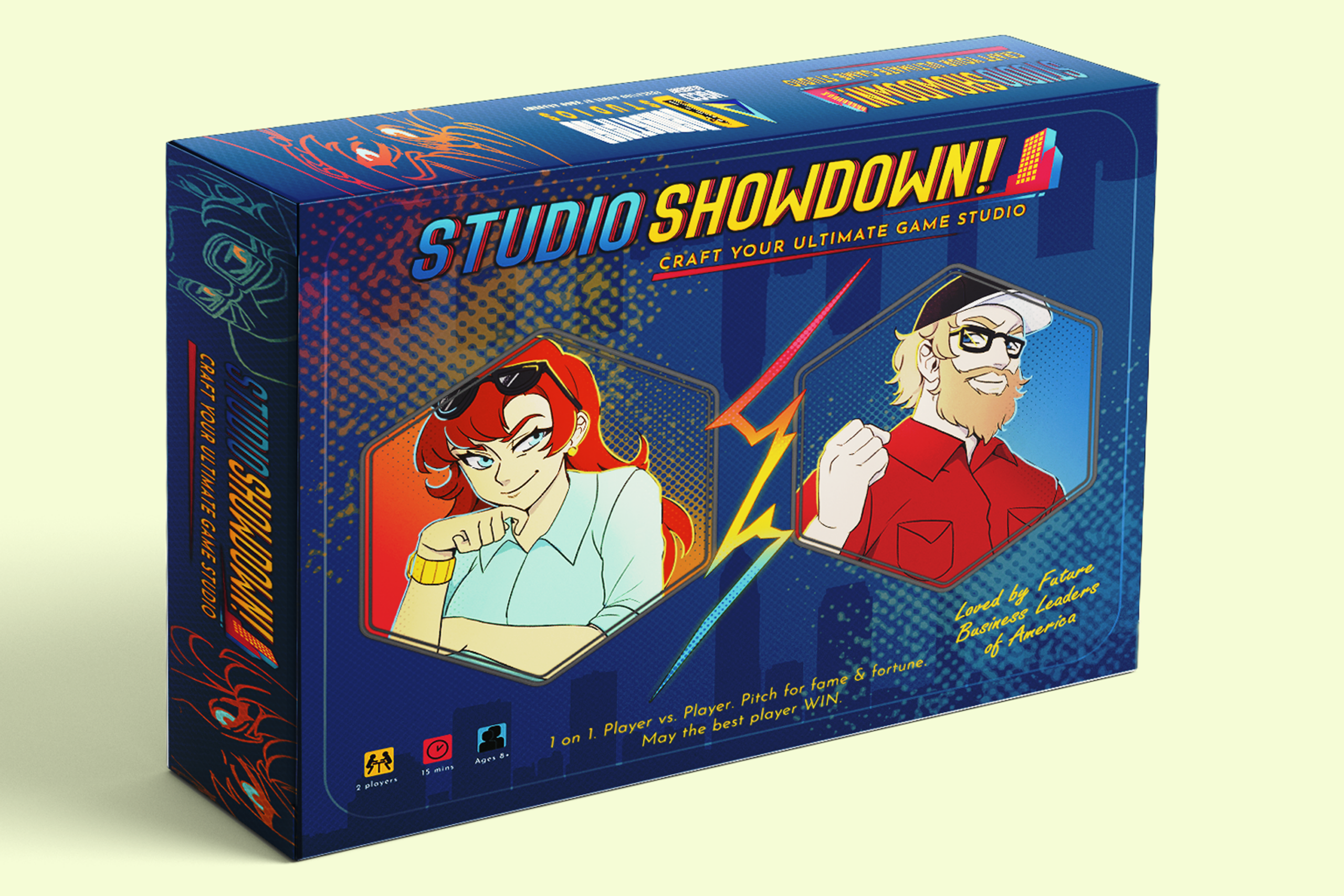
Traditional business education is often too generic. It lacks the “cool factor” that keeps students in their seats. When teaching marketing strategy to teens, you need a hook. The video game industry is that hook. It’s fast. It’s hit-driven. It’s a high-stakes arena where only the best strategists survive. Studio Showdown acts as the definitive bridge between game design and business logic. Students aren’t just players. They’re studio founders navigating a cutthroat market. By teaching marketing strategy to teens through this lens, you’re giving them a competitive edge they won’t find in a textbook.
The mechanics within these strategy board games go beyond simple luck. They force students to master fundraising and pitching. They have to convince the table that their vision is worth the investment. This isn’t a drill. It’s a simulation of real-world competition. For schools and institutions, the Educator Edition and Classroom Bundles provide a scalable way to bring this intensity into every classroom. It’s a turnkey solution for modern entrepreneurial education. It turns the classroom into a production floor where every decision counts.
Mastering the Business of Video Games
The gaming world is the perfect case study. It’s a massive industry that relies on a mix of technical skill and marketing brilliance. Students learn to outmanoeuvre rivals by identifying market gaps and timing their releases. We’ve moved past the era of simple, luck-based games. Today, Studio Showdown represents the next level of classroom engagement. It demands strategic mastery. It requires a deep understanding of the 4 Ps in a context that teens actually care about. They aren’t just learning to sell; they’re learning to dominate a market.
Building Portfolios Through Play
This isn’t just about having fun. It’s about building a foundation for the future. The decisions made during a game session translate directly to real-world business acumen. Students prepare for STEM and business careers simultaneously. They learn the logic of production and the art of the sale. They leave the classroom with a founder’s mindset and a portfolio of strategic wins. This is how you prepare the next generation for a competitive digital economy. Ready to bring a showdown to your classroom? Explore the Studio Showdown Educator Edition.
Master the Arena of Entrepreneurial Education
The 2026 business landscape belongs to those who can out-strategize the noise. We’ve moved beyond the era of passive learning. By shifting students from consumers to creators, you’re giving them more than just grades. You’re giving them a seat at the table. Teaching marketing strategy to teens is about providing the tools to navigate high-stakes competition with confidence and artistic bravery. It’s time to replace lectures with the pulse of real-world decision making.
Professional portfolios aren’t built through memorization. They’re built through the rigorous, safe failure of simulation. Developed by VGCD Academy and DEMYSTIFIED Studios, our framework focuses on the explosive growth of the game development industry. This isn’t just theory. It’s a proven method for building business acumen that stays with students long after they leave the classroom. Educators are already using these tools to bridge the gap between STEM and entrepreneurship.
Ready to transform your classroom into a high-octane production studio? Equip your students for the future with the Studio Showdown Classroom Bundle. Let’s turn your students into the founders and strategists the world is waiting for. The competition is already moving. Don’t let your curriculum fall behind.
Frequently Asked Questions
What is the best age to start teaching marketing strategy to kids?
Early teens, specifically between the ages of 12 and 14, represent the ideal window for introducing strategic business concepts. At this stage, students possess the cognitive maturity to grasp abstract ideas like resource allocation while remaining highly engaged by creative, competitive frameworks. Starting early ensures they view the digital world through the lens of a strategist rather than just a passive consumer.
Can board games really teach complex business concepts like fundraising?
Board games are exceptionally effective because they provide immediate, tangible consequences for every strategic decision. Unlike digital tools that can feel disconnected, analog games force players to look each other in the eye during a negotiation or a pitch. This builds the “muscle memory” of fundraising by requiring students to justify their spending and defend their market position against live rivals in real time.
How do I integrate marketing strategy into a STEM curriculum?
Marketing strategy is essentially applied data science and human psychology. In a STEM environment, you can position the “Marketing Mix” as a system of variables that require constant optimization. By teaching marketing strategy to teens within a technical context, you show them that a great product only succeeds if the delivery system and market positioning are as precisely engineered as the code itself.
What are the most important marketing skills for teens to learn in 2026?
The top skills for the 2026 economy include competitive intelligence, niche market segmentation, and the ability to interpret real-time data trends. Teens must learn to see past viral hype to understand the underlying mechanics of consumer behavior. Mastering the art of the pitch and clear, punchy communication remains the ultimate differentiator for teaching marketing strategy to teens in a crowded digital marketplace.
How does Studio Showdown differ from traditional business simulations?
Studio Showdown replaces generic corporate scenarios with the high-octane world of game development. While traditional simulations often feel like glorified spreadsheets, this game focuses on the “showdown” aspect of market dominance. It’s a tactile, face-to-face experience that prioritizes strategic bravery and creative problem solving over dry, repetitive data entry.
Do students need prior knowledge of the video game industry to play?
No prior expertise in the video game industry is required to excel at the game. The mechanics are built on universal business logic that applies to any creative field. Students learn the industry-specific rules as they play, making it an accessible and exciting entry point for anyone interested in entrepreneurship, production, or high-level strategy.
Is there a version of Studio Showdown specifically for schools?
We offer the Studio Showdown: Educator Edition and the Classroom Bundle specifically designed for institutional use. These versions include specialized guides to help teachers facilitate sessions and map game outcomes to national curriculum standards. They’re built to turn any classroom into a professional production studio with minimal setup time and maximum student engagement.