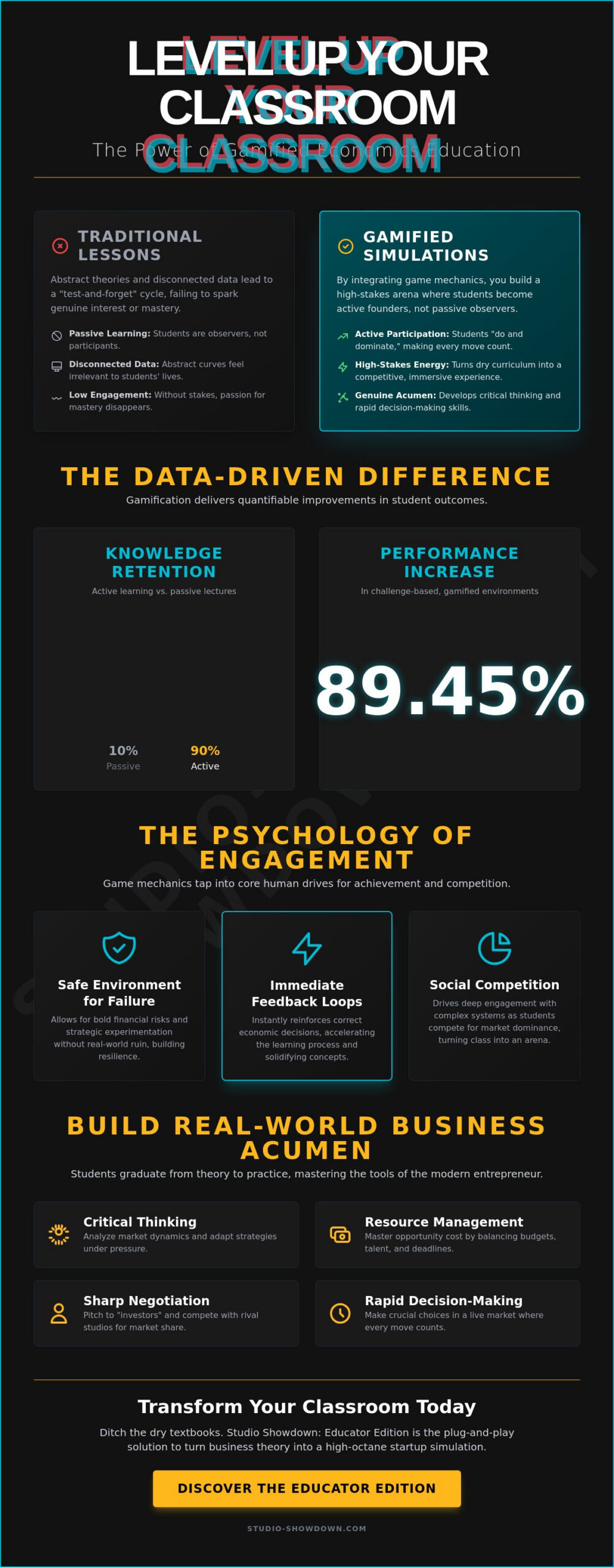
What if your students’ obsession with gaming became your most powerful teaching tool? It’s a frustrating reality: students manage complex virtual empires at home but struggle with basic ROI in the classroom. You need a way to make theory move at the speed of the modern world. By implementing gamified lesson plans for economics, you can leverage the 89.45% performance increase seen in challenge-based environments. Economics is the engine of the gaming world. When you teach the engine, your students finally master the machine.
You’re looking for a way to ditch the textbooks and bring high-stakes energy to your curriculum. We’ve designed a roadmap to help you do exactly that. Discover how to turn dry business theory into a high-octane startup simulation that builds genuine business acumen. We’ll preview the Studio Showdown: Educator Edition and show you how this “plug-and-play” solution creates an arena for strategy, fundraising, and victory. Let’s elevate your teaching from a standard lecture to a premium, immersive experience that demands total classroom participation.
Key Takeaways
- Learn how to boost knowledge retention to 90% by replacing passive lectures with active, high-stakes business simulations.
- Master the strategy behind building gamified lesson plans for economics that use the video game industry as a sandbox for teaching ROI and resource management.
- Discover why analog board games outperform digital tools by forcing students to engage directly with the math and logic of business strategy.
- Get a practical, two-step framework for selecting and integrating strategy games into your existing entrepreneurship curriculum.
- See how Studio Showdown: Educator Edition transforms complex fundraising and development cycles into a competitive, classroom-ready experience.
The Power of Gamified Lesson Plans for Economics
Gamification isn’t just a buzzword; it’s a strategic overhaul of the classroom experience. It involves the precise integration of game mechanics into non-game contexts to drive specific behaviors. In the world of pedagogy, the gamification of learning transforms passive observers into active participants. Research indicates that active learning increases student retention by up to 90% compared to traditional lectures. When you implement gamified lesson plans for economics, you aren’t just teaching formulas. You’re building an arena. Economics becomes a high-stakes competition. It’s no longer a series of static charts; it’s a live market where every move counts.
This approach does more than help students remember terms. It forces them to evolve. They develop critical thinking, sharp negotiation skills, and the ability to make rapid decisions under pressure. These are the tools of the modern entrepreneur. Classroom dynamics shift from “tell and test” to “do and dominate.” Engagement isn’t a luxury; it’s the requirement for mastery.
Why Traditional Economics Lessons Often Fail
Traditional methods treat economics as a post-mortem of dead data. Abstract curves like supply and demand feel disconnected from the pacy reality students live in. Passive learning. Disconnected data. Low engagement. This creates a “test-and-forget” cycle. Without emotional investment, hypothetical “Widget” companies fail to spark interest. Students don’t care about a fictional manufacturer; they care about winning. When the stakes are purely academic, the passion for mastery disappears. We need to bridge the gap between theory and the visual, fast-moving world of modern business.
The Psychology of Game-Based Learning
Game mechanics work because they mirror human drive. Immediate feedback loops reinforce correct economic decisions instantly. In a simulation, failure isn’t a grade; it’s a lesson. Safe environments for failure allow students to take bold financial risks without real-world ruin. This builds resilience. Social competition adds the final layer. It drives deep engagement with complex systems that would otherwise feel tedious. Using gamified lesson plans for economics taps into this competitive spirit. It turns a dry curriculum into a premium learning experience. Students become producers, not just consumers of information. They’re desperate to solve the next challenge and dominate the market simulation.
Simulating the Creative Economy: From Fundraising to Market Dominance
Widgets are dead. In 2026, students don’t want to calculate the equilibrium price of wheat or corn. They want to build the next global gaming phenomenon. Video game development provides the ultimate sandbox for resource management. It’s a complex ecosystem of talent, timing, and capital. By using gamified lesson plans for economics, you place students in the founder’s seat. They aren’t just reading about markets; they’re fighting for market dominance. This shifts the focus from abstract concepts to the tangible hustle of the creative economy.
Fundraising isn’t a theory here. It’s a survival skill. Pitching to investors requires more than a slide deck. It requires a firm grasp of valuation, equity, and future projections. While tools like The Fiscal Ship offer excellent simulations for macro-level policy, students also need to understand the micro-level pressure of a tech startup. They must learn to manage people, code, and hype simultaneously. Success depends on psychological strategy as much as mathematical precision. They aren’t just students anymore. They are studio founders navigating real-world industry challenges.
Teaching Opportunity Cost Through Game Development
Every decision is a trade-off. Hire a senior artist or invest in server stability? Add a multiplayer mode or launch three months early? This is the heart of opportunity cost. In a startup environment, venture capital is a finite fuel. Students must balance “scope creep” against their burn rate. They quickly learn that “polishing” a product has a diminishing ROI if the marketing budget is zero. It’s a brutal, beautiful lesson in resource allocation. They see the consequences of their choices in real-time. Action. Consequence. Evolution.
Market Competition and Rival Studios
The marketplace is a zero-sum game. Consumer attention is the rarest commodity. Students must navigate a landscape of rival studios, each vying for the same players. Strategic maneuvering is essential. They need to outpace competitors while adapting to sudden industry disruptions. Whether it’s a new tech trend or a viral competitor, the ability to pivot is what separates a unicorn from a bankruptcy. If you want to bring this level of intensity to your classroom, consider exploring the Studio Showdown: Educator Edition for a ready-to-use strategy framework.
Victory requires more than just a good product. It requires market timing. Students analyze competitor moves. They anticipate shifts. They learn that economics is a live, breathing battle. This isn’t just school. This is the start of their professional journey. They learn to ignore the visual noise and focus on the metrics that matter. Build. Pitch. Scale. Win.
Analog Strategy vs. Digital Simulations in the Classroom
Digital is efficient. It’s also invisible. Most educational software hides the “why” behind a proprietary algorithm. A student adjusts a slider, and the profit curve shifts automatically. The logic is buried. Analog strategy games do the opposite. They force students to be the algorithm. When you use analog gamified lesson plans for economics, students must perform every calculation, trade, and resource allocation manually. This manual engagement is where the “click” happens. Understanding isn’t automated; it’s earned.
Physical components provide a tactile sense of resource scarcity. Holding a finite stack of investment tokens feels different than seeing a digital balance. The weight matters. The limited space on a board matters. It creates a visceral connection to economic theory. Research into Gamification-Based Economic Learning Media shows that this level of interaction is critical for long-term retention. We’re moving beyond simple data entry into the realm of professional intuition.
The Social Factor: Negotiation and Pitching
Economics is a social science. It’s about human behavior, incentives, and the art of the deal. Analog games keep the experience social. Face-to-face negotiation builds soft skills that a screen simply cannot simulate. Students learn to read the room. They spot a rival founder’s hesitation during a trade. They experience the adrenaline of pitching a high-stakes business idea to a “board” of their peers. This isn’t just about numbers. It’s about influence. It’s about persuasion. It’s about the grit required to win in a competitive marketplace.
Durability and Classroom Management
Logistics shouldn’t kill your lesson. Digital tools often come with a side of technical debt. Software updates. Wi-Fi drops. Hardware glitches. These interruptions break the flow of learning. Analog tools are ready the moment you open the box. It’s easier for teachers to monitor five groups at once when the progress is visible on a table rather than hidden on a laptop. You eliminate the distraction of open browser tabs. You replace screen fatigue with high-energy collaboration. It’s a “plug-and-play” solution that actually works without a power outlet.
Designing Your Gamified Economics Curriculum
Designing a high-impact curriculum isn’t about adding “fun” to a lesson. It’s about engineering a system where learning is the only way to win. By 2026, the educational gamification market is projected to hit $3.19 billion. This growth isn’t accidental. It’s driven by the 60% of teachers who now recognize gamification as the most effective engagement strategy. To build effective gamified lesson plans for economics, you must move beyond play. You need a structured deployment that aligns with the 2025 National Content Standards in K-12 Economics. Follow this five-step blueprint to turn your classroom into a startup incubator.
- Step 1: Define the core economic concept. Start with a specific anchor like scarcity, ROI, or market equilibrium. The game must serve the concept.
- Step 2: Select a strategy game. Choose a tool that mirrors these mechanics. The game should force students to make the very trade-offs you’re teaching.
- Step 3: Run a Practice Round. Lower the barrier to entry. Let students make mistakes in a “pre-market” phase where the stakes are zero.
- Step 4: Facilitate a post-game debrief. This is the bridge. Connect their in-game wins and losses to real-world economic theory.
- Step 5: Transition to a professional portfolio. Move the data from the board into a business deliverable. This turns a classroom activity into a career asset.
Setting Learning Objectives for Strategy Games
Objectives must be sharp. Winning the game is a byproduct; mastery is the goal. Align your mechanics with state standards, specifically the updated 2025 CEE guidelines on technology and monetary policy. Focus on mastering the board through critical thinking and data analysis. Success is defined by a student’s ability to articulate their strategy. If they can’t explain why they made a hire, they haven’t mastered the lesson. They’ve just rolled the dice.
Assessment: From High Scores to Professional Portfolios
Ditch the multiple-choice quiz. Use game data to have students write “Annual Reports” for their fictional studios. They should reflect on financial losses as a “Founder’s Dilemma” case study. This approach builds a business board game mindset that prepares them for long-term career success. They learn to treat failure as data, not a grade. Ready to deploy a battle-tested system? Secure the Classroom Bundle to bring a professional production edge to your entrepreneurship track.
Your curriculum should be a production, not a lecture. Every step must lead to a tangible outcome. When students see their game performance translate into a professional report, their investment skyrockets. They aren’t just playing. They’re producing. They’re competing. They’re winning.
Studio Showdown: The Ultimate Classroom Strategy Tool
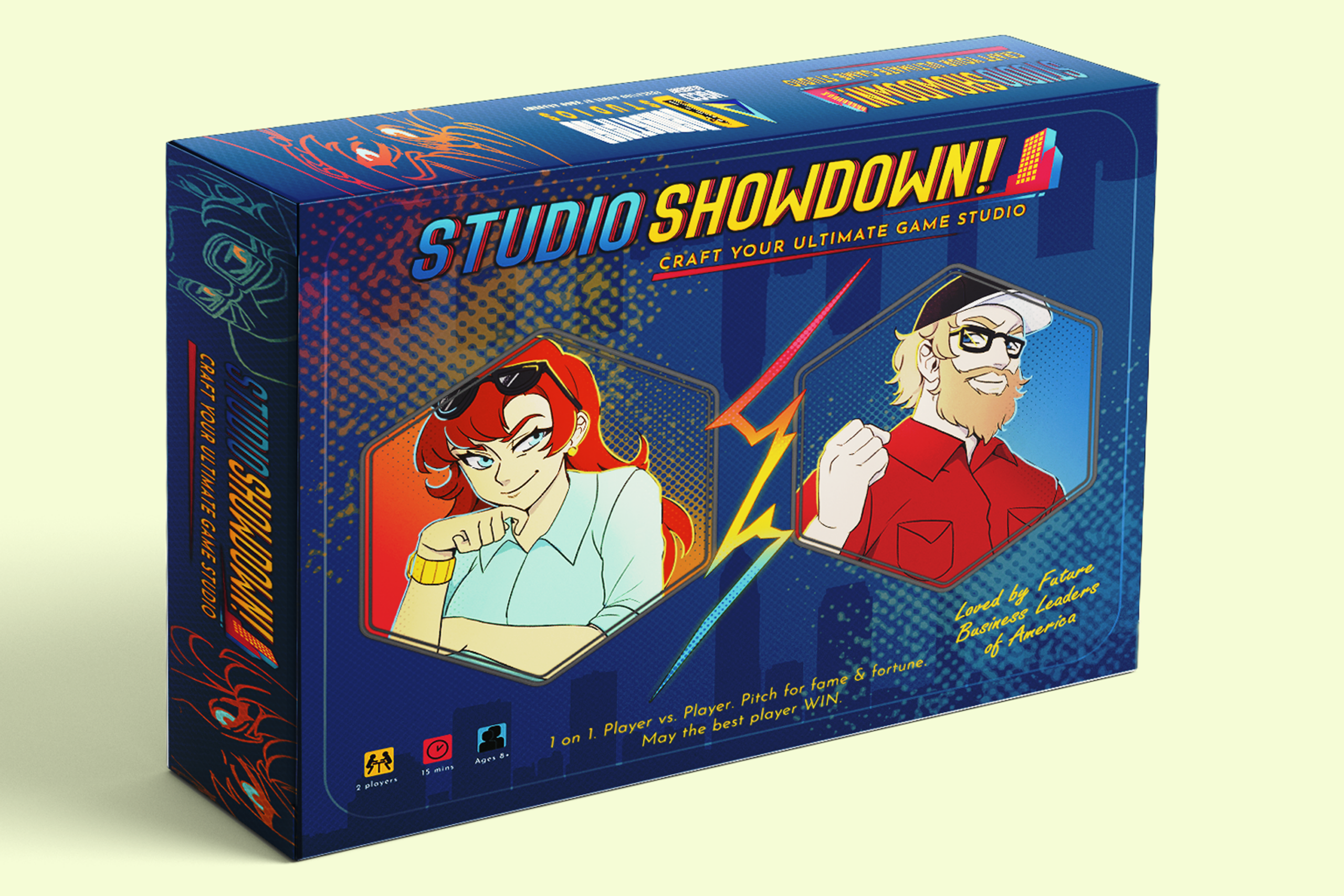
Theory meets reality. Studio Showdown isn’t just a game; it’s a high-stakes simulation of the $200B video game industry. Built by the visionaries at VGCD Academy, this tool bridges the gap between classroom textbooks and boardroom pressure. You aren’t just teaching entrepreneurship. You’re launching a studio. When you integrate Studio Showdown into your gamified lesson plans for economics, you give students a front-row seat to the chaos of production. They manage development cycles. They pitch to investors. They fight for market share. It’s fast, loud, and incredibly effective.
The design focuses on the core pillars of business: fundraising, pitching, and resource management. Students experience the grit required to move a project from a concept to a global launch. They learn that success isn’t about luck. It’s about the precision of your strategy and the strength of your pitch. This is where the abstract becomes tangible. Action leads to consequence. Consequence leads to mastery. Every round is a lesson in economic survival.
Beyond the Easy Money Game
Moving beyond the easy money game is essential for the 2026 learner. Traditional “money games” like Monopoly rely on the roll of the dice. Studio Showdown relies on the strength of the mind. It’s more than “Monopoly for gamers.” It’s a professional-grade simulation that teaches the financial risks of game development in a safe, classroom-controlled space. Students learn that one bad hire or a missed milestone can sink a project. They feel the pressure of a dwindling burn rate. They find the solution. They evolve.
Implementation and Educator Support
Scaling a premium experience for thirty students requires the right gear. The Studio Showdown: Educator Edition is built specifically for large groups. It provides the administrative tools needed to manage multiple “studios” simultaneously. For schools ready to overhaul their business track, the Classroom Bundle offers a cost-effective, institutional licensing solution. You get more than a box of components; you get a partner in the process.
We provide professional development workshops to ensure your transition into gamified lesson plans for economics is seamless and high-impact. Join a growing community of teachers using strategy board games to change lives. We’ll help you integrate these tools into your STEM or business curriculum with ease. This is the future of economic education. Don’t just teach the market. Own it.
Own the Future of Economic Education
Economics isn’t a spectator sport. It’s a battle for resources, timing, and market share. We’ve explored how moving from abstract charts to high-stakes startup simulations changes the classroom dynamic. You’ve seen why analog strategy beats digital algorithms for deep retention. You’ve learned how to build a curriculum that turns game data into professional portfolios. Implementing gamified lesson plans for economics isn’t just a trend. It’s a commitment to real-world results. Victory belongs to the prepared.
It’s time to elevate your production. Developed by VGCD Academy and DEMYSTIFIED Studios, our tools are built for the pacy world of 2026. We offer specialized pricing for schools and libraries to bring this premium experience to every student. Focus on building genuine business acumen that lives beyond the textbook. Upgrade your classroom with the Studio Showdown Educator Edition today. Let’s build the next generation of industry leaders together.
Frequently Asked Questions
How do gamified lesson plans for economics improve test scores?
Gamified lesson plans for economics improve scores by replacing rote memorization with active application. Research shows challenge-based learning can boost student performance by 89.45% compared to traditional lectures. When students apply ROI and scarcity concepts to win a game, they internalize the logic. This leads to higher mastery in business strategy and better performance on standardized assessments. It’s about understanding the “why” behind the data.
Are these games suitable for middle school or just high school?
These tools are designed for both middle and high school environments. The core mechanics of resource management and trade are accessible to younger students, while high schoolers can dive deeper into complex fundraising and market strategy. Teachers can scale the difficulty by adjusting the complexity of the debrief sessions. It’s about building business acumen at any age through scalable, high-stakes competition.
How long does a typical game session of Studio Showdown take in a classroom?
A typical session of Studio Showdown fits perfectly within a standard 45 to 60 minute class period. The game is engineered for quick setup and high-energy play. This allows enough time for the simulation and a brief introductory setup. Longer blocks can accommodate more rounds or a deeper post-game analysis to connect the play to specific economic theories. It’s efficient, professional, and targeted.
Do I need a background in game design to teach this curriculum?
You don’t need any background in game design to lead these lessons. The curriculum is a “plug-and-play” solution. We provide clear instructions and educator guides that handle the mechanics for you. Your role is to facilitate the competition and guide the debrief. The game provides the engine; you provide the professional context. It’s designed to be intuitive for any educator.
Can these games be used for financial literacy requirements?
Yes, gamified lesson plans for economics are ideal for meeting financial literacy requirements. Students manage burn rates, venture capital, and return on investment. They learn to navigate real-world financial risks in a safe, simulated environment. By the end of the simulation, they have a practical understanding of how money moves within a startup ecosystem. It turns abstract finance into a tangible, competitive skill.
How do I handle students who are not “gamers” in a gamified lesson?
You handle non-gamers by focusing on the business strategy rather than the “gaming” aspect. Studio Showdown is a business simulation. It appeals to students interested in leadership, negotiation, and creative production. The competitive social element usually draws in even the most tech-averse students. Everyone finds a role in the studio, whether it’s managing the budget or pitching the final product to their peers.
What is included in the Studio Showdown: Educator Edition?
The Studio Showdown: Educator Edition includes specialized components for large groups and comprehensive teaching guides. It features streamlined rules for classroom management and access to resources for tracking student progress. You also get specific lesson plans that align with the latest 2025 National Content Standards. It’s a professional-grade toolkit designed to help you lift your curriculum above the visual noise of traditional textbooks.
How does gamification support STEM and business standards?
Gamification supports STEM and business standards by integrating data analysis and technical decision-making into the curriculum. The updated 2025 standards now include technology and monetary policy as core requirements. These games force students to use math and logic to solve production bottlenecks. It turns a standard business class into a high-octane production environment that meets every institutional benchmark with precision and creative flair.