In 2026, a brilliant mechanic is just a line of code until it meets a market strategy. The real battle for success happens in the boardroom, not just the engine. You’ve likely felt that the industry is a black box of secret deals where creative passion rarely pays the bills. It’s a common fear. Mastering the business of video games for students is the only way to ensure your vision survives a global market projected to hit 326 billion dollars this year. You need more than a demo. You need a plan.
This guide bridges the gap between creative game design and professional entrepreneurship through hands-on business strategy. We’ll show you how to manage the full lifecycle of a game from pitch to profit while building a portfolio that proves your professional worth. Get ready to understand the mechanics of fundraising, marketing, and new 2026 regulations like the Kids Online Safety Act. It’s time to stop guessing and start outmaneuvering your rivals in the market. Let’s build something that lasts.
Key Takeaways
- Master the strategic framework behind the business of video games for students to transform creative concepts into sustainable, market-ready products.
- Navigate the three pillars of success: balancing development budgets, selecting distribution channels, and cutting through visual noise with high-impact marketing.
- Beat the “Burn Rate” by learning the high-stakes mechanics of fundraising, from early-stage networking to securing venture capital.
- Prove your professional worth to recruiters by documenting the business logic and market strategy behind your student projects.
- Sharpen your competitive edge with Studio Showdown, an analog strategy game that simulates the high-pressure reality of running a game studio.
What is the Business of Video Games for Students?
Innovation alone is a ghost. In the modern market, the business of video games for students is the strategic framework that turns a creative spark into a sustainable, profitable product. It isn’t just about spreadsheets or corporate jargon. It’s about survival. This discipline encompasses every move from initial fundraising and talent acquisition to distribution and post-launch monetization. If you want to build a career, you have to look past the screen.
Today, the global video game industry is a 200 billion dollar ecosystem that relies on razor-sharp strategy as much as it does on sophisticated software. Think of it this way: code is the engine, but business is the fuel. Without a solid commercial foundation, even the most revolutionary mechanics will stall before they reach an audience. Mastering this side of the craft ensures your vision doesn’t just exist; it thrives.
The Shift from Consumer to Creator
Playing a game and projecting a market trend are two different skills. To succeed, you must stop thinking like a fan and start thinking like a producer. In 2026, “The Hook” isn’t just a cool mechanic. It’s the unique value proposition that makes a title sellable in a saturated market. A Lead Designer focuses on the fun. A Studio Founder focuses on the burn rate, the pitch, and the competitor’s next move. You need to learn how to wear both hats. Success requires seeing the pixels and the profit margins simultaneously.
Why Traditional STEM is Not Enough
Coding skills get you through the door. Business skills keep the studio doors open. Traditional STEM education often ignores the brutal reality of the digital economy. Financial literacy isn’t optional when you’re managing a production budget or negotiating revenue splits. You need to understand how to allocate resources while your team is in a high-pressure development phase. This is where strategy board games become essential professional tools. They bridge the gap between abstract theory and the high-stakes practice of resource management. They teach you how to win before you ever ship a single line of code.
The Three Pillars: Development, Distribution, and Marketing
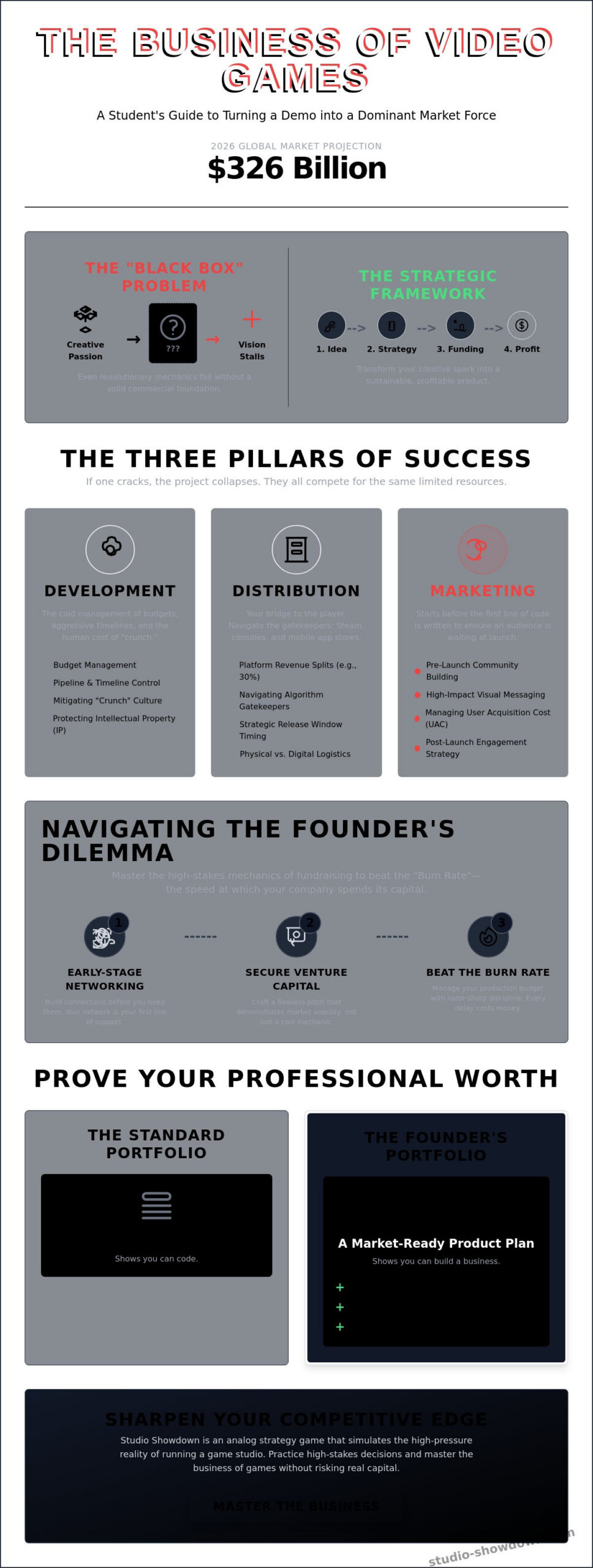
Success in the business of video games for students rests on three unstable pillars. Development, distribution, and marketing. If one cracks, the project collapses. Development is about more than art; it’s the cold management of budgets, aggressive timelines, and the human cost of “crunch” culture. You aren’t just making a game. You’re managing a production pipeline where every delay drains your bank account. Managing these resources requires a level of discipline that most creative programs don’t teach.
Distribution is your bridge to the player. You must navigate the gatekeepers of a multi-billion dollar industry, from Steam’s algorithm to the walled gardens of consoles and mobile app stores. Each platform demands a different cut and a different strategy. Marketing, however, is the most misunderstood pillar. It doesn’t start at launch. It starts before the first line of code is written. You build a community to ensure that when you finally open the doors, someone is actually waiting outside.
We call this the “Showdown” effect. These three pillars constantly fight for the same limited resources. Do you spend your last 10,000 dollars on a cinematic trailer or on three more weeks of polishing the physics engine? Every choice is a trade-off. To survive this pressure, students often find that practicing these high-stakes decisions through a tactical board game is the best way to sharpen their instincts without risking real capital.
Beyond the Code: Understanding Intellectual Property
Your code is temporary; your Intellectual Property (IP) is forever. Owning your IP is the most valuable asset you’ll ever hold. While licensing an existing brand might offer a shortcut to visibility, original creation gives you total control over sequels, merchandise, and spin-offs. In a competitive global market, protecting your ideas with trademarks and copyrights isn’t just legal busywork. It’s defending your future revenue streams against those who would copy your success.
The Logistics of Hitting the Market
Timing is everything. Launching your indie passion project the same week as a major AAA title is a death sentence. You must identify release windows where you can own the conversation. Beyond timing, you have to master the cost of user acquisition. In 2026, the price of getting a single player to download your game is rising. Understanding your Return on Investment (ROI) is the difference between a studio that grows and a studio that vanishes after one hit.
Navigating the Founder’s Dilemma: Risk and Fundraising
Every student-led studio starts with a dream, but it lives or dies by the clock. This is the “Burn Rate”. It’s the speed at which your venture consumes its capital before generating a profit. If you don’t understand your burn rate, you aren’t running a business; you’re indulging a hobby. In the business of video games for students, the founder’s dilemma is balancing the desire for creative perfection with the brutal reality of a shrinking bank account. You have to know when to push for more features and when to ship a “Minimum Viable Product” to keep the lights on.
Fundraising is the fuel for your ambition. It starts with “Friends and Family,” moves to government grants or incubators, and eventually scales to Venture Capital. However, money always comes with strings. Selling a vision to investors requires a shift in language. They don’t care about your shader code or your lore. They care about the bottom line. You aren’t selling a game; you’re selling a return on investment. Risk management means having the courage to pivot your project when the data says “no,” or cutting your losses before the studio collapses entirely.
The Pitch Deck: A Student’s Secret Weapon
A winning pitch deck is a visual narrative of success. It must highlight three things: the massive market size (projected to hit 326 billion dollars in 2026), your team’s unique technical edge, and your Unique Selling Proposition (USP). Investors see hundreds of decks. Yours needs to scream professionalism. When a publisher rejects you, don’t take it personally. Use the feedback to sharpen your edge. Practice your pitch until you can explain why your game will dominate its niche in under 60 seconds. If you can’t hook them in a minute, you won’t hook them at all.
Bootstrapping vs. External Investment
You have two paths: total freedom or rapid scale. Bootstrapping means self-funding your project. You keep 100% of the equity and 100% of the control, but your growth is limited by your own wallet. External investment, like Venture Capital, provides the capital to hire top-tier talent and dominate the market, but you’re giving up a piece of your soul. You’re answerable to a board. Many successful student-led indie studios start by bootstrapping a demo to prove the business of video games for students can actually work, then they use that leverage to negotiate better terms with investors later. Don’t give away the farm before you’ve even planted the seeds.
How Students Can Build a Game Industry Portfolio
Most student portfolios are galleries of static art or repositories of raw code. If you want to master the business of video games for students, your portfolio must do more. It must prove you understand why a game succeeds in a crowded market. Recruiters aren’t just looking for someone who can build a level. They want someone who understands the cost of building it. You need to show that you can bridge the gap between creative execution and commercial reality.
- Document the Business Logic: Don’t just show a mechanic. Explain why you chose it. If you developed a mobile title, cite the fact that mobile gaming holds 49% of the market share. Show the data behind your design.
- Create Mock Marketing Plans: Take your student project and build a launch strategy. Identify your target demographic within the 3.51 billion active gamers worldwide. Detail your projected user acquisition costs.
- Participate in Simulations: Prove your strategic thinking by documenting your performance in business simulations. Show how you managed resources under pressure.
- Use Data to Prove Market Fit: Use industry statistics to justify your scope. If you’re building for PC, explain how you’ll target the 56% of spending happening outside the top 20 titles.
The Value of Analog Simulation
Board games are the perfect low-stakes environment for high-stakes business lessons. They strip away the complexity of software to focus on pure strategy. A business board game teaches resource management better than any textbook ever could. You learn to balance cash flow, team talent, and market timing in real-time. Turning a session into a business case study for your resume shows a level of professional maturity that sets you apart from the visual noise of other applicants.
Networking for Introverts
Approaching mentors doesn’t require a sales pitch. It requires curiosity. Approach industry professionals on LinkedIn or at game jams with specific questions about their production cycles. Focus on soft skills like negotiation, empathy, and leadership. These are the traits that define a successful founder. Find your tribe among those who value dev-entrepreneurship. If you want to start testing your instincts today, get your copy of Studio Showdown and lead your first mock studio to victory. Show the world you have the tactical mind to survive the 2026 market.
Studio Showdown: Mastering the Business Through Analog Strategy
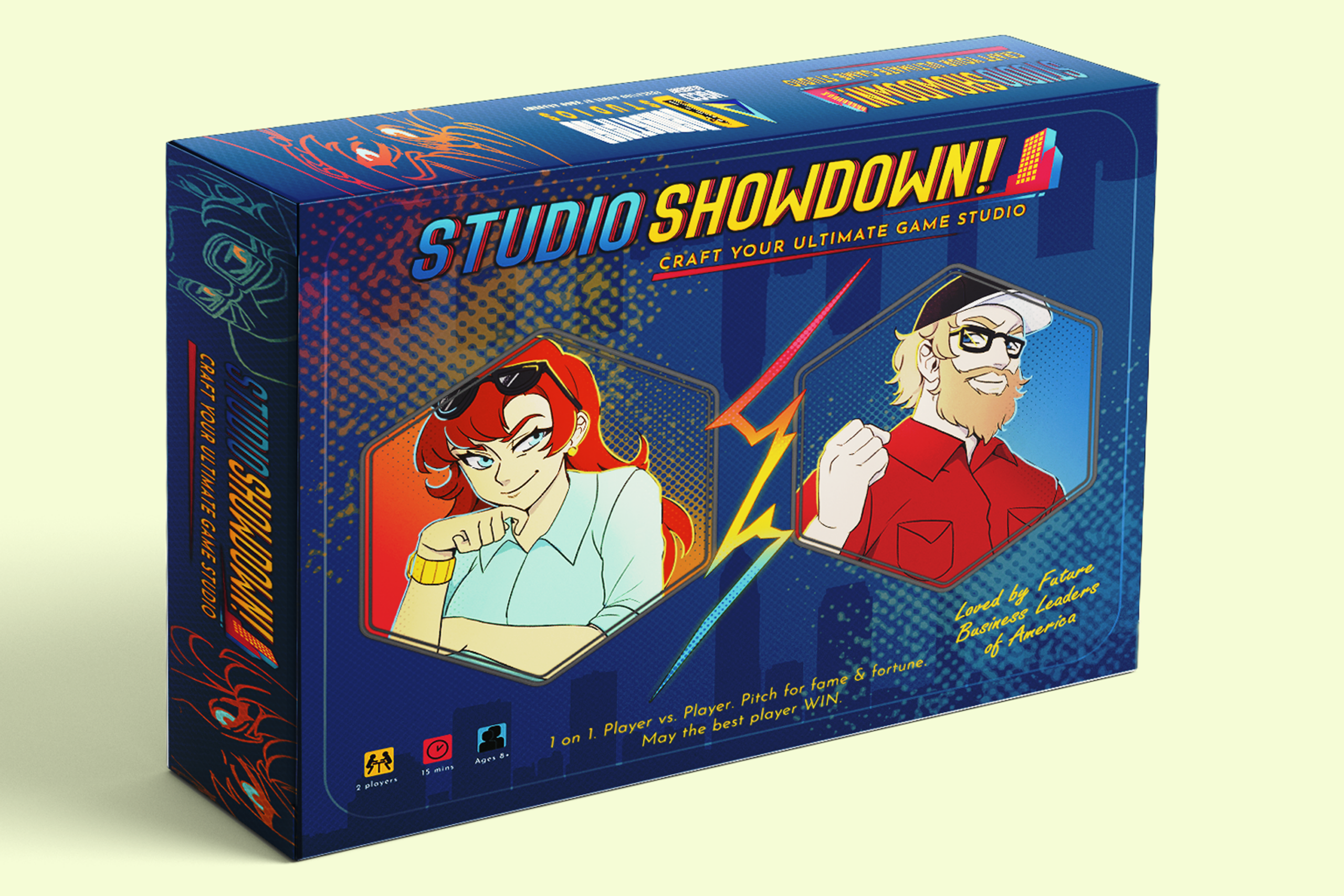
Theory is a blueprint; action is the construction site. To truly master the business of video games for students, you must step out of the lecture hall and into the pressure cooker of a studio launch. Studio Showdown is the definitive strategy board game built to simulate this high-stakes world. It strips away the comfort of abstract concepts and replaces them with the visceral reality of founding a company. You aren’t just a student anymore. You’re a founder.
Created through a powerhouse collaboration between VGCD Academy and DEMYSTIFIED Studios, this simulation forces you to navigate fundraising, high-pressure pitching, and the cutthroat tactics of rival studios. It provides a hands-on learning experience that a standard textbook simply cannot replicate. You’ll learn to manage the “Burn Rate” while facing the same market volatility that defines the 2026 industry. It’s about developing the instincts of a leader before you ever risk a single dollar of real capital.
From the Classroom to the Boardroom
The transition from academic study to professional execution is often a chasm. The Studio Showdown: Educator Edition bridges this gap by integrating directly with modern STEM and business curricula. It turns a standard lesson into a competitive arena where you build real-world business acumen while outmaneuvering your friends. There’s a psychological edge here too. The game allows you to “fail fast.” You can see a studio collapse, analyze the wreckage, and restart with a better strategy in under an hour. That’s a lesson that sticks.
Winning the Market
Every turn is a test of your strategic decision-making. Should you dump your remaining capital into cutting-edge tech or hire the top-tier talent that your rival is eyeing? The “Showdown” mechanic brings the thrill of the chase to life. You’ll deal with sudden market shifts, regulatory hurdles, and disruptions from competing studios that want your market share. Success isn’t guaranteed by your art; it’s earned through your strategy. Ready to lead your own studio? Get Studio Showdown for your classroom or home today. Lead the next generation. Dominate the market.
Dominate the Market Before You Ship
Pixels are cheap; strategy is priceless. You now have the roadmap to move beyond the “black box” of the industry. Mastering the three pillars of development, distribution, and marketing isn’t just an academic exercise. It’s your survival kit. By documenting your business logic and understanding the high-stakes reality of fundraising, you’ve already outpaced the competition. The business of video games for students is no longer a mystery. It’s a game you know how to win.
Don’t leave your career to chance. Developed by VGCD Academy experts and used in classrooms to build professional portfolios, Studio Showdown offers an immersive tabletop simulation of the 200 billion dollar gaming market. It’s the ultimate training ground for the next generation of leaders. You’ve studied the theory. Now, it’s time to lead the charge. Master the Industry—Order Studio Showdown Today and start building your empire. Your first big hit is waiting for a founder who knows the score.
Frequently Asked Questions
What is the “business of video games” for students exactly?
The business of video games for students is the commercial architecture that keeps a studio alive. It includes everything from securing venture capital to managing distribution on platforms like Steam. You’re learning to treat your creativity as a scalable asset. It’s the difference between a one-off project and a lifelong career.
Can I learn the business side of gaming without a college degree?
You don’t need a degree to master the market. Industry professionals value a portfolio that proves business logic and strategic thinking. Use simulations and game jams to build a track record. Focus on results. Data speaks louder than a diploma.
How much math is involved in the business of video games?
You’ll mostly use arithmetic and logic. Focus on calculating your studio’s burn rate and projected return on investment. You need to understand revenue splits, like the 88/12 split offered by the Epic Games Store. It’s about managing cash flow, not solving complex equations.
What are the most important business skills for a game developer?
Resource management is the king of skills. You must also master the art of the pitch to secure funding from investors. Negotiation and soft skills allow you to build a team without burning through your initial capital. It’s about being a leader, not just a technician.
How do board games help students learn business strategy?
Board games strip away the distractions of software bugs. They focus entirely on pure strategy and resource allocation. By playing, you learn to anticipate rival moves and manage limited assets. It’s a tactile way to sharpen your professional instincts without risking real capital.
What is the best way for a teen to start a video game studio?
Start small and protect your Intellectual Property. Build a demo that proves your “Hook” works. Use the business of video games for students to identify market gaps where your unique vision can dominate. Don’t wait for permission to lead.
Is the video game industry too competitive for new students?
The market is massive, hitting a projected 326 billion dollars in 2026. While the top titles are crowded, 56% of spending on PC happens outside the top 20 games. There’s plenty of room for founders who know how to target niche audiences. The competition is just a hurdle to clear.
How does Studio Showdown teach fundraising and pitching?
Studio Showdown puts you in the founder’s seat. You have to pitch your vision and secure capital while rivals try to disrupt your launch. It forces you to make the hard choices between investing in talent or saving your cash. It’s the ultimate practice for the real boardroom.