The traditional business textbook is dead weight. It fails to capture the pulse of a real boardroom or the sharp tension of a final pitch. You’ve watched students disengage from static lectures and grow weary of endless screen time. It’s a common struggle. Teaching complex concepts like venture capital or market saturation often feels like fighting an uphill battle against short attention spans. You need a tool that cuts through the noise. Integrating high-stakes entrepreneurship games for students transforms the classroom from a lecture hall into a high-pressure startup incubator.
It’s about more than just engagement. It’s about tactical survival. You want your students to understand business mechanics through action, not just observation. This 2026 guide shows you how tabletop simulations and strategic games force students to think like founders. We’ll explore how tools like the Studio Showdown Board Game move beyond theory. You’ll learn to create an environment that mirrors real-world competition, sharpens critical thinking, and helps students build professional portfolios. We’re breaking down the best simulations to help your students master the art of the deal, handle fundraising, and dominate their market.
Key Takeaways
- Bridge the gap between STEM and business by replacing static textbooks with high-stakes, analog simulations.
- Learn how top-tier entrepreneurship games for students accelerate retention through real-time feedback and competitive market strategy.
- Master the professional art of fundraising and capital management using strategy-heavy tabletop simulations.
- Scale your classroom impact with specialized educator bundles designed to align with modern 2026 curriculum standards.
- Transition students from passive learners to confident founders by mirroring the intensity of real-world startup showdowns.
Why Entrepreneurship Games are Essential for Students in 2026
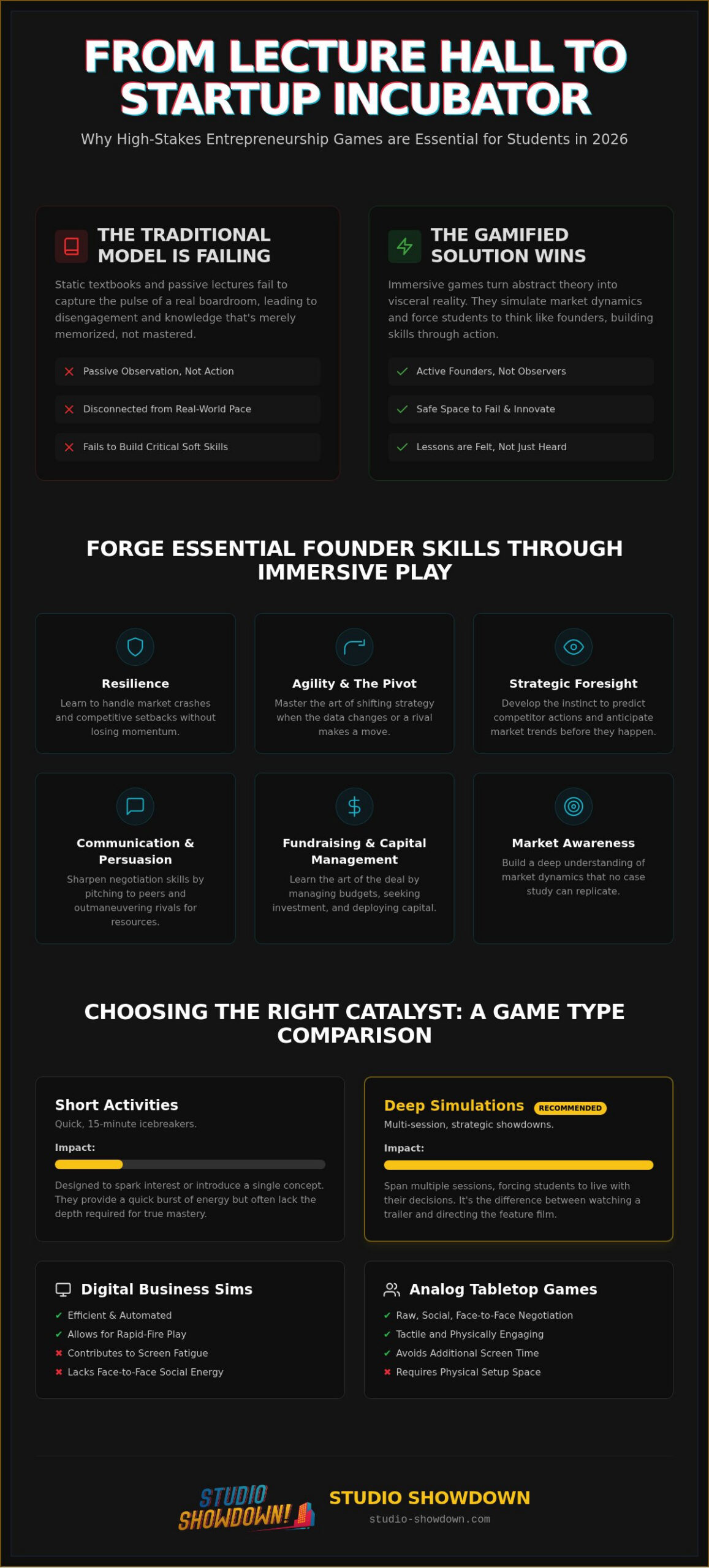
The traditional lecture hall is a relic. Textbooks can’t teach the adrenaline of a market crash or the grit needed for a series A round. They’re static. They’re silent. Entrepreneurship games for students bridge this gap by turning abstract theory into a visceral reality. At their core, entrepreneurship games are interactive systems that simulate market dynamics and resource management. They don’t just explain business; they demand it. Gamification isn’t a gimmick here. It’s a high-octane engine for retention. By providing immediate feedback loops on every decision, these business simulation games ensure that lessons aren’t just memorized. They’re felt. This immersive play builds a mindset defined by resilience, agility, and strategic foresight. It moves students from passive observers to active founders. It’s business education, vfx-level intensity, and real-world stakes combined.
The Shift Toward Experiential Learning
Gen Z and Gen Alpha students aren’t interested in “what-ifs.” They demand relevance. They want to see how their actions impact a bottom line in real-time. The traditional “lecture-first” model is failing because it lacks stakes. It’s dry. It’s disconnected from the pacy world of modern startups. Games solve this by creating a safe space to fail. In a simulation, a bankrupt studio is a lesson, not a life-altering disaster. High stakes keep the energy high. The controlled environment allows for the type of bold experimentation that leads to genuine innovation. Students learn to fail fast. They learn to recover faster. It’s about building a professional portfolio through trial and error, not just passing a multiple-choice test.
Developing Soft Skills Through Competition
Business is a contact sport. You can’t learn to negotiate with a slide deck. Live gameplay forces students to sharpen their communication and persuasion skills when the pressure is on. They aren’t just crunching numbers. They’re pitching to peers. They’re outmaneuvering rivals for market dominance. This environment teaches the “Pivot.” It’s the most critical skill in any startup. When the market shifts or a competitor drops a superior product, students must adapt or get left behind. Competitive play fosters a healthy rivalry. It builds a level of market awareness that no case study can replicate. It’s about winning, losing, and understanding exactly why it happened. This is how you build leaders who can cut through the visual noise of a crowded market.
- Resilience: Handling setbacks without losing momentum.
- Agility: Shifting strategy when the data changes.
- Strategic Foresight: Predicting competitor moves before they happen.
The goal is simple. We’re replacing boredom with a showdown. Students who play these games don’t just graduate with a degree. They graduate with the instincts of a CEO.
Beyond Monopoly: Comparing Different Types of Business Games
Not all games are created equal. Some rely on the roll of a die and blind luck. Others demand cold, hard logic and ruthless strategy. Choosing the right entrepreneurship games for students requires a sharp eye for the intended outcome. You aren’t just looking for a time-filler. You’re looking for a catalyst. In 2026, the market for educational simulations has split into two distinct camps: low-stakes “easy money” games and high-stakes strategic showdowns. One keeps students busy. The other keeps them thinking.
Short Activities vs. Deep Simulations
Short activities are the 15-minute icebreakers of the classroom world. They’re designed to spark interest or introduce a single concept like “The Pivot” or a “Sales Pitch.” They provide a quick burst of energy. However, they often lack the depth required for true mastery. Deep simulations are different. They span multiple sessions. They force students to live with the consequences of their decisions over time. It’s the difference between watching a trailer and directing the feature film. You can explore why Beyond the Easy Money Game: Why Strategy Wins in 2026 is becoming the new standard for serious educators.
Analog Tabletop vs. Digital Business Sims
Digital simulations are efficient. They automate the math and allow for rapid-fire play. But they also contribute to the growing problem of screen fatigue. Analog board games are surging back into the curriculum for a reason. There’s a raw, social energy in face-to-face negotiation that a digital interface simply cannot replicate. Physical components like cards, boards, and tokens ground the experience. They make abstract financial assets feel tangible. Tactile learning aids retention. When students sit across from a rival, they learn to read body language and master the art of the deal in real-time. It’s about Mastering the Board: The 2026 Guide to Strategy Board Games to reclaim the classroom’s physical space.
Selection depends entirely on your audience and goals. Middle schoolers might thrive on faster-paced, simpler mechanics. University students require the complexity of fundraising, studio management, and market dominance. Align the game with your specific curriculum. If you’re teaching STEM, look for simulations that focus on production cycles and development. If the focus is pure business, prioritize the negotiation. For educators looking to overhaul their entire approach, the Classroom Bundle provides a professional, ready-to-deploy solution that brings real-world intensity to the table.
- Tactile Feedback: Physical assets make financial consequences feel real.
- Unfiltered Communication: Real negotiation happens across a table, not a chat box.
- Strategic Depth: Multi-session play allows for complex, long-term planning.
The goal is to move beyond the superficial. Don’t settle for games that just pass the time. Choose tools that build founders.
5 Key Business Skills Students Learn Through Immersive Play
Immersive play is the ultimate forge for future CEOs. While textbooks offer definitions, entrepreneurship games for students offer scars and successes. It’s where theory meets the grind. These simulations force students to juggle the critical pillars of business in a high-stakes environment. They don’t just read about market forces. They feel them. By stepping into the role of a founder, students develop a specialized toolkit that translates directly to the professional world. It’s about moving beyond the visual noise of a classroom and into the tactical reality of a startup showdown.
- Fundraising: Mastering the art of securing and protecting capital.
- Market Analysis: Identifying gaps and outmaneuvering rivals for dominance.
- Product Lifecycle: Managing the journey from raw concept to a hit launch.
- Strategic Pivot: Changing direction when the data demands a new path.
- Pitching: Selling a vision with authority and clarity.
Fundraising and Financial Literacy
Games teach the hard numbers that lectures often miss. Revenue isn’t profit. Profit isn’t investment capital. Understanding these distinctions is vital for survival. Under pressure, students must manage burn rates and maintain cash flow to keep their ventures alive. It’s a brutal balancing act. One wrong move ends the game. This environment forces them to respect the runway and make every dollar count. You can see these mechanics in action by exploring The Ultimate Business Board Game: Master Entrepreneurship in 2026.
Pitching and Strategic Communication
Every game session is a high-pressure rehearsal for the real world. Students don’t just play; they build a professional portfolio of “business wins” and tactical decisions. Persuasion becomes a weapon. They learn to translate complex game mechanics into compelling narratives for their peers or “investors.” This fosters evidence-based decision making. They stop guessing and start calculating. In a competitive environment, the ability to communicate a strategy clearly is what separates a hobbyist from a founder. It’s about impact, authority, and winning the room.
Product lifecycle management is the final test. Students must navigate the messy middle of development, balancing quality against tight deadlines. They learn that a perfect product that never launches is a failure. Speed to market matters. Market dominance requires more than a good idea; it requires flawless execution and a relentless competitive spirit. This is the difference between learning business and living it.
Implementing Entrepreneurship Games in Your Curriculum
Strategy without execution is just a daydream. Integrating entrepreneurship games for students requires more than just clearing desk space. It’s a tactical shift in how you deliver value. You’re aligning gameplay with rigorous STEM and business curriculum standards. Every turn must serve a learning objective. Use the debrief to bridge the gap between the game board and the real world. Connect a failed launch in the game to actual market shifts in the tech industry. This isn’t just a break from the routine. It’s a professional simulation. The best entrepreneurship games for students are the ones that force them to defend their choices under pressure.
Starting Your First Game-Based Unit:
- Identify the Core Concept: Choose one focus, like fundraising or market dominance.
- Deploy the Simulation: Introduce the mechanics and let the competition begin.
- Monitor the Burn: Observe how teams manage resources and handle setbacks.
- Facilitate the Debrief: Ask why they won or lost. Connect the “why” to real-world business mechanics.
Classroom Management and Bundling
Efficiency is the hallmark of a great founder. It’s also the hallmark of a great educator. Set up “Studio Hubs” in your classroom to organize group play and encourage collaboration. For larger groups, managing multiple units is a logistical challenge. The Classroom Bundle offers institutional efficiency by providing enough materials for an entire cohort to compete simultaneously. If you need a more guided approach, the Studio Showdown: Educator Edition provides the framework to lead students through complex scenarios without losing the competitive edge. It’s production-level organization for the modern classroom.
Assessment and Portfolio Building
How do you grade a showdown? You don’t just look at the final score. You grade the strategic intent. A student might lose the game but demonstrate a flawless understanding of market analysis or a brilliant pivot. This is the data that matters. Encourage students to document their “Founder Journey.” This record of decision-making and resilience is a powerful addition to college applications. It proves they can think like a CEO. By connecting game outcomes to current events in the gaming industry, you show them that their classroom experience is a direct rehearsal for their future career.
Ready to transform your classroom environment? Explore the Classroom Bundle to launch your first high-stakes simulation.
Studio Showdown: The Ultimate Startup Simulation for Students
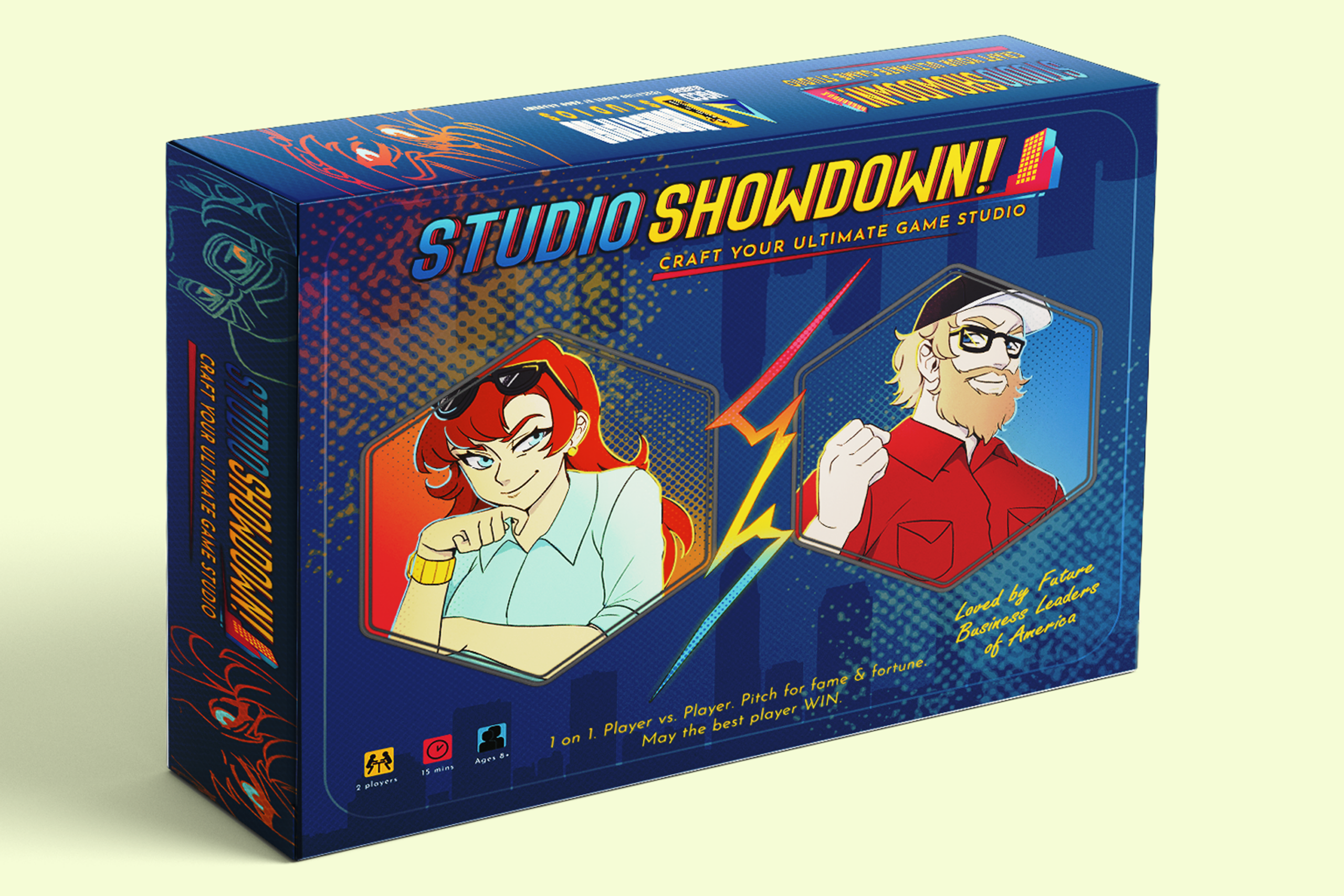
Studio Showdown Board Game represents the pinnacle of entrepreneurship games for students. It’s a high-stakes dive into the video game industry. We don’t just teach business; we simulate the adrenaline of a studio launch. This niche is the perfect hook for today’s tech-savvy students. They already understand the product. Now they must master the mechanics of the market. From day one, they’re positioned as founders. They learn to secure funding, manage development cycles, and crush the competition. It’s a showdown where only the most strategic survive. It’s about moving beyond the screen and into the tactical reality of the boardroom.
The Founder Experience
Launching a hit game in a crowded market is a brutal challenge. Students must navigate the visual noise of a saturated industry while outmaneuvering rival studios. It’s about tactical dominance. Studio Showdown builds real-world business acumen through play. It forces students to weigh the cost of innovation against the reality of a burn rate. They aren’t just moving pieces on a board. They’re making the same high-pressure calls as a professional CEO. This is the premium, analog experience described in our Screen-Free Activities for Teens and Families: The 2026 Strategy Guide. It’s about reclaiming the social energy of negotiation.
The gameplay focuses on three core pillars:
- Strategic Fundraising: Securing the capital needed to fuel development without losing control.
- Market Dominance: Identifying trends and releasing the right product at the right time.
- Resource Allocation: Managing a team of developers and artists to hit critical deadlines.
Institutional Support for Educators
We don’t just sell games. We build partners. We provide specialized pricing and training for schools and after-school programs. Our professional development workshops ensure that integrating strategy games into STEM is seamless and effective. Educators get the tools they need to lead. The Studio Showdown: Educator Edition and Classroom Bundle are designed for institutional efficiency. We offer the structure. You provide the arena. Together, we’re moving entrepreneurship games for students beyond the simple icebreaker and into the realm of professional portfolio building. We help you turn your classroom into a startup incubator where students don’t just learn business; they live it. Join the showdown. Elevate your curriculum. Transform your students into founders.
Launch Your Students into the Founder Arena
The shift toward immersive learning isn’t just a trend; it’s a necessity. Static business models can’t compete with the raw energy of a live simulation. By integrating entrepreneurship games for students, you’re giving them the tools to master fundraising, market strategy, and the high-stakes world of studio management. These aren’t just games. They’re professional rehearsals for the real world. Every decision matters. Every pivot counts.
Developed by industry experts at VGCD Academy, our simulations are used by educators nationwide to bridge the gap between STEM and business education. This analog, screen-free approach ensures deeper engagement and forces students to look their rivals in the eye. They’ll walk away with more than a grade; they’ll have the instincts of a startup founder and a portfolio of strategic wins. It’s time to move beyond the textbook and into the showdown.
Equip your classroom with the Studio Showdown Classroom Bundle today and watch your students transform into confident business leaders. The next great industry breakthrough starts at your classroom table. Don’t let them stay on the sidelines.
Frequently Asked Questions
What are the best entrepreneurship games for middle school students?
Start with accessible tabletop options like Products: The Card Game or strategy-focused card simulations. These titles introduce market mechanics without overwhelming younger learners. Middle schoolers thrive on fast-paced feedback and clear goals. Look for games that emphasize creative problem-solving and basic resource management. These entrepreneurship games for students provide a low-risk environment to test ideas before moving to complex simulations like Studio Showdown in later grades.
How do board games teach financial literacy better than textbooks?
Board games turn abstract numbers into tangible assets that students must protect. Textbooks describe profit; games force you to earn it to survive. When a student manages a burn rate in a simulation, the consequences of a bad decision are immediate and visible. This hands-on experience builds a visceral understanding of cash flow and capital management. It replaces passive reading with active, tactical decision-making that sticks long after the lesson ends.
Can Studio Showdown be used for high school STEM curricula?
Yes, Studio Showdown acts as a perfect bridge between STEM and business education. It focuses on the production cycle of video game development, requiring students to manage technical resources and artistic talent. High schoolers learn to balance the technical aspects of STEM with the economic reality of a product launch. It’s a high-octane way to teach project management, resource allocation, and market-driven innovation in a professional, technical context.
How long does a typical session of an entrepreneurship game take?
Most sessions range from 45 to 90 minutes depending on the complexity of the simulation. Short activities might take 15 minutes, but deep strategic play requires a full class period to allow for negotiation and pivots. Studio Showdown is designed to fit standard block schedules. You can also split gameplay across multiple days. This multi-session approach allows students to reflect on their strategy and return with a fresh, aggressive tactical plan.
Do I need business experience to teach entrepreneurship using games?
No, you don’t need an MBA to facilitate these sessions effectively. The games are designed to act as the primary instructor for business mechanics. Your role is to guide the debrief and connect game scenarios to real-world examples. Tools like the Studio Showdown: Educator Edition provide the necessary framework and lesson plans. You act as the creative producer, setting the stage for students to discover entrepreneurial principles through their own showdowns.
What is the difference between the standard and Educator Edition of Studio Showdown?
The standard Studio Showdown Board Game is built for competitive strategy play among peers. The Educator Edition adds a layer of instructional support designed specifically for the classroom. It includes specialized lesson plans, assessment rubrics, and facilitation guides to help teachers align gameplay with curriculum standards. It’s a professional-grade tool that transforms a high-stakes simulation into a structured educational unit while maintaining the same intense, founder-focused gameplay.
How can students add board game experience to their professional portfolios?
Students should document their “Founder Journey” by recording specific strategic wins and pivots. They can describe how they managed fundraising or outmaneuvered rivals in high-stakes entrepreneurship games for students. This demonstrates critical thinking, resilience, and a firm grasp of market dynamics. Adding these case studies to a portfolio proves to recruiters that the student has practical, simulated experience in handling complex business challenges and leading a team to victory.
Are there bulk discounts for schools ordering Classroom Bundles?
Yes, institutional pricing is available for schools and organizations ordering in volume. The Classroom Bundle is specifically designed to provide cost-effective access for entire cohorts. This ensures that every student has the components needed for a full-scale simulation. We recommend contacting our team directly to verify current pricing for institutional orders. These bundles provide the efficiency and materials required to run professional-level startup showdowns across multiple classrooms simultaneously without compromise.