What if the traditional “trust fall” is actually killing your students’ interest in collaboration? Most educators know that “chalk and talk” lessons fail to prepare young minds for a high-stakes, competitive career. You’ve likely seen the glazed-over eyes when you mention another generic icebreaker. It’s frustrating to watch potential stagnate because the tools don’t match the ambition. This guide moves past the fluff to deliver a high-octane list of team building games for students that bridge the gap between classroom theory and professional reality.
Teaching complex concepts like negotiation, risk, and market strategy requires more than a textbook. You want high participation and measurable results. We promise to reveal fifteen strategic simulations, featuring the Studio Showdown Board Game, that transform passive learners into collaborative powerhouses. We’ll explore everything from survival-themed challenges to intensive business simulations that integrate STEM skills. It’s time to elevate your classroom culture. Cut the noise and give your students the professional edge they deserve. Let’s build a legacy of leadership together through games that demand excellence and reward bold thinking.
Key Takeaways
- Trade outdated icebreakers for high-stakes competitive collaboration that mirrors professional entrepreneurship and real-world risk.
- Explore 15 curated team building games for students designed to sharpen communication, strategy, and high-pressure decision-making.
- Learn how to convert classroom gameplay into powerful portfolio pieces that showcase a student’s strategic wins to college recruiters.
- Discover why the Studio Showdown Board Game is the premier tool for teaching fundraising, pitching, and market dominance.
- Analyze the specific benefits of analog board games over digital simulations to ensure your classroom tools drive maximum engagement.
Beyond Icebreakers: Why Students Crave Competitive Collaboration
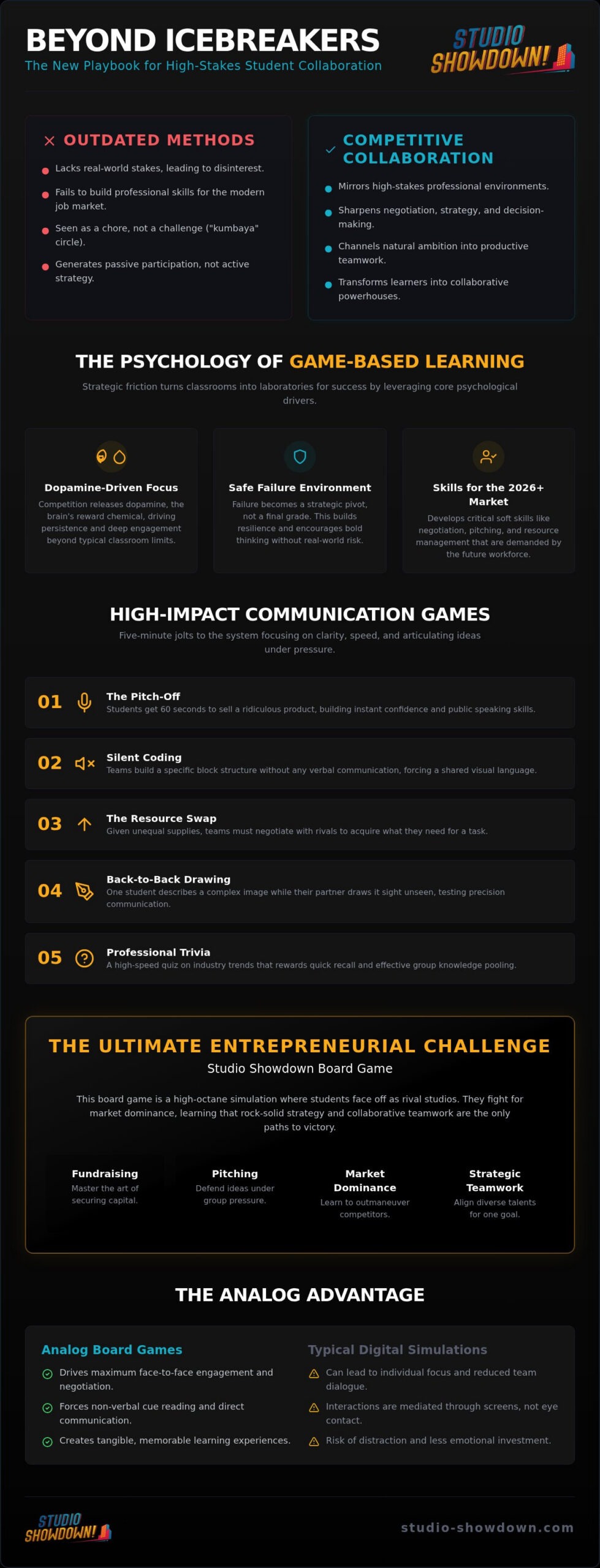
Modern students see through the “kumbaya” circle. Traditional Team building often feels like a chore because it lacks stakes. Trust falls don’t prepare a student for a boardroom or a high-growth tech startup. They crave competitive collaboration. This framework defines high-stakes student engagement and is the foundation for effective team building games for students. It replaces passive participation with active, strategic friction. It’s not just about winning; it’s about winning together in a scenario that mirrors professional reality. Today’s students are digital natives. They understand systems, rewards, and feedback loops. A simple icebreaker feels hollow to someone who has navigated complex digital worlds. They need something that challenges their intellect and rewards their ambition.
The Psychology of Game-Based Learning
Play isn’t just a break from work. It’s the engine of focus. When students engage in competitive team building games for students, their brains release dopamine. This chemical reward drives persistence. Competition creates a “safe” high-pressure environment. Failure here isn’t a grade; it’s a pivot. It’s a strategic lesson learned without the sting of real-world bankruptcy. Students move from “How do I get an A?” to “How do we dominate this market?”. This shift is crucial. It breaks down the fear of failure. It turns a classroom into a laboratory for group success where the stakes feel real but the risks are managed.
Soft Skills for the 2026 Job Market
The 2026 workforce doesn’t just need workers. It needs architects of ideas. Negotiation, pitching, and resource management are no longer optional extras. They’re the core. Moving beyond simple communication into strategic persuasion is the goal. Students must learn to defend an idea under fire. They need to manage limited resources while rivals close in. Strategic Teamwork is the ability to align diverse talents toward a singular market goal. These skills stick because they’re practiced, not just preached. Game-based learning ensures long-term retention through emotional and intellectual investment.
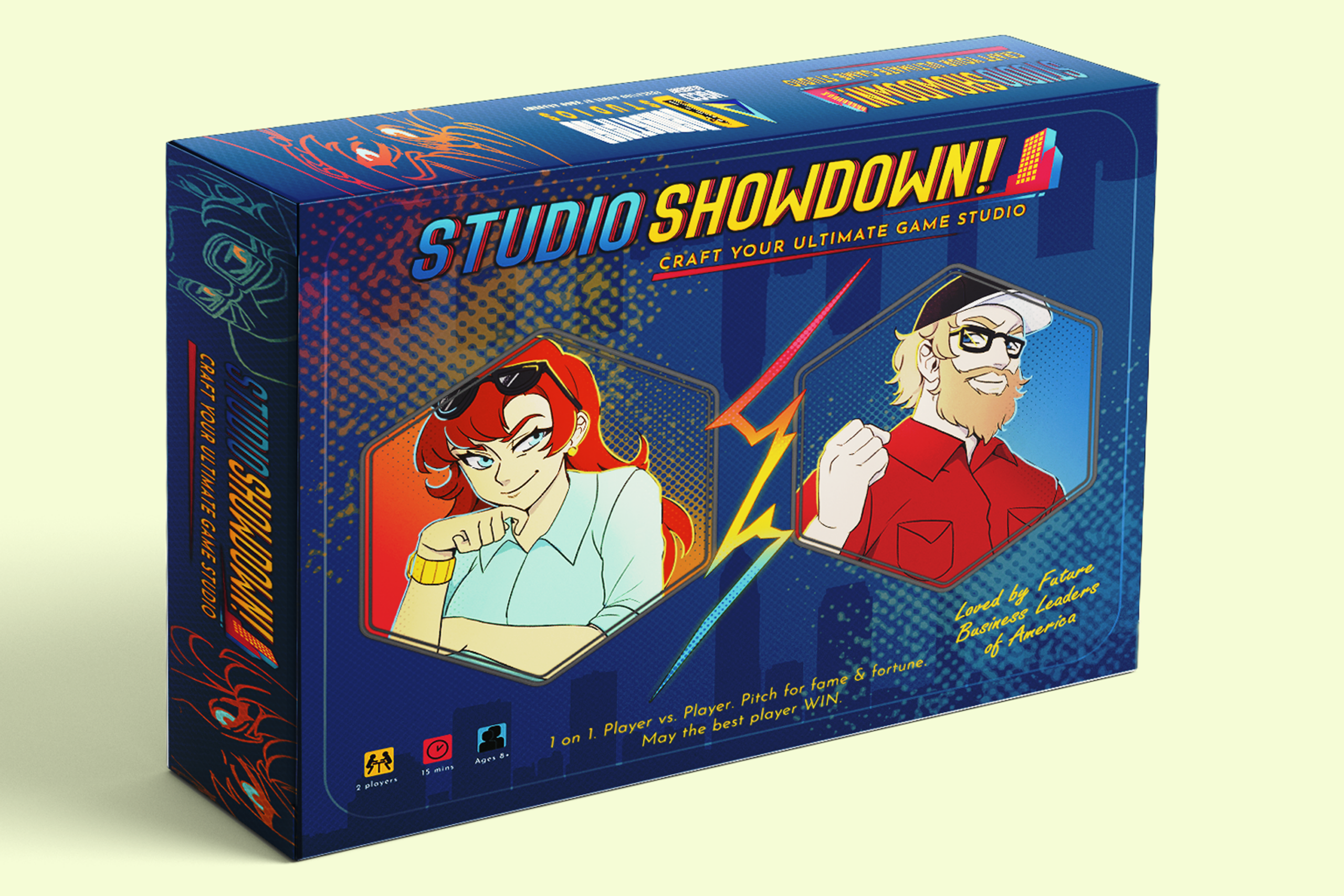
We call this the “Showdown.” It’s a healthy outlet for natural ambition. Instead of suppressing the urge to win, we channel it. By using the Studio Showdown Board Game, educators provide a battlefield for professional growth. It’s a simulation where students face off as rival studios. They fight for market dominance. They learn that the only way to reach the top is through a rock-solid, collaborative strategy. This isn’t just a game. It’s a rehearsal for their future. It transforms the classroom into a high-octane production house where every move counts and every team member plays a vital role in the studio’s survival.
15 High-Impact Team Building Games for Students
Winning in 2026 requires more than participation. It demands a tactical edge. Traditional icebreakers are dead weight. They don’t build the professional muscle students need to survive in a competitive market. These team building games for students move from simple energy shifts to complex professional simulations. We’ve categorized them into three tiers: Communication, Problem-Solving, and Deep Strategy. Each game is designed to strip away passivity and replace it with decisive, collaborative action. Stop wasting time on games that don’t matter. Start building a studio culture in your classroom.
Quick-Start Communication Games
These games provide a five-minute jolt to the system. They focus on clarity, speed, and the ability to articulate ideas under pressure.
- The Pitch-Off: Students get 60 seconds to sell a ridiculous product idea. Think “dehydrated water” or “solar-powered flashlights.” It builds instant confidence and public speaking skills.
- Silent Coding: Teams must build a specific structure using blocks without any verbal communication. It forces students to read non-verbal cues and develop a shared visual language.
- The Resource Swap: Give teams unequal supplies for a simple task. They must negotiate with rivals to get what they need. It’s a fast-paced lesson in trade and compromise.
- Back-to-Back Drawing: One student describes a complex image while their partner draws it. Precision is everything here.
- Professional Trivia: A high-speed quiz on industry trends that rewards quick recall and group knowledge.
Complex Problem-Solving Challenges
These challenges require mental and physical coordination. They simulate the friction found in real-world production cycles.
- The Bug Hunt: Teams swap their current projects and find flaws in each other’s logic or design. It teaches ego-free peer review and radical transparency.
- Market Pivot: Mid-way through a task, the facilitator changes the objective. This tests the team’s ability to stay calm and adapt to new data.
- Portfolio Sprint: Teams have 15 minutes to create a visual mock-up for a brand. It’s about speed, visual storytelling, and decisive leadership.
- The Human Knot (Strategic Edition): Untangle the group without speaking, focusing entirely on lead-follow dynamics.
- Bridge Building: Construct a bridge using limited materials to support a specific weight. It’s a classic test of physics and resource management.
The final tier focuses on long-form simulation. These five games include the Studio Showdown Board Game, Business Tycoon simulations, Startup Life cycles, Crisis Room scenarios, and Negotiation Wars. These are the “Deep Strategy” tools that prepare students for the 2026 job market. If you’re ready to move beyond the basics, the Studio Showdown Board Game offers a ready-made framework for high-stakes classroom competition. It turns students into studio owners who must pitch, fundraise, and outmaneuver their rivals to win.
Simulation vs. Physical Games: Choosing the Right Stakes
Choosing the right tool defines the outcome. You wouldn’t use a hammer for a surgical cut. Similarly, not all team building games for students serve the same pedagogical purpose. Physical games ignite energy. Simulations build empires. The difference lies in the stakes. When students play for “points,” they’re playing a game. When they play for market dominance, they’re building a career. This distinction is vital for educators who want more than just a loud classroom. They want a classroom that functions like a high-growth production house.
Digital simulations offer scale, but analog tools offer presence. Physical board games force eye contact. They demand immediate, face-to-face negotiation. In the debate of Analog vs. Digital: Why Board Games Win, the tactile experience often creates deeper psychological imprints. There’s no screen to hide behind. Every move is a public statement. Every trade is a handshake. This level of accountability is what transforms a group of individuals into a cohesive unit.
Stakes change behavior. Simulated dollars feel heavier than generic points. Market dominance triggers a different level of critical thinking. Rivalry isn’t about being mean. It’s about healthy friction. It pushes students to refine their logic because they know their peers are looking for an opening. This competitive edge drives excellence. It turns a simple lesson into a “showdown” where only the most collaborative and strategic minds succeed.
The Power of Business Simulations
Gen Z and Gen Alpha are born gamers. They understand systems, rewards, and feedback loops. Simulating a video game studio speaks their language. It turns abstract concepts like fundraising into a tangible mission. They learn financial literacy by managing budgets that feel real. You can see how Business Simulation Games Teach Real-World Skills through immediate feedback loops. It’s high-stakes learning without the real-world debt. It bridges the gap between school and the professional studio environment.
Physical Games for Energy and Trust
Physical games have their place. Use them to break tension. A quick “Bug Hunt” or a “Resource Swap” resets the room. They are perfect for kinesthetic learners who need to move to think. However, they have limits. A physical game rarely teaches the nuances of a complex pitch or long-term resource management. The key is balance. Use movement to build the team’s spirit, then use simulations to build their brains. High-energy team building games for students should serve as the spark, while strategy games serve as the fuel for long-term growth.
The Facilitator’s Playbook: Turning Games into Career Portfolios
The game ends. The career begins. Facilitation is the bridge between a classroom win and a professional milestone. If you treat these activities as simple time-fillers, you lose the most valuable part of the process. Effective team building games for students must lead to concrete evidence of growth. The “Debrief” phase is where you strip away the fun and expose the mechanics of success. Ask your students why they lost a funding round. Force them to analyze why their negotiation failed. This is how you transform a “Showdown” into a masterclass in market strategy.
Facilitators must guide students to document their “Strategic Wins.” A victory in a complex simulation isn’t just a score; it’s a Case Study. When students can articulate how they managed resources or pivoted during a market crash, they have something for their college applications. Integrating these sessions into broader STEM and business curricula ensures that play serves a higher academic purpose. You aren’t just playing games. You are building a professional narrative.
Documentation and Reflection
Every student should maintain a “Founder Journal.” This isn’t a diary. It’s a log of decisions, risks, and outcomes. Tracking decision-making during the game allows students to see their own growth in real-time. Use peer-to-peer feedback loops that mirror professional “Code Reviews.” Students should critique each other’s strategies with radical transparency. This process turns a single victory into a polished portfolio piece. They learn to defend their choices with data, not just feelings. This habit of reflection is what separates a student from a future studio lead.
Managing the Competitive Spirit
Rivalry is a powerful engine if you know how to tune it. Set ground rules for “Healthy Showdowns” early. Professional competition is about excellence, not personal attacks. When a “Market Crash” happens in the game, use it as a learning moment. Setbacks are inevitable in the 2026 job market. Fostering a “Studio Culture” within the classroom means teaching students to respect their rivals while trying to outmaneuver them. It’s about building a community where everyone pushes each other to be better. Conflict isn’t a problem to be solved; it’s a resource to be managed.
Ready to turn your classroom into a high-stakes production house? Don’t settle for mediocre engagement when you can drive professional results. To launch your first high-impact simulation, get the Studio Showdown Board Game and start building your students’ career portfolios today.
Studio Showdown: The Ultimate Entrepreneurial Team Challenge
The search for the perfect team building games for students ends here. Most activities provide a temporary spark, but the Studio Showdown Board Game provides a permanent professional foundation. It is the definitive entrepreneurial simulation. Students don’t just participate; they compete as rival studios fighting for market dominance. This isn’t a leisure activity. It’s a high-stakes rehearsal for the creative industry. The mechanics mirror reality. Fundraising, pitching, and studio management aren’t abstract concepts. They are the daily grind of the game. Every card is a choice. Every choice is a consequence.
The Studio Showdown: Educator Edition is built specifically for the classroom. It bridges the gap between a casual “Board Game Night” and the rigors of Business School. Educators get more than a box. They get a curriculum. It’s a tool designed to extract maximum strategic thinking from every session. No more passive learners. Just future founders. By using team building games for students that carry real weight, you prepare them for the visual noise of the 2026 market. This is where theory meets the road.
A Hands-On Experience in Game Development
Success requires mastering the art of the “Pitch.” In this simulation, you must outmaneuver rivals to secure capital. It’s about more than having a good idea. It’s about selling it. Strategic resource allocation is the heart of the experience. Do you hire more developers to finish the project faster? Or do you invest in marketing to ensure the hit survives the noise? These are the real-world trade-offs professionals face every day. Analog play ensures these lessons are visceral. You see the rival’s face when you take their market share. You feel the pressure of a dwindling budget. This is business acumen in its purest, most engaging form. It’s a battle of wits where only the most collaborative teams survive.
Bringing the Showdown to Your Classroom
Scaling this experience is simple. The Classroom Bundle provides institutional licensing for schools ready to overhaul their collaborative culture. It’s a complete package for high-impact learning. We also provide professional development workshops for educators. Master the mechanics. Lead the debrief. Drive the results. You don’t need to be a business mogul to teach these skills. You just need the right framework. The 2026 job market rewards those who can work together under fire. Don’t let your students enter that market unprepared. It’s time to equip your students for the Showdown and transform your classroom into a powerhouse of innovation. Cut the fluff. Start the showdown.
Mastering the Future of Collaborative Leadership
The 2026 classroom isn’t a place for passive observation. It’s a production floor where the next generation of founders is forged. You’ve seen how the right team building games for students move beyond simple entertainment. They build professional portfolios. They teach negotiation. They simulate the high-stakes friction of the real market. By choosing strategy over “silly” icebreakers, you give your students a competitive edge that lasts far beyond graduation. Every session is a rehearsal for a career in the creative industry.
It’s time to redefine financial literacy through play. Our strategy-first mechanics are built for deep critical thinking and are already trusted by VGCD Academy educators to deliver measurable results. Don’t settle for mediocre engagement. Elevate your curriculum with a tool that bridges the gap between the classroom and the boardroom. Your students deserve a challenge that respects their ambition and rewards their collaborative efforts. It’s about providing the right tools for the right fight.
Order the Studio Showdown Board Game for Your Classroom and start building your studio culture today. Your students are ready for the showdown. Give them the platform to win.
Frequently Asked Questions
What are the best team-building games for high school students?
High schoolers crave professional relevance. The best team building games for students at this level include the Studio Showdown Board Game, high-pressure pitch-offs, and market pivot simulations. These activities treat students like adults. They demand strategic resource allocation and clear communication. Avoid “silly” icebreakers. Focus on games that simulate the creative industry where results are measurable and the stakes feel real. It’s about building a studio culture, not just playing.
How do you facilitate team building without it being awkward?
Eliminate awkwardness by framing activities as professional simulations. Stop calling them “games” and start calling them “studio challenges.” Set clear, high-stakes objectives immediately. Students engage when they understand the “why” behind the task. Keep the pace fast to prevent overthinking. A facilitator should act as a producer or CEO, giving directives rather than just supervising play. This shift in perspective removes social pressure and replaces it with professional focus.
Can strategy board games really teach business skills?
Strategy board games are powerful pedagogical tools. They simulate complex systems like fundraising, market strategy, and team management in a safe environment. The Studio Showdown Board Game specifically focuses on the art of the pitch and studio growth. Students learn to manage limited capital while outmaneuvering rivals. These analog experiences force face-to-face negotiation and immediate feedback loops. It’s a hands-on lesson in entrepreneurship that textbooks simply cannot replicate.
How long should a student team-building activity last?
Timing depends on the objective. Quick energy shifts like a “Pitch-Off” should last 10 to 15 minutes. Full sessions of team building games for students require 45 to 90 minutes. This allows for a proper setup, the “Showdown” phase, and a critical debrief. Long-form games drive deeper retention. Short bursts are perfect for resetting focus before a “chalk and talk” lesson or a complex coding project.
How do I handle students who don’t want to participate in games?
Assign specific professional roles to every student. If someone is hesitant to “play,” make them the Lead Auditor, the Market Analyst, or the Creative Director. Every team needs a diverse set of talents to win. When participation is tied to a specific project role, the “game” feels like a task. This structure provides a safe entry point for introverts. It ensures that every student contributes to the group’s strategic success.
What is the difference between cooperative and competitive team building?
Cooperative team building focuses on a shared internal goal. Competitive team building uses external rivalry to drive excellence. While both are valuable, competitive simulations often trigger higher levels of critical thinking. Rivalry forces students to refine their logic and defend their decisions against peer critique. It mirrors the reality of the 2026 job market. Ideally, you should use cooperative mechanics within a team to defeat a competitive rival studio.
How can I link team-building games to my existing curriculum?
A 2026 report indicates that 67% of K-12 teachers found that collaborative learning opportunities improved both teaching and student outcomes. Integrating these activities into STEM and business curricula serves as a practical lab for this growth. Use the Studio Showdown Board Game to teach financial literacy. After the game, have students write case studies for their portfolios. You aren’t adding to the curriculum; you are applying it with measurable impact.
Are there screen-free team-building options for tech-focused students?
Analog board games are the ultimate screen-free tool for tech-heavy students. They provide a vital break from digital noise while still requiring high-level algorithmic thinking. The Studio Showdown Board Game offers a tactile experience that demands face-to-face negotiation. It forces students to read non-verbal cues and practice interpersonal skills that are often lost behind a monitor. It’s a premium, low-tech way to build high-tech collaborative powerhouses in any classroom.