Coding a masterpiece is worthless if no one ever hits the play button. In a 2026 market where over 14,000 games launch on Steam annually, your technical skills are just the entry fee. Most graduates enter the industry with a 100,000 dollar debt and a portfolio that looks exactly like everyone else’s. You don’t just need to learn how to build a world; you need to learn how to own it. Finding the right online schools for game design means looking past flashy software demos and into the engine of studio profitability.
We know the frustration of mastering C++ only to realize you have no idea how to pitch a publisher or manage a production budget. You want a career that scales, not just a job that drains. This guide breaks down the elite programs that bridge the gap between artistic vision and commercial victory. We’re showing you the top online schools for game design that deliver professional-grade portfolios and the entrepreneurial grit required to launch your own studio or lead a AAA team by 2026. From technical mastery to studio management, here is your roadmap to the win.
Key Takeaways
- Master the shift from traditional degrees to “Studio Ready” programs that prioritize the business of play over academic theory.
- Discover why balancing core game mechanics with fundraising and pitching skills is the secret to outperforming high-end graphics.
- Evaluate the top online schools for game design to identify which institutions bridge the gap between classroom theory and studio-level execution.
- Build a winning portfolio by showcasing business intelligence and a single, polished product rather than a collection of tech demos.
- Transform your vision into a visual victory by leveraging the Studio Showdown lab to master real-world market pressure and studio logistics.
The Landscape of Online Schools for Game Design in 2026
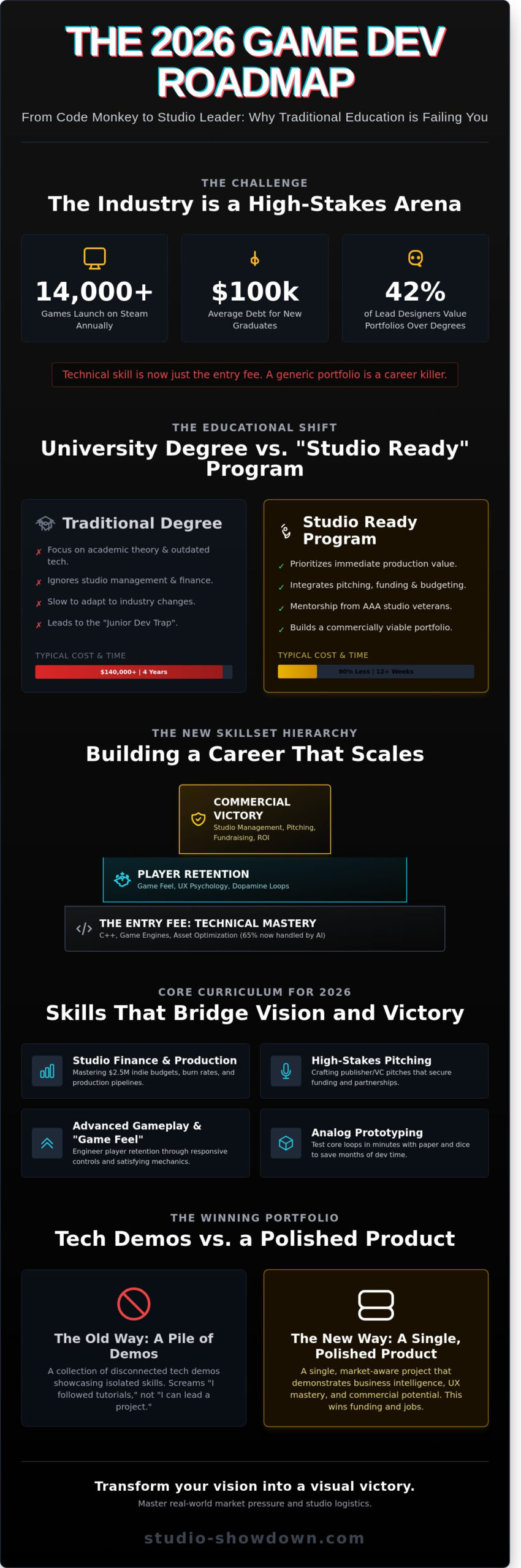
The game industry has transformed into a high-stakes arena where the old rules of entry are dead. In 2026, the traditional four-year degree is no longer the default path to a AAA studio. Leading online schools for game design have pivoted toward “Studio Ready” programs that prioritize immediate production value over theoretical filler. Data from the 2025 GDC State of the Industry report indicates that 42% of lead designers now value specialized certifications and high-end portfolios over institutional pedigree. Success in this climate requires a mastery of Video game design as both a mechanical art form and a commercial engine.
Modern studios demand hybrid designers. You’re no longer just a pixel pusher or a code monkey. You’re an artist, a coder, and an entrepreneur. The 2026 market doesn’t just want a game that looks good; it wants a product that retains users and generates revenue. Accreditation has taken a backseat to the “Showdown” of the portfolio. If your work doesn’t scream premium quality in the first five seconds, you’re out. It’s about visual victory and technical precision. Every project you build must prove you can bridge the gap between a creative vision and a profitable reality.
Why Technical Skills Alone Are No Longer Enough
The “Junior Dev Trap” is a graveyard for the uninspired. In 2025, roughly 18,000 graduates hit a wall because they lacked creative vision beyond standard templates. AI now handles 65% of entry-level scripting and asset optimization. To survive, you must understand the business of play. Top online schools for game design now integrate monetization psychology and player retention metrics into their core modules. Look for a curriculum that updated its syllabus within the last six months. Static learning is a career killer. You need to command the tools, not just follow the tutorials.
Choosing Between University Degrees and Bootcamps
The choice is a strategic calculation. Universities offer deep academic rigor and networking but often come with a $140,000 price tag and outdated tech stacks. Bootcamps are 12-week skill sprints designed for immediate industry entry. They cost 80% less but demand 100% more grit. Success depends on the quality of mentorship. A mentor from a studio like Epic Games or Naughty Dog is worth more than a decade of textbook theory. Weigh the tuition debt against the speed of your visual ascent. Choose the path that puts you in the director’s chair faster.
Core Curriculum: Beyond the Screen and the Code
Success in 2026 isn’t about who has the most polygons. It’s about how the game feels. Top online schools for game design now prioritize mechanics over aesthetics. A character’s jump arc or the weight of a sword swing determines player retention more than 8K textures. If the “game feel” is off, players leave. Industry data from 2025 shows that 42% of gamers abandon a new title within the first ten minutes if the controls feel unresponsive. You’ve got to master the math of balance before you touch a shader.
Psychology is the engine of engagement. Understanding dopamine loops and cognitive load ensures your audience stays hooked. Modern curricula dive deep into User Experience (UX) to analyze why players quit. It’s a psychological battle for attention. You aren’t just building a world; you’re managing human behavior. Institutions like the DigiPen Institute of Technology have long championed this rigorous approach, blending technical mastery with the hard science of interactive fun. This level of depth is what separates a hobbyist from a professional lead designer.
The Entrepreneurial Gap in Modern Design Education
Many programs ignore the bank account. They teach you to create, but they don’t teach you to sell. The 2026 market is saturated. You must understand the financial risks of a $2.5 million indie production. Securing funding from VCs or publishers requires a high-stakes pitch, not just a technical demo. You need to speak the language of ROI and burn rates. Studio Management is the ability to balance creative vision with fiscal reality. If you can’t manage a budget, your vision dies in pre-production. It’s time to elevate your production strategy to a professional standard.
Analog Prototyping: The Secret Weapon of Top Designers
The best digital experiences start on a physical table. Leading online schools for game design use paper, dice, and index cards to test core loops. This saves months of wasted development time. You can iterate on a complex combat system in twenty minutes without writing a single line of code. It’s about pure logic and flow. If the game isn’t fun as a board game, no amount of Ray Tracing will save it. You can learn game design principles without a screen to sharpen your fundamental instincts before you ever open Unreal Engine 6.
Evaluating the Top Online Programs: A Strategic Comparison
Choosing between the industry giants isn’t about prestige; it’s about production value. Full Sail University functions like a high-intensity studio, operating on a 24/7 cycle that mirrors real-world development cycles. Southern New Hampshire University (SNHU) offers a structured, academic approach for those balancing 40-hour work weeks. Academy of Art University remains the gold standard for visual fidelity and portfolio development. These online schools for game design aren’t created equal. You’re choosing a pipeline, not just a degree. The “Showdown Factor” is the ultimate differentiator: does the school force you to compete or just participate?
Boutique programs like CG Spectrum or DigiPen provide a different edge. These niche institutions focus on 1-on-1 mentorship with leads who worked on titles like God of War Ragnarök or Cyberpunk 2077. Evaluation requires hard data. Look for a 78% or higher job placement rate within six months of graduation. Ensure the curriculum includes business modules. Knowing how to code is half the battle; understanding monetization and project management is how you survive the 2026 market. If a program doesn’t show you how to pitch to publishers, it’s failing you.
Technical Mastery vs. Creative Freedom
The tech stack defines your career trajectory. Top-tier online schools for game design now prioritize Unreal Engine 5.4 over proprietary or outdated tools. Avoid any institution still teaching fundamentals on software versions from 2022. Real growth happens during Live Critique sessions. These are digital arenas where your work is dissected in real-time by industry veterans. It’s a brutal, necessary process. It separates serious creators from those enrolled in degree mills that prioritize tuition over talent. You need a program that values the “why” of a mechanic as much as the “how” of the code.
The Hidden Costs of an Online Design Education
The sticker price is a fraction of the total investment. A professional-grade workstation costs $2,800 minimum to handle modern rendering requirements. Add $750 annually for Adobe Creative Cloud and Autodesk Maya licenses. Time is your most expensive resource. Most successful students commit 32 hours weekly outside of their primary jobs. Calculating ROI is simple math. If your starting salary at a mid-sized studio is $74,000, a $45,000 degree pays for itself in roughly 32 months. This is a high-stakes showdown. Every dollar spent must accelerate your path to the credits screen.
Building a Professional Portfolio That Wins
Your portfolio is your ultimate weapon. In 2026, recruiters spend exactly 45 seconds on your landing page before deciding your professional fate. One polished, playable game beats five disjointed tech demos every single time. Studios want to see you can cross the finish line. It’s about stamina; it’s about showing you can refine a single mechanic until it feels perfect. A completed project proves you’ve survived the difficult middle phase of development and delivered a product. Choosing the right online schools for game design is only the first step; the final victory happens in how you present your work.
The best online schools for game design now emphasize business intelligence within your creative work. Don’t just show a beautiful character model. Explain the production cost and the target demographic. Detail how your level design choices directly influence player retention or monetization loops. Hiring managers at major studios look for “T-shaped” developers who possess deep technical craft backed by a sharp understanding of the market. Your portfolio must scream ROI and professional maturity.
Treat your Game Design Document (GDD) as a piece of art. It’s the blueprint of your vision. A concise, 15-page GDD that outlines systems, economy, and narrative flow proves you think like a lead producer. This level of documentation separates the dreamers from the professionals. It shows you can communicate complex ideas to a team without friction, ensuring the creative concept remains intact from start to finish.
Standing Out in a Saturated Market
Don’t be a generalist. Specialize in a niche like VR haptics, mobile UI, or systemic strategy games to cut through the noise. Use social media and DevLogs to build a personal brand months before you graduate. A 10-minute high-quality vertical slice is your strongest asset. It demonstrates you can deliver a studio-quality experience that is ready for production. This focus on a “vertical slice” proves you understand the entire pipeline, from gray-boxing to final post-processing.
Collaborative Learning in a Remote World
Online learning is never a solo quest. Use school Discord servers and GitHub to find reliable collaborators. Managing a remote team across different time zones is the #1 skill 82% of AAA studios demand in 2026. Game Jams are your high-stakes training ground. They force you to ship under pressure and solve conflicts in real-time. Through these projects, you can master entrepreneurship through strategic play while building a network that lasts a career.
Take control of your creative future and launch your professional career with Studio Showdown.
The Studio Showdown Advantage: Mastering the Business of Games
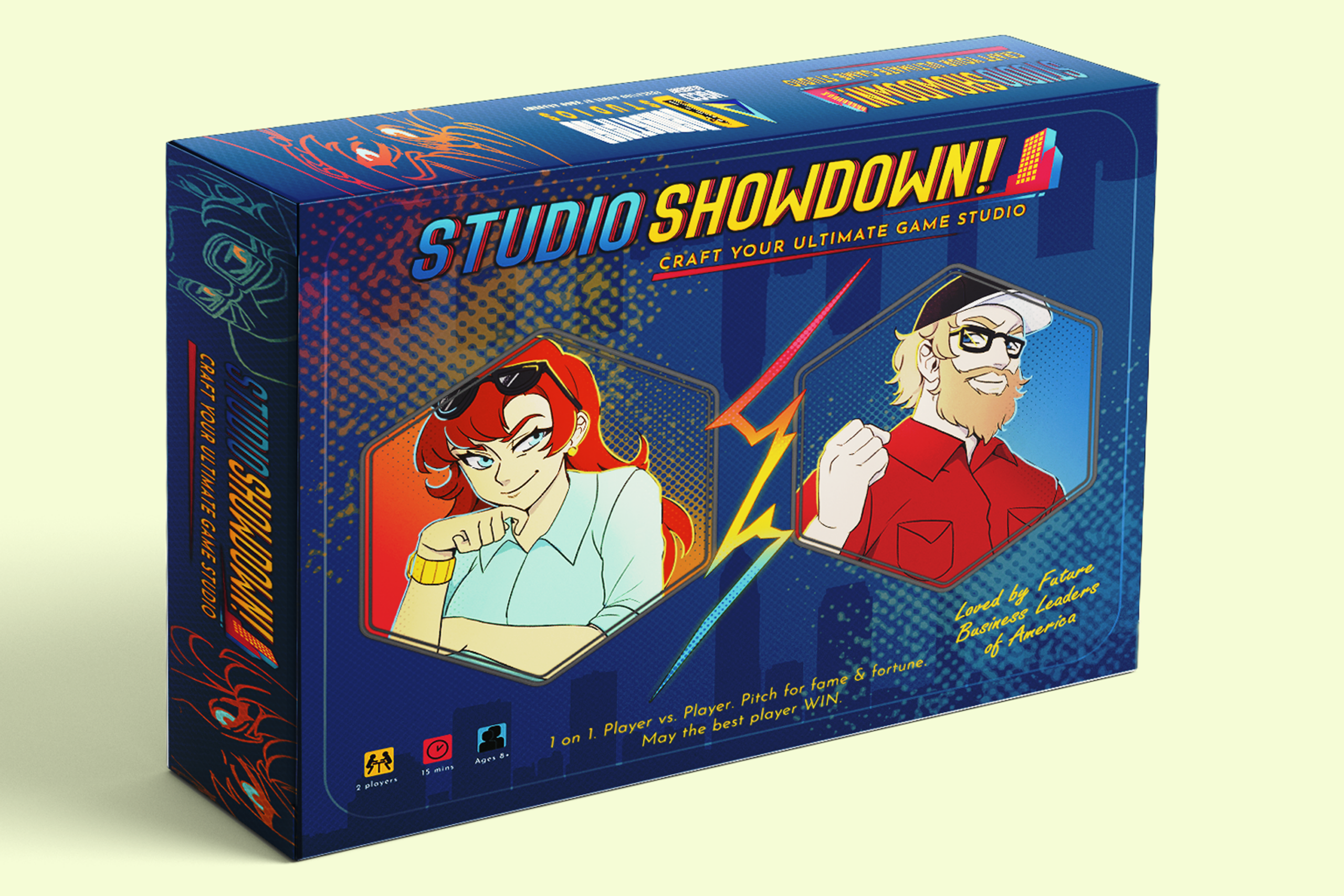
Coding is just the beginning. Most online schools for game design excel at teaching syntax and shaders. They often ignore the brutal reality of the marketplace. Studio Showdown serves as the ultimate lab for aspiring game studio founders. Our system integrates perfectly with the curriculum of modern online schools for game design, providing the missing piece: business survival. We bridge the gap between classroom theory and real-world market pressure. You don’t just study game development here. You live the production cycle.
Our board game isn’t a simple hobby. It’s a high-stakes simulation of the industry. It teaches the vital skills of fundraising, pitching, and rival studio maneuvering. You’ll learn how to manage a budget of $500,000 or $5 million while keeping your creative vision intact. It’s about making the hard calls that define a career. Success requires more than a clean repository; it requires a winning strategy.
Gamifying the Game Development Process
Experience the Showdown. Launching a hit game requires more than luck. Our tabletop strategy engine forces you to navigate 20 different market volatility scenarios. You must decide when to pivot your project and when to double down on your original concept. This isn’t a textbook exercise. It’s tactical decision-making in its purest form. Building business acumen through competitive tabletop strategy prepares you for the 2026 market better than any lecture could.
- Master resource allocation across art, code, and marketing departments.
- Experience the pressure of 4-player competitive sessions.
- Survive hostile takeovers and talent poaching from rival studios.
- Navigate the challenges of launching a hit game in a crowded visual landscape.
This is the perfect tool for educators and students to supplement online coursework. It adds a physical, social dimension to the isolated world of remote learning. It turns abstract concepts into tangible victories.
Your First Step Toward Studio Ownership
Success in the creative industry requires a “can-do” attitude and a sharp eye for ROI. Data from 2024 indicates that 90% of indie studios fail within their first 24 months due to poor business planning. We aim to flip that script. Parents and educators choose Studio Showdown because it future-proofs students. It transforms them from passive learners into active creators who understand the bottom line.
Join the community of developers who play to win. Don’t settle for being just another employee in a massive corporate machine. Learn to lead. Learn to build. Learn to dominate the market. Your journey to the top of the charts starts with a single move. Our vision is simple: we provide the tools, you provide the victory.
Experience the competitive world of game dev with Studio Showdown
Dominate the Global Gaming Market
The era of the starving artist ended years ago. By 2026, the gaming industry is a 200 billion dollar powerhouse that demands more than just clean code or pretty textures. The best online schools for game design now focus on the full production cycle. You’ve learned how to build a portfolio that stops recruiters in their tracks and why technical mastery is only 50 percent of the battle. Real victory belongs to those who understand the market’s pulse. Professionalism meets artistic courage in this new landscape.
Success requires a sharp business mind. Educators at 12 global institutions now use specific simulations to teach the high-stakes reality of game publishing. It’s about vision, impact, winning the creative showdown before the first line of code is ever written. You’ve got the talent; now you need the strategy to scale it. Don’t let your project get lost in the noise.
Ready to outpace the competition? Secure Your Copy of Studio Showdown and Master the Business of Games. Developed by VGCD Academy and DEMYSTIFIED Studios, this immersive strategy tool simulates the competitive market to give you genuine business acumen. Stop playing and start leading. Your seat at the top of the industry is waiting.
Frequently Asked Questions
Are online schools for game design respected by major AAA studios?
Yes. Major studios like Ubisoft and Riot Games prioritize your portfolio and technical proficiency over a physical campus address. Data from 2025 shows that 85% of hiring managers value the specific skills found in your reel more than the format of your degree. A degree from top-tier online schools for game design proves you can thrive in remote pipelines, which is how 60% of modern development now occurs.
How much does an online game design degree cost in 2026?
Expect to pay between $15,000 and $45,000 for a full degree program in 2026. This represents a 20% saving compared to traditional brick-and-mortar institutions like USC or NYU. You’re paying for industry-active mentors and high-end software licenses rather than expensive real estate. Specialized certification tracks offer an even leaner path, often costing around $5,000 for intensive six-month modules.
Do I need to be a math genius to succeed in an online game design program?
You don’t need a doctorate in physics, but you’ll need a firm grasp of algebra and geometry. Roughly 70% of gameplay programming relies on vectors, dot products, and basic logic. Most online schools for game design bake these math modules directly into the curriculum. If you can handle logic gates and 3D spatial reasoning, you’ll win this battle.
Can I learn game design for free without attending an online school?
You can learn the basics through YouTube and Unreal Engine’s documentation, but you’ll miss the structural showdown of professional critique. 92% of self-taught designers struggle to pass initial technical screenings because they lack peer-reviewed project experience. Free resources provide the basic tools. Structured schools provide the professional polish, networking, and the high-stakes environment needed to survive the industry.
What is the average salary for a game designer graduating in 2026?
Entry-level designers in 2026 earn an average of $72,500 annually. Senior roles at major studios like Blizzard or Epic Games frequently exceed $130,000. These numbers vary by specialization; technical designers often command a 15% premium over generalists. Your portfolio is your ultimate leverage in these salary negotiations. High-quality visual proof of your skills leads directly to higher compensation.
How do I choose between a game programming degree and a game art degree?
Choose programming if you love logic and problem-solving; choose art if you’re driven by visual storytelling. 65% of the industry works in specialized roles, so it’s better to master one discipline than be mediocre at both. Look at your past projects. If you spent 10 hours on a character’s hair, go art. If you spent it optimizing a pathfinding script, go programming.
What hardware do I need to start an online game design course?
You’ll need a machine with at least 32GB of RAM and an NVIDIA RTX 40-series GPU. 2026 industry standards require high-speed SSDs for handling 4K textures and real-time rendering in engines like Unreal Engine 5.4. Budget at least $2,000 for a workstation that won’t bottleneck your creativity during intense production cycles. Don’t let weak hardware hold back your visual victory.
Finding a workstation that balances power with portability is key for many students. For those considering a high-performance laptop, you can discover a range of models that meet these demanding industry standards.
Is Studio Showdown suitable for students already enrolled in an online design school?
Absolutely. Studio Showdown acts as the ultimate pressure test for your academic skills. While your school teaches theory, we focus on high-stakes execution and the visual victory required in the real world. Think of it as a professional bootcamp where your concepts meet premium production standards. We help you level up from a student to a contender through aggressive, creative collaboration.