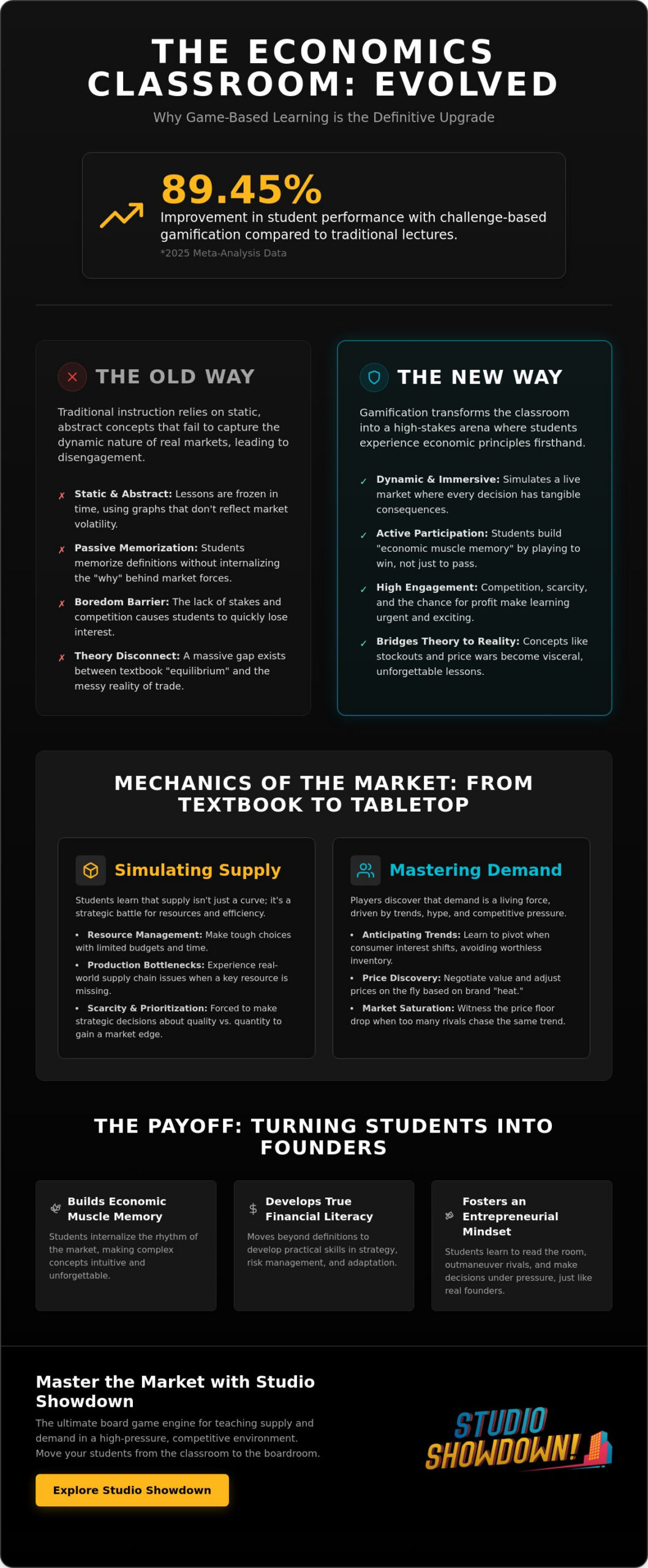
A 2025 meta-analysis revealed that challenge-based gamification can improve student performance by 89.45% compared to traditional lectures. It’s a definitive shift. The era of the static chalkboard is dead. You’ve likely felt the frustration of watching students disengage the moment an abstract graph appears. They crave the heat of the market, not the dry ink of a textbook. Teaching supply and demand with games is the only way to cut through the noise and deliver a lesson that sticks.
We know the pressure of finding high-impact tools that actually fit within a standard class period. You need professional results without the fluff. This guide promises to transform your classroom into a high-stakes arena where economic theory meets raw entrepreneurship. We’ll show you how to use immersive simulations to make market equilibrium feel urgent and tangible. It’s time to move beyond the curves and give your students the competitive edge they deserve.
Key Takeaways
- Build economic muscle memory by replacing static graphs with high-stakes classroom competition that students actually remember.
- Bridge the gap between theory and reality by simulating production costs and shifting consumer trends in a live environment.
- Master the strategy of teaching supply and demand with games by balancing structured briefings with the productive energy of a market simulation.
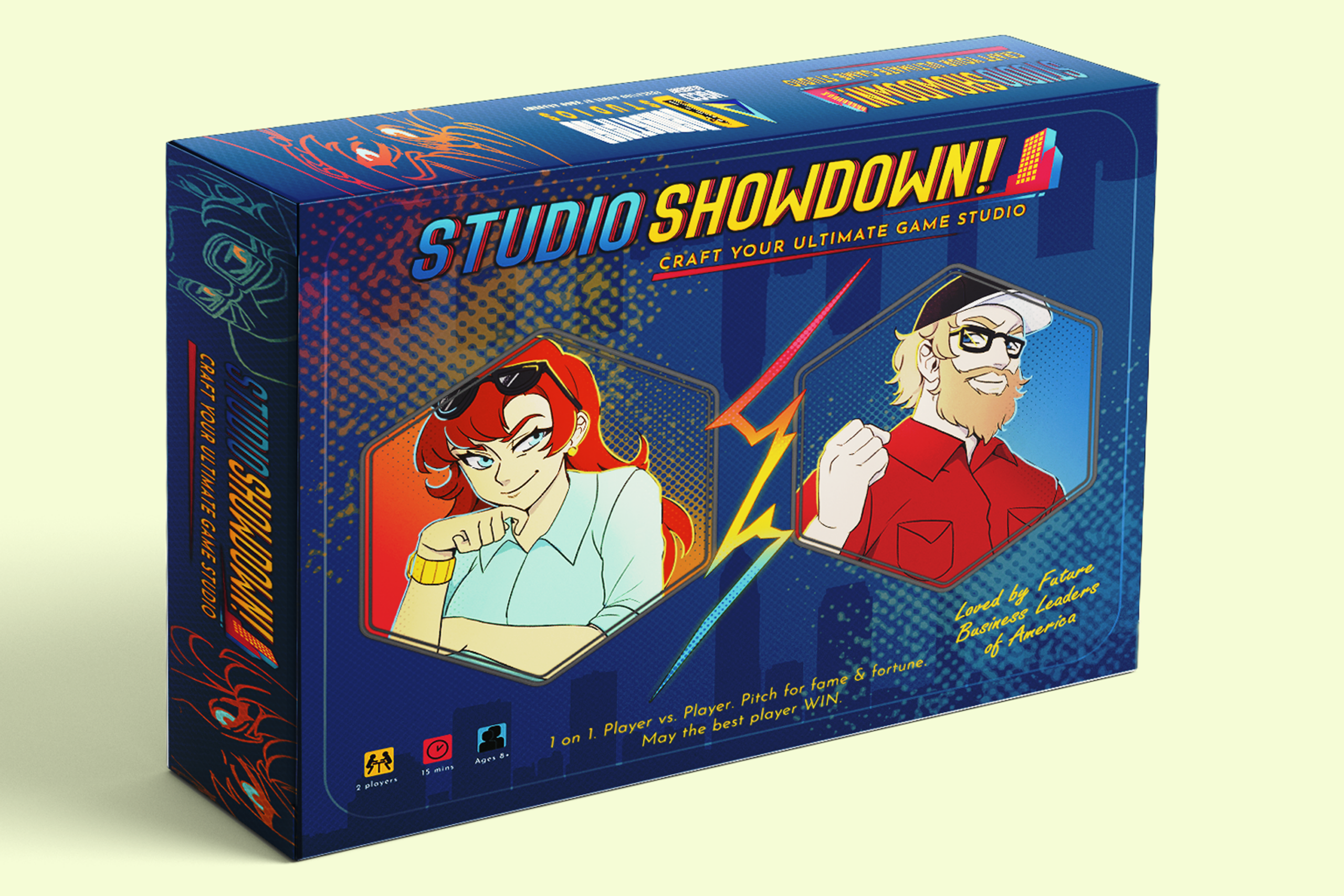
- Discover how Studio Showdown puts students in the founder’s seat, requiring them to navigate market forces and outmaneuver rivals to win.
Why Games are the Best Way to Teach Supply and Demand
Economics isn’t a spectator sport. It’s a battle for resources. When you’re teaching supply and demand with games, you aren’t just lecturing. You’re dropping students into a simulated arena where every decision carries weight. Traditional methods rely on static curves. Real markets rely on adrenaline, intuition, and speed. It’s the difference between looking at a photo of a race and actually sitting in the cockpit. You don’t just learn the rules; you play to win.
Active participation creates muscle memory for economic concepts. Students don’t just memorize definitions. They internalize the rhythm of the market. They feel the pressure of a stockout. They experience the rush of a high-margin sale. This isn’t just education. It’s a production-level simulation that turns abstract theory into a tangible asset. By moving from graphs to inventory management, we bridge the gap between the classroom and the boardroom. Precision meets passion. Theory meets reality.
The Problem with Traditional Economics Instruction
Textbooks fail because they’re frozen in time. They describe a world of perfect information that doesn’t exist. In a real market, volatility is the only constant. There’s a massive disconnect between “equilibrium” on paper and the messy reality of trade. Most middle and high school students hit a boredom barrier by the second chapter. They see abstract lines. They don’t see the stakes. Without the heat of competition, the core economic principle of supply and demand remains a foreign language. We need to raise the bar.
Defining Supply and Demand Through Play
Supply is the fuel that powers the market, while demand is the engine that drives its direction. Games make this relationship visceral. When a player raises their price and watches their customers vanish, they grasp the inverse relationship instantly. It’s about witnessing the market forces in real time. Random events, or market shocks, force players to pivot. A sudden shortage of raw materials isn’t just a bullet point. It’s a strategic crisis. It’s a fight for survival. It’s the ultimate test of their entrepreneurial vision.
Game-based learning improves long-term retention because it attaches emotional weight to the data. Scarcity, competition, profit, loss. These aren’t just words. They’re the stakes of the game. When students play, they learn to outmaneuver their rivals. They learn to read the room. They develop a level of financial literacy that textbooks simply can’t touch. Teaching supply and demand with games isn’t just a strategy; it’s a total upgrade of the educational experience. It turns students into founders.
The Mechanics of Market Forces: From Textbooks to Tabletop
Forget widgets. Forget coffee shops. Textbooks use these tired examples because they’re safe. They’re also forgettable. When you’re teaching supply and demand with games, the mechanics must feel urgent. Supply isn’t just a line on a graph; it’s the struggle to secure talent and resources. Demand isn’t just a desire; it’s the unpredictable pulse of a crowd. On the tabletop, these forces clash in real time. Students aren’t just plotting points on a grid. They’re fighting for market share. Every move is a risk. Every sale is a victory.
Simulating Production and Scarcity
Resource management is the heart of the supply side. Students must grapple with limited budgets and finite time. They quickly realize they can’t have everything. They have to choose. Do they invest in premium quality or push for volume? Production bottlenecks act as real-world supply chain issues. When a resource is missing, the line stops. This scarcity forces students to prioritize. It creates a competitive race where the first to market often wins, but the last to market might have the better product. It’s a balancing act. Quality and quantity are constantly at odds.
Understanding the Consumer Mindset
Anticipating the crowd is the key to mastering demand. Demand is never static. It’s a living, breathing force fueled by marketing and hype. In a simulation, “hit games” can trigger massive demand spikes that shift the entire board. Students learn that demand isn’t just about price; it’s about relevance. They must learn to pivot when the hype dies down. If they can’t adapt, they’ll find themselves with a warehouse full of products nobody wants. This is where price discovery happens. Students negotiate value on the fly, adjusting their prices based on the perceived “heat” of their brand. It’s fast. It’s visceral. It’s real.
The impact of competition becomes visible when the market reaches saturation. When too many players chase the same trend, the price floor drops. It’s a brutal, necessary lesson in economic reality. Facilitating these complex interactions requires a robust framework that moves beyond simple trading. Educators often find that the Studio Showdown board game provides the perfect engine for these lessons. It moves students into the high-pressure world of studio management. They see the big picture. They learn to win the market by understanding the forces that shape it.
Comparing Popular Supply and Demand Games for the Classroom
Choosing the right tool is a tactical decision. It’s not about filling time; it’s about hitting objectives with precision. Teaching supply and demand with games requires matching the mechanic to the specific economic concept you want to dominate. Not all games are built for the same level of engagement. Some focus on the speed of vocabulary, while others dive deep into the brutal reality of market competition. You need a toolkit that scales with your students’ ambitions.
- Quick Review Games: High speed, low friction. These are your pulse-checks. Use them for drilling terms like surplus, shortage, and equilibrium. They’re perfect for the first ten minutes of class.
- Market Simulations: High energy, high noise. These simulate the pit-trading floor. Students trade cards or commodities to find a price. It’s the best way to see price equilibrium emerge from chaos in real time.
- Strategy Board Games: High stakes, high reward. These are the marathon sessions. They require long-term critical thinking and resource management. They don’t just teach economics; they teach the entrepreneurship journey.
Evaluating these tools comes down to three factors: setup time, player count, and depth. A game that takes forty minutes to explain is a lost opportunity. You need a system that gets students into the action within five minutes. Efficiency is everything in a pörgős classroom environment.
Analog vs. Digital Economic Simulations
Screens create distance. Tabletop creates friction. While digital interactives offer convenience, they often fail to capture the social-emotional pressure of a real market. Face-to-face negotiation forces students to read body language and verbal cues. When students handle physical tokens, scarcity feels real. It’s the difference between clicking a button and losing a physical asset. Explore the deeper benefits of analog vs. digital board games to see why tactile learning wins every time. Physical components turn abstract data into a visceral experience.
Criteria for Choosing a Classroom Game
Your choice must align with the 2025 National Content Standards in K-12 Economics. These updated guidelines emphasize the role of technology and market volatility. You need scalability. A game that works for five students but fails for thirty is a liability. Precision matters. Replayability is the ultimate test of value. Can students fail, analyze their strategic mistakes, and pivot in the next round? That’s where the real learning happens. If they can’t try again, they aren’t learning; they’re just following instructions. Teaching supply and demand with games should empower students to master the market, one round at a time.
Implementing Game-Based Learning: A Strategy Guide for Educators
Theory is safe. Execution is where students grow. Implementing teaching supply and demand with games requires more than just opening a box. You need a tactical plan. Start with a pre-game briefing that sets the economic stage. Don’t just explain the rules; explain the stakes. Tell them they’re founders. Tell them the market is volatile. When you frame the activity as a professional challenge, student buy-in skyrockets. They aren’t just playing a game; they’re launching a venture.
Managing the chaos of a live simulation is an art form. It will be loud. It will be fast. This energy is a sign of engagement, not a lack of discipline. Your role is to facilitate the flow. Watch for the moments where the market shifts. Point out the “invisible hand” in action as prices begin to stabilize or crash. By the end of the session, students should have a trail of data. Use these results to build student portfolios that demonstrate their growing business acumen and strategic thinking. It turns a single class period into a career-building milestone.
The Art of the Debrief
The game is the hook, but the debrief is the anchor. This is where play becomes permanent knowledge. Ask the hard questions. Why did the price of the “hit” product crash in round three? Was it a sudden surge in supply or a shift in consumer preference? Force students to map their session onto a standard supply and demand graph. When they see their own decisions reflected in those lines, the abstraction vanishes. This process hardens their real-world business simulation skills, ensuring they can apply these lessons to any market they enter in the future.
Integrating Economics into STEM and Business
Economic forces don’t stop at the social studies door. Supply and demand dictate the survival of every tech startup and game development studio. This provides a massive cross-curricular opportunity. Math classes can use game data for graphing and trend analysis. Social studies can explore the history of market shocks. ELA students can practice the art of the pitch. High-quality business simulation games bridge the gap between classroom theory and high-stakes career reality by forcing students to make decisions under pressure. It’s time to stop teaching in silos and start teaching for the real world.
Ready to bring this level of intensity to your classroom? Explore the Studio Showdown: Educator Edition and transform your next lesson into a competitive market showdown.
Mastering the Market with Studio Showdown
Teaching supply and demand with games reaches its peak when the stakes are personal. Studio Showdown isn’t a passive exercise. It’s a high-octane business simulation. Students step into the role of studio founders. They aren’t just shifting tokens; they’re managing a creative empire. They must navigate a market that rewards innovation and punishes stagnation. This is where the abstract becomes professional. Rival studios are always watching. One wrong move in talent acquisition or a missed market trend can end a project. It’s a battle for relevance. Every decision is a calculated risk that shapes their visual success.
The transition from student to founder happens the moment the game begins. By acting as studio founders, students experience the high-stakes reality of supply and demand in game development. They learn that a great idea isn’t enough. You need the right resources at the right time. You need to outmaneuver rivals who are chasing the same talent and the same audience. This competitive drive turns a standard lesson into a memorable production. It builds a level of professional confidence that a textbook can’t replicate.
A Competitive World of Game Development
The entertainment industry is hit-driven. It’s volatile. Studio Showdown captures this perfectly by simulating the constant tug-of-war between supply and demand. Players must manage the supply of specialized talent while balancing the fluctuating demand for new titles. It’s a delicate equilibrium. Mastering the pitch is essential. You have to sell your supply to a market that is already saturated with options. Students learn to find the gap. They learn to create value where others see noise. This isn’t just play. It’s a production-level simulation of an industry that moves at the speed of light.
Ready-to-Use Classroom Solutions
Educators need tools that work out of the box. The Studio Showdown: Educator Edition is built for the 2026 classroom. It removes the friction of setup. It provides a structured framework for teaching supply and demand with games. You don’t have to invent the scenarios. We’ve done the work. For schools looking to scale their entrepreneurship programs, Classroom Bundles offer a complete solution. You can outfit an entire department with the tools of the trade. It’s a turn-key upgrade for any economics curriculum. Order a Classroom Bundle to bring the showdown to your students today.
Every session builds a professional portfolio. Students leave the class with more than just a grade. They leave with an understanding of market mechanics that most founders take years to learn. They’ve faced the pressure. They’ve outmaneuvered the competition. They’ve mastered the market. This is the future of economic education. It’s bold. It’s creative. It’s effective. The visual noise of the classroom fades away when the competition begins. This is where the next generation of leaders is made.
Launch the Next Generation of Founders
The chalkboard is a relic. Your students deserve a high-stakes arena where they can test their intuition against the reality of market forces. Teaching supply and demand with games isn’t just an alternative method; it’s a total strategic upgrade. We’ve moved beyond the “widget” era. We’re now in the era of the founder. By transforming your classroom into a studio, you give students the muscle memory they need to navigate any market with precision.
Studio Showdown, developed by VGCD Academy and DEMYSTIFIED Studios, is the definitive tool for this shift. It’s built for peak student engagement and real-world business acumen. This isn’t about filling a class period. It’s about building a career foundation. You have the power to turn abstract data into a visceral experience. Don’t settle for mediocre engagement when you can lead a market showdown. It’s time to elevate the educational experience.
Bring Studio Showdown to your classroom today and watch the theory come to life. Your classroom is the next great production. Let’s make it a success.
Frequently Asked Questions
What is the best age to start teaching supply and demand?
Middle school, specifically ages 11 to 13, is the ideal starting point for foundational economic concepts. At this stage, students possess the abstract reasoning skills required to understand trade-offs. While younger children can grasp basic trading, middle and high schoolers are ready for the high-stakes entrepreneurship and strategic depth found in professional simulations. It’s about scaling the complexity to match their growing ambition.
Can I teach supply and demand without using complex math or graphing?
Yes, you should focus on market logic before introducing formulas. Teaching supply and demand with games allows students to internalize the “why” behind price shifts through visceral experience. The math then becomes a tool for explaining their wins rather than a barrier to entry. When students feel the pressure of scarcity, the eventual graphing feels like a natural extension of their own strategic decisions.
How long does a typical classroom economic simulation take?
Most effective classroom games are designed to fit within a standard 45 to 60 minute period. This window includes a rapid five-minute briefing, thirty minutes of high-intensity gameplay, and a concluding ten-minute debrief. Efficiency is critical for modern educators. You need a tight loop of action and analysis that respects your schedule while delivering maximum impact without any wasted energy.
Are board games or digital simulations better for teaching economics?
Board games are superior for fostering the social negotiation and body language reading required in real-world markets. While digital tools offer convenience, tabletop simulations provide a tactile experience that makes scarcity feel permanent. Physical tokens and face-to-face competition create a level of social-emotional learning that screens simply can’t replicate. It’s a premium, immersive way to harden student business acumen.
How do games like Studio Showdown align with educational standards?
Studio Showdown is specifically engineered to align with the 2025 National Content Standards in K-12 Economics. It directly addresses the updated focus on technology, market volatility, and entrepreneurial decision-making. You don’t have to choose between engagement and academic rigor. It’s a professional-grade production that meets the demands of modern curricula while keeping students locked into the competitive challenge.
What are the most common misconceptions students have about supply and demand?
Students often believe that sellers have absolute power over pricing. They forget that the buyer has the final vote in any transaction. Games shatter this illusion instantly. Players quickly realize that a high-priced product is worthless if it sits on the shelf. The market is a brutal, honest judge. Simulations teach them that value is a negotiated reality, not a fixed number.
How can I adapt these games for students with different learning needs?
Use team-based play to pair students with complementary strengths, such as analytical thinkers with persuasive negotiators. Clear iconography and physical tokens support tactile learners and those who struggle with abstract data. You can also adjust the number of resources or the length of rounds to manage the cognitive load. Inclusion doesn’t mean lowering the stakes; it means opening the arena to everyone.