The era of passive, eye-rolling social-emotional learning is dead. Most teenagers would rather stare at a blank screen than sit through another cringey lecture on empathy or active listening. You see the gap widening every day. Screen addiction is real. Face-to-face collaboration is becoming a lost art. It’s frustrating to watch brilliant students struggle with the very professional dynamics they’ll need to survive in the 2026 workforce.
We agree that traditional methods aren’t just boring; they’re ineffective. Finding the right group activities for developing soft skills in teens shouldn’t feel like a losing battle against a smartphone. It’s time to elevate the experience. This guide promises to transform your approach by replacing tired icebreakers with high-stakes, professional-grade simulations. You’ll discover how to turn passive learning into active mastery that mirrors the intensity of a real-world studio.
We’re diving into high-impact strategies designed to build communication, conflict resolution, and strategic thinking. From competitive board game dynamics to industry-style pitching, we’ll show you how to create an environment where students lead their own learning. Prepare to bridge the gap between school and career with precision and creative grit.
Key Takeaways
- Redefine soft skills as essential survival tools in a 2026 economy where human-centric negotiation is your greatest edge over AI.
- Explore high-impact group activities for developing soft skills in teens that replace passive listening with active, professional-grade simulations.
- Master the art of “co-opetition” to eliminate social loafing and drive real-world accountability within your student teams.
- Use the Studio Showdown Board Game as a strategic laboratory where students navigate fundraising and industry pivots in real time.
- Bridge the gap between the classroom and the career world by fostering an environment that mirrors professional studio dynamics.
Teen Soft Skills: Why They Matter in 2026
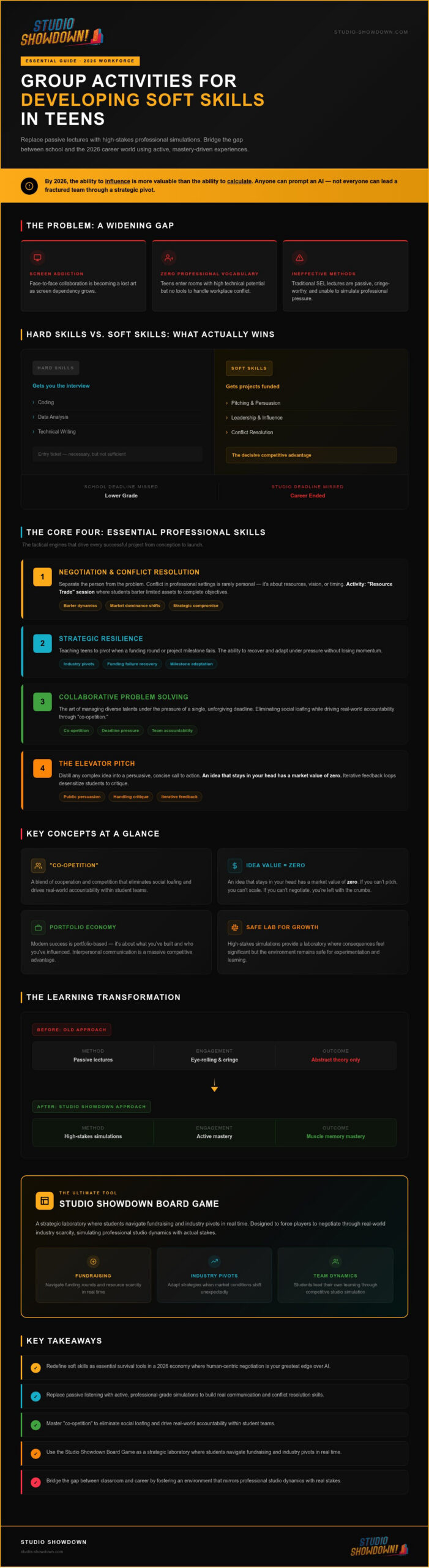
Soft skills aren’t just “people skills.” They are professional survival tools. By 2026, the distinction between technical ability and interpersonal mastery has blurred. Anyone can prompt an AI to write code or solve a complex math equation. Not everyone can lead a fractured team through a strategic pivot. This is why group activities for developing soft skills in teens have moved from the optional column to the essential one. We’re looking at a world where the ability to influence is more valuable than the ability to calculate.
Hard skills get you the interview. Coding, data analysis, and technical writing are the entry tickets. However, soft skills like pitching and leadership are what actually get projects funded. Teens often enter the room with high technical potential but zero professional vocabulary. They lack the tools to handle workplace conflict without it becoming personal. They don’t know how to advocate for their ideas in a high-pressure environment. Without these tools, their hard skills remain locked behind a wall of social anxiety and screen addiction.
The 2026 Professional Landscape
Automation has eaten the routine. The demand for creative problem solvers is at an all-time high. Modern success is portfolio-based; it’s about what you’ve built and who you’ve influenced. Interpersonal communication is now a massive competitive advantage. If you can’t pitch, you can’t scale. If you can’t negotiate, you’re left with the crumbs of the creative economy. Today’s youth must learn to view every interaction as a production phase where quality and clarity determine the outcome.
The Gap Between School and the ‘Real World’
Traditional academic settings struggle to simulate professional pressure. A missed deadline in class results in a lower grade; a missed deadline in a professional studio can end a career. Teens need exposure to these stakes through intentional group activities for developing soft skills in teens. These activities provide a laboratory for growth where the consequences feel significant but the environment remains safe for experimentation. High-stakes simulations bridge the experience gap by forcing students to move beyond theory and into tactical execution. In the context of entrepreneurship, soft skills are the strategic ability to manage human dynamics and resource scarcity to ensure a project’s survival.
The Core Four: Essential Professional Skills for the Modern Teen
Generic advice about “being nice” won’t cut it in the 2026 economy. Modern success isn’t about being the smartest person in the room; it’s about being the person who can align the room toward a common goal. To bridge the gap between high school and a high-stakes career, we focus on the “Core Four” professional tools. These are the tactical engines that drive every successful project from conception to launch. By integrating specific group activities for developing soft skills in teens, we move these concepts from abstract theory into muscle memory.
Negotiation is the first pillar. It isn’t a brawl; it’s a bridge. Strategic resilience follows closely, teaching teens to pivot when a funding round or a project milestone fails. Then comes collaborative problem solving, which is the art of managing diverse talents under the pressure of a single, unforgiving deadline. Finally, the elevator pitch ensures that no matter how complex an idea is, it can be distilled into a persuasive, concise call to action. These aren’t just “soft” traits; they’re the hard requirements for project survival.
Negotiation and Conflict Resolution
We teach teens to separate the person from the problem. Conflict in a professional setting is rarely personal; it’s usually about resources, vision, or timing. To master this, we recommend a “Resource Trade” session. In this activity, students barter limited assets to complete their objectives. They learn how market dominance shifts and when a strategic compromise is better than a total stalemate. This type of high-stakes training is exactly why the Studio Showdown Board Game was designed, as it forces players to negotiate through real-world industry scarcity.
Pitching and Public Persuasion
Every teen must learn to sell their ideas. An idea that stays in your head has a market value of zero. Pitching is the art of public persuasion, and it requires overcoming the deep-seated fear of critique. We use iterative feedback loops to desensitize students to “no.” When a student hears a critique, they shouldn’t see it as a personal attack. They should see it as a fresh data point for their next version. Clear communication is the direct link to project success. If you can’t explain the value, you won’t get the buy-in. These group activities for developing soft skills in teens turn shy students into confident advocates for their own creative vision.
Collaborative vs. Competitive: Choosing the Right Group Dynamic
Pure cooperation is often a slow leak in the classroom. When there’s no external pressure, social loafing takes over. One student carries the load; three others drift. This isn’t an effective model for the 2026 workforce. Instead, we advocate for “Co-opetition.” This dynamic forces teams to collaborate internally while competing externally against a market or a rival studio. It creates a high-stakes atmosphere that mirrors the real business world, where teams must align perfectly to beat the competition. Effective group activities for developing soft skills in teens must harness this friction to produce genuine growth.
Healthy competition isn’t about crushing an opponent. It’s about testing your strategy against another’s vision. It forces teens to sharpen their communication and refine their tactics in real time. The goal is to move beyond mere participation and toward high-performance engagement. Without a clear win condition or a rival to beat, the motivation to innovate often vanishes. We aren’t just playing games; we’re simulating the pressure of a global marketplace where every decision has a consequence.
The Case for Strategic Competition
Competition drives engagement for the most reluctant learners. It turns a standard lesson into a mission. By using game mechanics, we lower the emotional stakes of failure. Losing a round isn’t a catastrophe; it’s a prompt to reboot and try a new approach. This environment teaches teens to be gracious winners and resilient losers. They learn that failure is just a data point, not a personality trait. This resilience is a core pillar of professional mastery that traditional, non-competitive settings often fail to build.
Building High-Performance Teams
High-performance teams don’t happen by accident. They require clear roles and structure. We use role-playing within groups to ensure accountability. Assign specific roles like The Founder, The Developer, and The Marketer. Each role has a unique set of responsibilities and a distinct voice. You can look at strategy board games to see how these mechanics balance a group. When everyone has a specific job, social loafing dies. Every voice must be heard because every role is critical to the team’s survival in a high-pressure simulation.
The final step is the debrief. The activity provides the experience, but the debrief provides the insight. Ask the hard questions. Why did the negotiation fail? Who took the lead when the project stalled? This reflection turns a fun afternoon into a career-defining lesson. This is how group activities for developing soft skills in teens become more than just entertainment; they become professional training grounds for the next generation of industry leaders.
5 High-Impact Group Activities to Run This Week
Theory is the blueprint; execution is the build. To bridge the gap between classroom theory and 2026 career reality, you need tactical drills. These five group activities for developing soft skills in teens are designed to move beyond worksheets and into high-pressure professional simulations. They turn the classroom into a studio where every decision has a measurable impact.
- The ‘Shark Tank’ Pitch: Teams have ten minutes to prep a game concept. They present to a panel of “investors” who provide blunt, iterative feedback. It’s a masterclass in clarity and persuasion.
- The Resource Scramble: Distribute unequal supplies like paper, tape, and markers. Force teams to barter for what they need to complete a build. Negotiation becomes a survival necessity.
- The Crisis Pivot: Halfway through a project, change the market rules. A sudden “funding cut” or “tech shift” forces students to practice strategic resilience in real time.
- The Blind Architect: One student describes a complex structure while the other builds it without seeing the original. This is a pure test of verbal precision and active listening.
- The Studio Founder Challenge: Students act as founders managing a budget and a team. This is where group activities for developing soft skills in teens culminate in a full-scale business simulation.
For facilitators who want a turnkey solution for these dynamics, the Studio Showdown Board Game provides a ready-made laboratory for professional growth.
Facilitation Tips for Maximum Engagement
Gamify the rewards to drive participation. Don’t just give grades; give “market shares” or “venture capital credits.” Set clear Rules of Play to maintain a professional atmosphere from the start. Use physical timers to simulate real-world deadline pressure. Friction creates the heat necessary for growth. Without a ticking clock, the stakes never feel real enough to change behavior.
Debriefing: Turning Play into Learning
The activity is the fuel, but the debrief is the engine. Ask three questions: What was the breaking point? How did the team handle the pivot? Who led the negotiation? Link these sessions to other screen-free activities to keep the momentum going outside the classroom. Encourage teens to document these wins in their professional portfolios. They aren’t just playing games; they are building a track record of leadership and strategic grit.
Studio Showdown: The Ultimate Soft Skill Laboratory
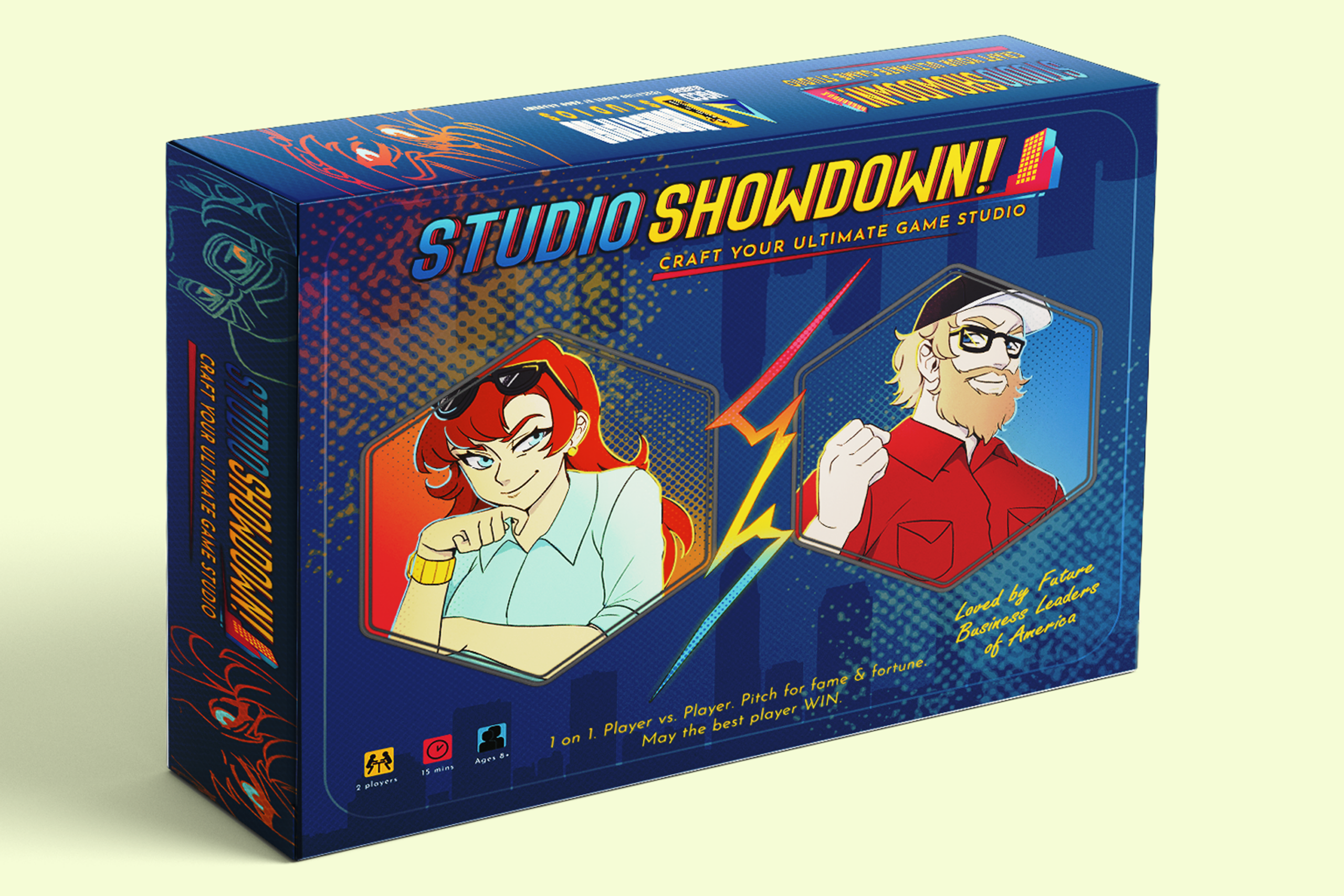
Studio Showdown Board Game is the ultimate laboratory for professional growth. It replaces abstract worksheets with a high-stakes simulation of the video game industry. Teens aren’t just sitting in a circle; they’re acting as studio founders navigating a cutthroat market. This isn’t a passive exercise. It’s a battle for resources, funding, and talent. By using the video game development world as a hook, we ensure total engagement. Students forget they’re learning social-emotional skills because they’re too busy trying to outmaneuver their rivals. This is the gold standard for group activities for developing soft skills in teens.
The game forces players to master fundraising and strategic maneuvering. Fundraising requires a pitch, not a handout. You manage a budget and assess risks with every move. Every turn is a lesson in professional acumen. For institutions, the Studio Showdown: Educator Edition offers a turnkey solution. It’s built for classrooms and libraries where facilitators need high-impact results without a prep-heavy burden. We’ve designed the mechanics to be intuitive yet deep, ensuring the focus remains on communication and strategy.
From Tabletop to Portfolio
Playing a business simulation translates directly to a resume. It provides concrete examples of budgeting, risk assessment, and pitching under pressure. When a teen can explain how they pivoted their studio’s strategy to survive a market crash, they’re speaking the language of the 2026 workforce. Explore the ultimate business board game to see how these mechanics foster deep entrepreneurial mastery and professional grit.
Implementing Studio Showdown in Your Program
Scaling this experience is easy with the Classroom Bundle. It’s designed for large groups where multiple studios compete simultaneously. The game fits perfectly into STEM and business curricula, providing the “soft” layer that technical courses often miss. It turns a standard lesson into a competitive event. The Studio Showdown experience serves as a high-velocity bridge to entrepreneurship, transforming students into founders before they even graduate. These are the most effective group activities for developing soft skills in teens because they mirror the intensity of the real world.
Master the 2026 Competitive Landscape
The gap between classroom theory and career reality is closing fast. We’ve explored how high-stakes simulations and “co-opetition” transform passive students into proactive founders. These group activities for developing soft skills in teens aren’t just about social harmony; they’re about strategic survival in a world dominated by AI. You now have a roadmap to replace cringey icebreakers with professional-grade challenges that demand grit and creative vision.
It’s time to implement a soft skill laboratory that mirrors the intensity of a real-world production studio. Our immersive 2026 business simulation was developed by VGCD Academy experts to ensure every session delivers measurable growth. With classroom-ready bundles available, you can pivot your entire curriculum toward active mastery. Don’t settle for mediocre engagement when you can foster elite leadership and professional acumen. The stakes are real, and the results will be visible in every pitch and project your students touch.
Order the Studio Showdown: Educator Edition for your program today!
The future belongs to those who can lead, negotiate, and pivot under pressure. Start building that future in your classroom now. Success is a production, and you’ve got the lead role.
Frequently Asked Questions
How can I teach soft skills to a teenager who isn’t interested in ‘feelings’?
Reframe the conversation around competition and success. Most teens reject traditional social-emotional learning because it feels abstract or forced. Instead, use high-stakes simulations where soft skills are the only way to achieve a tangible goal. When the objective is to secure funding or outmaneuver a rival, skills like empathy and active listening become tactical advantages rather than emotional chores. It’s about winning the game, not just talking about emotions.
What are the most important soft skills for teens to have by 2026?
By 2026, the most critical tools are negotiation and strategic resilience. As AI handles technical calculations, the human edge lies in the ability to pivot during a crisis and influence others. Teens must master collaborative problem solving to manage diverse teams under tight deadlines. These professional survival tools ensure they can lead projects and secure buy-in in a volatile, portfolio-based economy where creative grit is the primary currency.
Can board games really teach professional business skills?
Absolutely. A well-designed strategy board game acts as a professional laboratory. It forces players to practice fundraising, risk assessment, and pitching in a high-pressure environment. Unlike a lecture, games provide immediate feedback on strategic choices. When teens play Studio Showdown, they are acting as studio founders navigating real industry scarcity. They learn to manage resources and negotiate trades because their success depends on it, making the business skills stick.
How do I facilitate a group activity for a large class of 30+ students?
Large groups require structure and scale. Break the class into small “studios” of four to five students each. Use the Classroom Bundle to ensure every team has the resources to compete simultaneously. Assign specific roles like Founder or Marketer to prevent social loafing. Set strict timers to maintain deadline pressure. This structure allows you to manage 30+ students while ensuring everyone participates in the group activities for developing soft skills in teens.
What is the difference between a ‘social skill’ and a ‘professional soft skill’?
Social skills are about basic interaction; professional soft skills are about tactical outcomes. Being “nice” is a social skill, but “negotiating a contract” is a professional soft skill. One focuses on being liked, while the other focuses on being effective. Professional soft skills are the strategic application of communication and leadership to move a project forward. We teach teens to view these interactions through the lens of production and market success.
How much time should I allocate for a soft skill group activity?
Allocate at least 60 to 90 minutes for a high-impact session. You need 10 minutes for the setup, 40 to 50 minutes for the core simulation, and at least 15 minutes for the debrief. The debrief is the most important phase because it turns the experience into a lesson. Don’t rush the process. High-stakes group activities for developing soft skills in teens require enough time for the pressure to build and the strategy to evolve.
Are there screen-free activities that still appeal to ‘gamer’ teens?
Yes. Tabletop strategy games that mirror the video game industry are highly effective. Gamer teens are naturally drawn to systems, win conditions, and resource management. By using a board game that simulates studio development, you tap into their existing interests without the need for a screen. It forces them into face-to-face collaboration while keeping the mechanical depth they crave. It’s the perfect bridge between their digital hobbies and real-world professional dynamics.
How do I measure the success of a soft-skill building program?
Success is measured through visible shifts in behavior. Look for students who begin to resolve conflicts without facilitator intervention. Track their ability to deliver a concise elevator pitch or pivot a strategy when a project fails. You can also measure success by the quality of their professional portfolios. When a teen can articulate a specific instance where they led a team or negotiated a trade, the program has achieved its goal of building career-ready acumen.