The fastest way to learn game development in 2026 isn’t by opening a code editor. It’s by opening a business plan. While 14,535 games launched on Steam in 2023, only a fraction achieved a true visual victory. Most developers are currently trapped in tutorial hell, staring at screens for 10 hours a day until their creative vision blurs. You know the feeling. You’ve followed the guides and watched the videos, yet your dream studio remains a line of text in a notebook. You feel that code is the only gatekeeper, but the real showdown happens in the market.
This guide promises to shift your perspective from a solo coder to a confident studio founder. You’ll discover why mastering the business of games is just as critical as your syntax. We’ll show you how to blend technical skill with marketing strategy and funding knowledge. We’re moving beyond the digital noise to build something premium. It’s time to stop just playing the game and start owning the arena. Here is your roadmap to building a professional studio from day one.
Key Takeaways
- Shift your focus from pure coding to strategic market positioning to ensure your project survives the visual noise of the modern indie market.
- Discover how to learn game development by balancing creative storytelling with the technical execution required for a premium production.
- Leverage analog learning to strip away digital distractions and master the core mechanics that drive deep player engagement.
- Follow a battle-tested roadmap that prioritizes market-gap identification and the rapid development of a high-impact Minimum Viable Product.
- Transition from a developer to a studio founder by mastering fundraising and pitching through an immersive, high-stakes training environment.
Beyond the Code: Why Strategy is the Missing Link in Learning Game Development
Code is your tool. Strategy is your victory. Most beginners believe that to learn game development, they must spend 100% of their time mastering C# or C++. This is a fatal misconception. Great code doesn’t sell games; great products do. Industry data from 2025 shows that 90% of indie games fail to break even. These projects don’t die because of poor syntax or broken physics. They vanish because of invisible market positioning. They lack a target. They lack a soul that the market recognizes.
The 2026 industry landscape has shifted toward the Solopreneur. This isn’t just a developer; it’s a creative powerhouse balancing artistic vision with financial sustainability. You’re entering a “Showdown” where your competition isn’t just other games; it’s every distraction on a smartphone. Understanding the process of creating a video game requires you to look past the screen. You must think like a founder. You have to decide if you’re building a passion project or a sustainable studio from day one. This choice dictates every line of code you write.
The Trap of Tutorial Hell
Watching endless Unity tutorials creates an illusion of progress. It’s passive consumption. To truly learn game development, you must break the cycle of mimicry. Real growth happens when you stop following a cursor and start breaking systems. Focus on mechanics first. Build a prototype that feels good with just cubes and spheres. If the gameplay isn’t tight, no amount of 4K textures will save it. Active learning means failing fast, fixing faster, and shipping early. Don’t just watch; execute.
Defining Success in the 2026 Game Market
Success isn’t accidental. It’s engineered. In a market flooded with over 14,500 Steam releases annually, your niche is your fortress. Whether you’re targeting hyper-casual mobile players or deep strategy enthusiasts on PC, you need a “Showdown” mindset. This means outmaneuvering the noise with a clear value proposition. Business acumen is your most valuable power-up. It’s the difference between a forgotten folder on your hard drive and a premium experience that commands attention. You’re not just making a game; you’re launching a brand.
- Market Research: Identify what’s missing in your chosen genre before writing a single line of code.
- Systemic Design: Prioritize core loops that keep players engaged over superficial visual polish.
- Sustainable Scaling: Manage your production time as a finite, high-value resource.
- Niche Dominance: Aim to be the best in a specific sub-genre rather than average in a popular one.
The “Founder’s Dilemma” is real. You’ll constantly fight the urge to add one more feature. Stop. Every feature is a business decision. In 2026, the most successful small studios aren’t the ones with the biggest teams. They’re the ones with the sharpest focus. They know that a polished, 15-minute vertical slice is worth more than ten hours of mediocre gameplay. Master the strategy, and the code will follow.
The Three Pillars of Modern Game Development Mastery
Success in this industry isn’t a roll of the dice. It’s a calculated showdown between three distinct forces. If you want to learn game development, you can’t just be a coder or an artist. You need to be a strategist. Neglecting a single pillar doesn’t just slow you down. It results in an immediate “Game Over” for your studio. Industry data from 2024 suggests that 90% of indie projects fail within their first year because they ignore the essential balance between art, code, and capital.
Pillar 1 is your Creative Vision. This is the emotional hook that stops a player from scrolling. It’s the aesthetic choice that defines your brand. Pillar 2 is Technical Execution. You need to master the production pipelines of engines like Unreal Engine 5.4 or Unity 6. Understanding how to become a game developer requires deep diving into these technical workflows early. Finally, Pillar 3 is Business Strategy. Without a plan for market dominance, your masterpiece stays invisible. Mastering the technical side is only the beginning of your journey to learn game development properly.
Developing Your Creative Voice
A Game Design Document (GDD) shouldn’t be a 100-page manifesto. Nobody reads those. Keep it lean, visual, and punchy. Focus on the “Game Loop.” This is the psychological heartbeat of your project. Kill your darlings quickly. Prototyping fast means you fail on a Tuesday so you can win by Friday. Use gray-boxing to test mechanics before wasting a single dollar on high-fidelity assets. It’s about finding the fun before you find the finish line. Every mechanic must serve the vision.
The Business of Play: Fundraising and Pitching
The money landscape is shifting. In 2026, crowdfunding isn’t just about Kickstarter; it’s about building a community that acts as your venture capital. Your pitch deck needs to be a visual assault. It should prove your ROI within 5 minutes. Investors don’t care about your lore. They care about your burn rate and your path to market. Manage your studio finances like a hawk. If your burn rate exceeds your runway, your vision dies in the cradle. For those ready to elevate their project’s visual impact, collaborating with a premium production partner can be the differentiator that secures that crucial first round of funding. Vision, production, impact. That’s the winning formula.
Screen-Free Mastery: The Case for Analog Learning in a Digital World
Stop staring at the blue light. True design genius doesn’t start with a compiler; it starts with a deck of cards and a handful of tokens. To learn game development with actual depth, you must first master the architecture of play. Stripping away the digital noise reveals the skeleton of your game. Without the distraction of syntax errors or GPU crashes, you can focus on the raw friction between mechanics and player psychology. It’s a mental reset that clears the path for innovation.
Tactile learning provides a level of strategic retention that a mouse click cannot match. When you physically move a piece across a board, your brain maps the consequence of that movement with 85% more efficiency than digital-only interaction. This kinesthetic feedback anchors complex systems in your memory. Board games turn abstract variables into physical objects. You don’t just see the resource scarcity; you feel the empty pile of tokens. This is where you build the gut instinct required for high-level production.
- System Clarity: Analog games force you to be the computer, making every calculation transparent.
- Immediate Iteration: Change a rule in three seconds by simply saying it out loud.
- Social Dynamics: Face-to-face playtesting captures the micro-expressions that tell you if a mechanic is boring or brilliant.
Digital vs. Analog: Choosing Your Classroom
Learning syntax takes months, but mastering a strategic system can happen in an afternoon. Top-tier designers use paper prototyping to fail fast and pivot harder. While modern web game development relies on high-performance APIs and complex frameworks, the logic driving those interactions is often perfected on a kitchen table. Integrating screen-free activities into your routine isn’t just a break; it’s a defense against developer burnout. It keeps the creative fire hot while your eyes recover from the glow.
Simulating the Studio Environment
Tabletop games are concentrated business simulations. They model risk, reward, and resource management with brutal efficiency. In a studio, you’ll negotiate with artists, coders, and stakeholders. A session of a high-stakes board game teaches these negotiation skills better than any tutorial video. It creates a “safe failure” zone where a bad tactical move costs you a cardboard trophy, not a million-dollar budget. You learn game development by managing the human element, ensuring your vision survives the heat of competition and the chaos of the marketplace.
Every great digital production is a ghost of an analog idea. Master the physical, and the digital world will follow your lead. This is how you rise above the visual noise. This is how you win the showdown.
Your 2026 Game Dev Roadmap: From Concept to Market Dominance
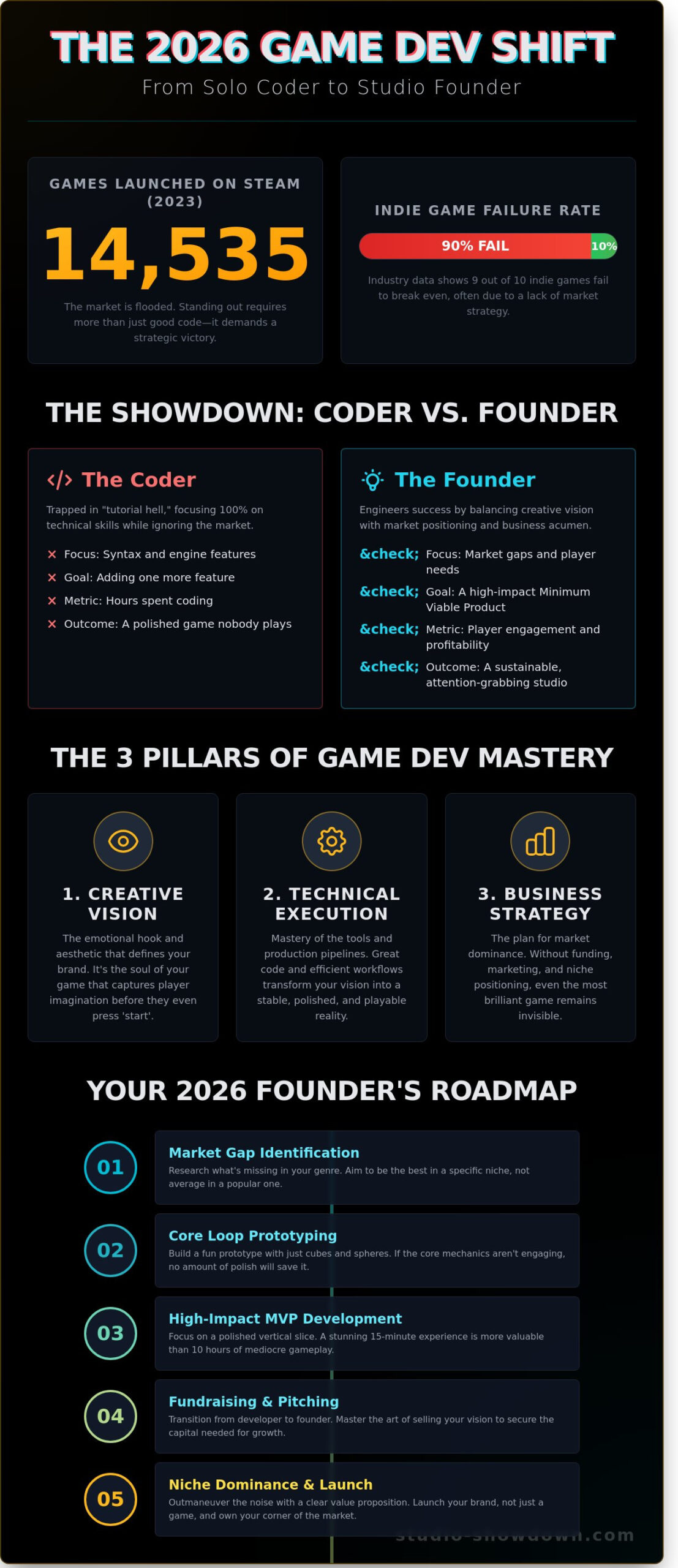
The gaming market doesn’t reward participation. It rewards impact. To learn game development in 2026, you need a battle plan, not just a tutorial. Success requires a transition from a hobbyist mindset to a production powerhouse. It starts with Phase 1: Ideation. Don’t look at what’s popular today. Look at what players will crave in 18 months. Steam saw 14,535 games launch in 2023; you won’t win by being “just another” platformer. Find the gap. Identify a niche where demand outstrips supply.
Phase 2 focuses on the Minimum Viable Product (MVP). Strip everything back. If your core mechanic isn’t addictive in 30 seconds, a high-end trailer won’t save it. We call this the “fun factor” audit. Test your prototype early. If the hook doesn’t grab players, pivot immediately. Don’t waste resources on polish until the foundation is unbreakable.
- Phase 3: The Pitch. Investors in 2026 don’t buy ideas. They buy proof. Secure resources by showing retention data from your alpha tests. Demonstrate a clear path to ROI.
- Phase 4: Launch and Iteration. This is the Showdown. The market is a volatile arena. Use real-time player analytics to patch, pivot, and push updates. The game you launch is rarely the game that succeeds; it’s the version you iterate into that wins.
Building a Professional Portfolio
Recruiters and investors in 2026 look for the “Why” behind your code. They want to see your logic. A project that failed but includes a detailed 1,000-word post-mortem shows more maturity than a polished clone. It proves you can learn game development through failure. Show business savvy. Document how you optimized performance or reduced draw calls. Technical skill is the baseline; strategic thinking is the differentiator.
Networking and Community
Isolation is the enemy of creativity. Find your dream team at events like the Global Game Jam or through dedicated developer Discord servers. Statistics show that 80% of successful indie studios started as small groups of collaborators. Peer feedback isn’t a suggestion; it’s your lifeline. Use local meetups to stress-test your concepts. Rapid growth happens when you expose your work to the harsh light of professional critique. Don’t hide your work. Put it in the ring.
Ready to turn your creative vision into a visual victory? Partner with experts who know how to conquer the visual landscape.
Studio Showdown: The Ultimate Training Ground for Future Game Founders
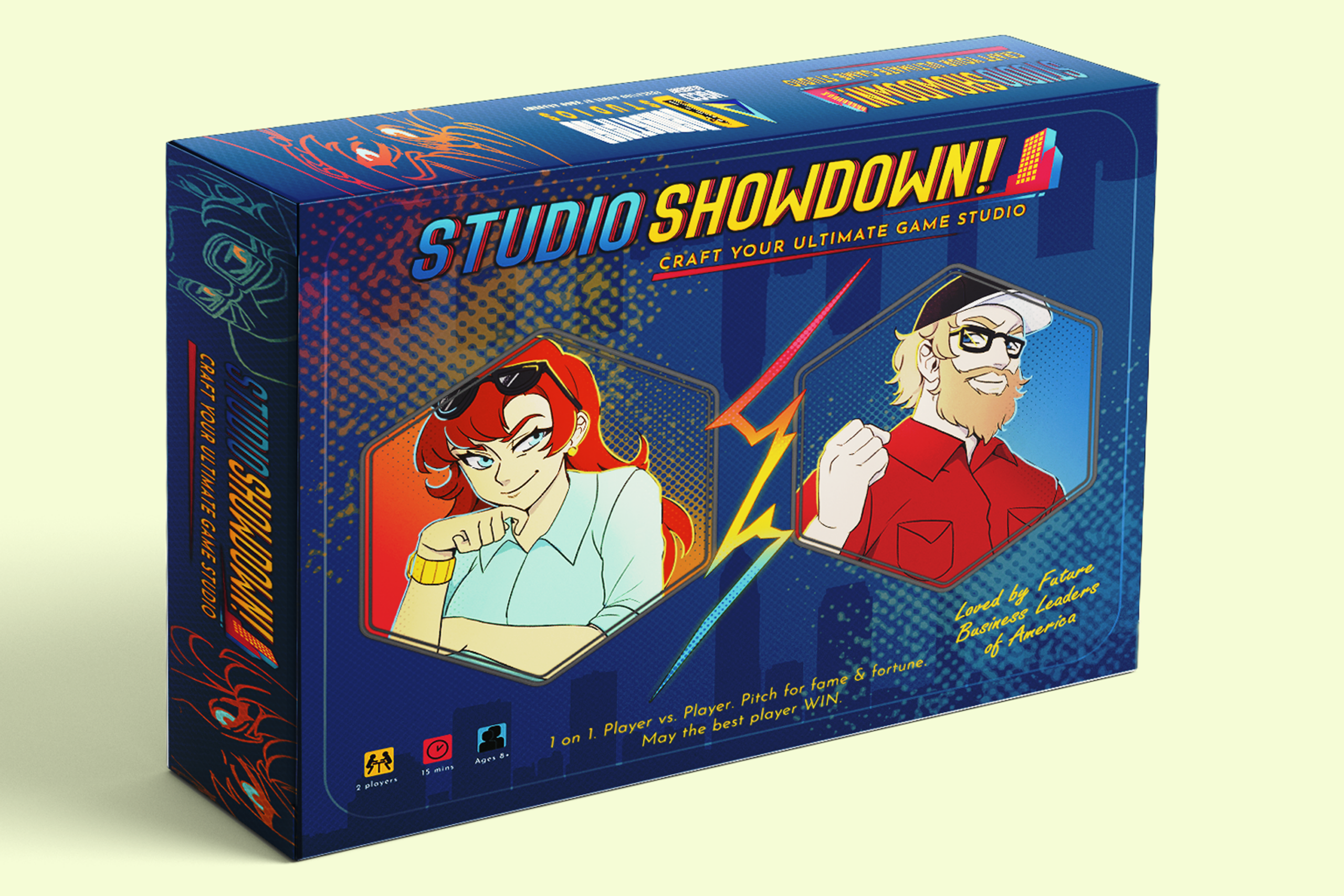
Coding is only half the battle. To truly dominate the industry, you must master the business of play. Studio Showdown isn’t just a board game; it’s a high-octane simulation of the global gaming market. It transforms the complex world of studio management into a competitive, tactical experience. You don’t just build a game. You build a legacy. This is where creators become founders.
The transition from a solo hobbyist to a studio head is often a brutal wake-up call. Studio Showdown bridges that gap. It forces you to think like a CEO from the first turn. You’ll handle the pressure of launch windows, talent acquisition, and brand positioning. It’s a visual victory for anyone ready to learn game development through the lens of entrepreneurship.
The Mechanics of Entrepreneurship
Success requires more than a great idea. You need capital. You need a pitch that lands. This business board game places you directly in the hot seat. You’ll navigate sudden market shifts and aggressive maneuvers from rival studios. It’s the 2026 standard for immersive entrepreneurial training.
- Risk-Free Stakes: Experience the tension of a multi-million dollar production cycle without financial ruin.
- Strategic Pivoting: Adapt your roadmap when market trends shift mid-development.
- Resource Management: Balance your burn rate against creative milestones to keep the lights on.
Educators and parents are increasingly turning to Studio Showdown for career readiness. It provides a structured environment to practice soft skills that textbooks often ignore. Negotiating deals and managing crisis events prepares students for the 18-month production cycles common in the indie scene. It’s a calculated, professional approach to a creative career.
Get Started with Your First Studio
Don’t wait for a degree to start your studio. Use the game to sharpen your business acumen today. Every session is a lesson in efficiency and impact. You’ll learn to identify high-value opportunities and avoid the pitfalls that sink 90% of new startups. It’s the fastest way to learn game development as a sustainable business model.
By joining this ecosystem, you also enter the VGCD Academy community. This is a network of bold, aspiring developers who share your drive. You’ll exchange strategies, find collaborators, and refine your vision. The “Showdown” isn’t just about winning a board game. It’s about winning in the real world. Every move you make on the board is a rehearsal for your future empire.
Your journey from developer to mogul starts here. Stop dreaming about the industry and start leading it. Secure your copy of Studio Showdown and start your journey now. Level up your career. Claim your victory.
Claim Your Victory in the 2026 Gaming Market
Success in the next era of gaming requires more than just technical proficiency. You’ve seen that the 2026 landscape demands a fusion of analog strategy and digital execution. To truly learn game development, you must move beyond the code. You need to master the three pillars of modern production while building a roadmap that leads directly to market dominance. The path to becoming a founder isn’t a solo journey through documentation. It’s a high-stakes competition where strategy defines the winner.
Educators and aspiring entrepreneurs are already using specialized tools to bridge the gap between hobbyist projects and professional portfolios. This isn’t just about finishing a game; it’s about launching a studio that survives the visual noise of a crowded marketplace. Developed by the experts at VGCD Academy and DEMYSTIFIED Studios, Studio Showdown provides the immersive strategy experience you need to scale. It’s the ultimate training ground for those who refuse to settle for mediocrity. Stop dreaming about your project and start executing your vision with precision.
Master the Business of Games with Studio Showdown
The industry is waiting for your unique voice. Step into the arena and build something legendary today.
Frequently Asked Questions
Can I learn game development without knowing how to code?
Yes, you can build high-performance titles using visual scripting systems like Unreal Engine 5 Blueprints. These tools allow you to learn game development logic without writing a single line of C++ or C#. Industry data shows 40% of prototypes in major studios now start with visual nodes to accelerate the production cycle. It’s about the logic, not the syntax. You focus on the vision while the engine handles the heavy lifting.
How long does it take to become a professional game developer in 2026?
Reaching a professional junior level typically requires 1,500 hours of deliberate practice over 12 to 18 months. By 2026, the demand for specialized technical artists will grow by 15% according to industry forecasts. You need a portfolio of three polished projects to stand out. Speed is a weapon. Consistency is the fuel that drives your creative engine toward a studio-ready standard.
What are the most important business skills for a game studio founder?
Mastering cash flow management and agile production pipelines is vital for any founder. You must account for a 25% contingency buffer in every budget to survive the inevitable showdown of development delays. Successful founders prioritize the Minimum Viable Product to test market fit early. It’s a high-stakes game where technical precision meets cold, hard business strategy.
Is it better to learn game design through board games or video games?
Board games are the ultimate training ground for pure mechanics because they strip away the visual noise. Designing a physical prototype forces you to balance math and player psychology without hiding behind 4K textures. The 2008 classic book by Jesse Schell highlights that if a game isn’t fun with cardboard, it won’t be fun with pixels. Master the rules first, then build the world.
How do I get funding for my first indie game project?
Launch a Kickstarter campaign or apply for the Epic MegaGrants program which has distributed over 100 million dollars to creators. Crowdfunding success requires a 30-day marketing blitz and a playable demo to build trust. Investors look for a 10% month-over-month growth in your community Discord. Secure your capital, protect your vision, and dominate the market with a funded production.
What is the best game engine for beginners to start with?
Unity is the premier choice for beginners because it powers 65% of the world’s mobile games. Its massive Asset Store provides thousands of ready-made 3D models and scripts to jumpstart your first production. When you learn game development on this platform, you join a community of 2 million active developers. It’s a versatile tool that scales from simple 2D puzzles to complex VR experiences.
Do I need a college degree to work in the game industry?
You don’t need a four-year degree when a killer portfolio proves your value to a lead producer. Recent 2024 hiring trends show that 30% of indie studio hires prioritize GitHub contributions and itch.io releases over traditional diplomas. Show, don’t tell. A single polished level that demonstrates lighting, physics, and gameplay flow is your golden ticket into the industry.
How can I teach game development to students in a classroom setting?
Use a Game Jam format where students complete a functional prototype within a 5-day sprint. Tools like Scratch or Roblox Studio provide immediate visual feedback that keeps engagement levels at 90% or higher. Break the classroom into roles like Lead Designer and Quality Assurance to simulate a real studio environment. It’s about turning passive learners into active creators through a structured, competitive showdown.