What if the most impressive thing in your application isn’t a line of code, but a strategic business plan? Most applicants believe that building a portfolio for game design school is strictly about technical mastery. They’re wrong. In 2026, elite programs like NYU Tisch and CalArts aren’t just looking for enthusiasts or junior programmers. They want visionaries. They want “Studio Founders” who understand the synergy between creative mechanics and market strategy. It’s about rising above the visual noise with professional intent.
You likely feel the weight of the competition. It’s natural to fear that your creative process is too messy to document or that a lack of deep coding knowledge will leave you behind. We understand that struggle. This guide promises to transform that anxiety into a clear, punchy strategy for success. You’ll learn to master the art of showcasing your creative vision and business acumen to secure your spot in a premier program. We’ll provide a checklist of essential portfolio pieces and show you exactly how to prove you have the strategic mindset to thrive in a global market projected to exceed $200 billion this year.
Key Takeaways
- Pivot from a file dump to a curated narrative. Master the “T-shaped” profile that balances specialized skill with broad industry awareness.
- Lead with your niche. Focus on 3-5 high-impact projects that cut through the visual noise and prove your creative authority.
- Leverage analog prototyping as a secret weapon. When building a portfolio for game design school, use paper systems to reveal your deep understanding of game balance.
- Adopt the “Studio Founder” mindset. Learn to include professional pitch decks and business logic that demonstrate your potential as a future industry leader.
- Document real-world strategic decisions. Use Studio Showdown to simulate complex development cycles and capture the “why” behind your design choices.
The Game Design School Portfolio: Your Blueprint for Admission in 2026
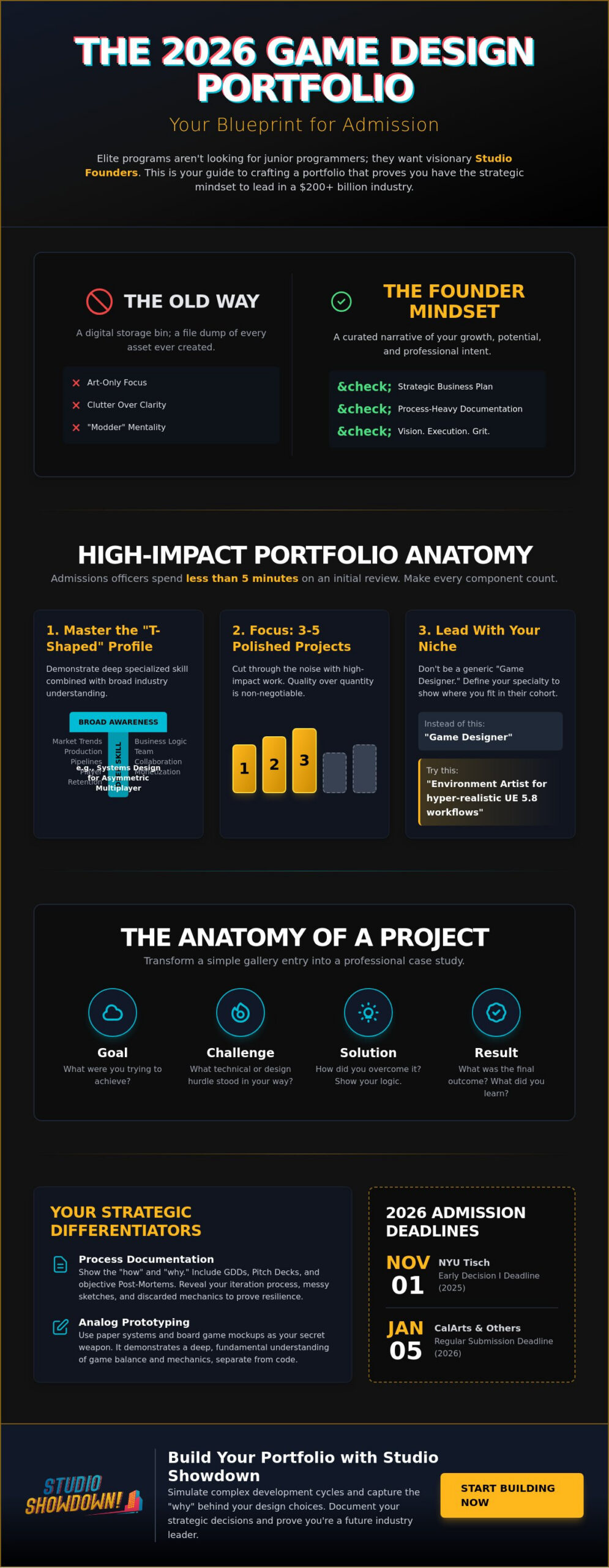
Your portfolio isn’t a digital storage bin for every file you’ve ever created. It’s a curated narrative of your growth, your technical potential, and your professional intent. Building a portfolio for game design school in 2026 requires a production-first mindset that prioritizes clarity over clutter. Admissions officers at elite institutions like NYU Tisch or CalArts face a massive influx of talent. They typically spend less than five minutes on an initial review. If your creative vision isn’t immediate, it’s invisible. You must present yourself as a “T-shaped” individual. This means you possess deep, specialized mastery in one area, like system design or environment art in Unreal Engine 5.8, paired with a broad understanding of how the entire industry functions.
The industry has shifted. The days of “art-only” portfolios are over. Modern programs demand process-heavy documentation. They want to see the sketches, the failed iterations, and the logic behind your choices. Show them the “how” and the “why” rather than just the finished render. This transparency proves you can handle the rigors of a professional pipeline where collaboration and iteration are the only paths to success. Vision. Execution. Grit. These are the traits that secure an acceptance letter.
The “Final Boss” of Admissions: Why Strategy Matters
Creative talent is the baseline; strategy is the differentiator. As the global video game market climbs toward $200 billion in 2026, schools are looking for students who understand the business of play. You need to rise above the “modder” status. Demonstrating business acumen shows you understand player retention and market trends. Every project in your folder should feel like a mini-startup. A critical component of this is your Game Design Document (GDD). This document shouldn’t just list features. It should outline the core loop, the monetization strategy, and the technical constraints. It proves you’re thinking like a producer, not just a player.
Setting Your Portfolio Goals
Precision beats volume. When building a portfolio for game design school, start by reverse-engineering the requirements of your target programs. Deadlines for the 2026-2027 academic year arrive fast. NYU Tisch Early Decision I hits on November 1, 2025, while CalArts and others require regular submissions by January 5, 2026. Your goal is to balance technical skill with conceptual originality. Don’t just build another platformer. Create a project that establishes a “Founder” persona. Choose 3-5 polished pieces that highlight your unique voice and your ability to solve complex design problems under pressure. This is your opening move in a high-stakes game. Make it count.
Core Components of a High-Impact Game Design Portfolio
Your portfolio headline is your first strike. Don’t settle for a generic “Game Designer” tag. Define your niche immediately. Are you a “Systems Designer specializing in asymmetric multiplayer” or an “Environment Artist focused on hyper-realistic Unreal Engine 5.8 workflows”? This specificity tells admissions officers exactly where you fit in their cohort. Building a portfolio for game design school requires a ruthless editor’s eye. You only need three to five polished pieces. Each project must serve as a testament to your technical depth and your ability to execute a vision from concept to completion. If a project doesn’t scream professional quality, cut it.
Every entry needs a pulse. Use a structured “Anatomy of a Project” breakdown to guide the reader through your logic. Define the Goal (what were you trying to achieve?), the Challenge (what technical or design hurdle stood in your way?), the Solution (how did you overcome it?), and the Result (what was the outcome?). This framework transforms a simple gallery into a professional case study. Visual documentation is your evidence. Use high-resolution screenshots, clean flowcharts, and logic diagrams to prove your systems work. Tutors want to see the architecture of your ideas, not just the paint on the walls.
Documenting the Creative Process
The “Post-Mortem” is the most critical part of any project entry. It proves you can analyze your own work with objective clarity. Show the iteration. Include messy sketches, early prototypes, and discarded mechanics. This transparency demonstrates that you can take feedback and pivot when a design fails. Admission boards look for this resilience. They want to see that you’ve mastered the strategic decision-making required to lead a studio through a difficult development cycle. Proving you can kill your darlings for the sake of the player experience sets you apart from thousands of hobbyists.
Visuals and Layout Best Practices
Speed is your ally. Follow the “two-click” rule: a viewer should be able to reach any project on your site within two clicks of landing on your homepage. Use high-quality GIFs to demonstrate gameplay feel instantly. Static images can’t capture the “juice” of a mechanic. Keep your descriptions concise and impact-driven. Avoid technical fluff and focus on the results of your design choices. Your layout should be clean, professional, and mobile-responsive. In a world where 95,000 mobile games are downloaded every minute, your ability to present information clearly across all platforms is a non-negotiable skill for the 2026 market.
Beyond the Screen: Why Analog Prototyping Sets You Apart
Paper prototyping is the ultimate filter. It strips away the distractions of shaders, lighting, and syntax errors. When you’re building a portfolio for game design school, an analog project proves you understand the bones of a game. If the mechanics aren’t fun on a kitchen table with index cards and dice, no amount of Unreal Engine 5.8 polish will save them. This is where you demonstrate your core video game development skills without hiding behind a screen. It shows you can isolate variables and design for the player experience first.
Admissions tutors value students who can isolate logic. In a board game, every rule is a line of code. Every token is a data point. By presenting an analog system, you show you can balance probability and player agency manually. It’s a bold move. It signals that you are a system architect, not just a software user. You are proving that you can manage the complexity of a game without the crutch of a compiler. This clarity of thought is exactly what sets a “Studio Founder” apart from the crowd.
The Value of Tabletop System Design
Tabletop design is pure math and psychology. You must demonstrate how you handle probability and resource management without a computer to do the heavy lifting. Show the math. Include your balance spreadsheets. When documenting these for your digital portfolio, treat your physical prototype like a professional production asset. Use high-key lighting for your photos. Capture the components in action. Create a clean, well-typeset PDF of your rulebook. This level of detail proves you respect the production pipeline, regardless of the medium. It shows you understand that player interaction is the heart of every successful title.
Analog vs. Digital: A Strategic Balance
Schools value designers who can think outside the screen. Integrating analog logic into your digital projects leads to tighter gameplay loops and more meaningful choices. It forces you to consider the economy of actions and the weight of every player decision. For deeper context on why this approach is so effective, explore Analog vs. Digital: Why Board Games Win. Mastering this strategic balance is the key to building a portfolio for game design school that feels both innovative and grounded. You aren’t just making a game; you’re engineering an experience.
Documenting the “Studio Founder” Mindset: Pitching and Business Logic
Admissions officers aren’t just looking for artists. They’re looking for architects of success. When you’re building a portfolio for game design school in 2026, you must prove you understand the machinery behind the play. Most applicants showcase a finished level. You need to showcase a business case. Including a professional Pitch Deck as a portfolio piece is the ultimate differentiator. It signals that you don’t just create content; you create value. This deck should outline your core loop, your target audience, and your path to market viability. It’s about demonstrating that you can lead a project from a whiteboard sketch to a global release.
Market awareness is your armor. With the global video game market projected to exceed $200 billion in 2026, the stakes have never been higher. You need to show you understand who is playing and where. In 2025, 95,000 mobile games were downloaded every minute. Compare that to just 3,800 for PC and console titles. If your work doesn’t reflect an understanding of these platform dynamics, you’re designing in a vacuum. Proving you understand the game development business and its inherent financial risks shows a level of maturity that most candidates lack. It transforms you from a hobbyist into a professional asset.
Fundraising and Resource Management
Every game is a battle for resources. Show that you understand development budgets. Even if your project was solo, document how you would have allocated a hypothetical budget or managed a team of three specialists. Pitching your game as a business venture proves you have producer traits. You aren’t just making a “fun” game. You’re building a sustainable project that can survive the volatile industry cycles. This proactive attitude is exactly what elite programs look for in their future alumni.
Market Dominance and Rivalry
Don’t pretend your game exists in a bubble. Analyze your competitors. If you’re building a tactical RPG, explain how it outmaneuvers established titles. Proving your game has a clear Unique Selling Proposition (USP) is vital for your documentation. This strategic outmaneuvering shows you possess the competitive edge schools crave. You are a founder. You play to win. You can start mastering these high-stakes production decisions today with Studio Showdown.
Building Your Portfolio with Studio Showdown
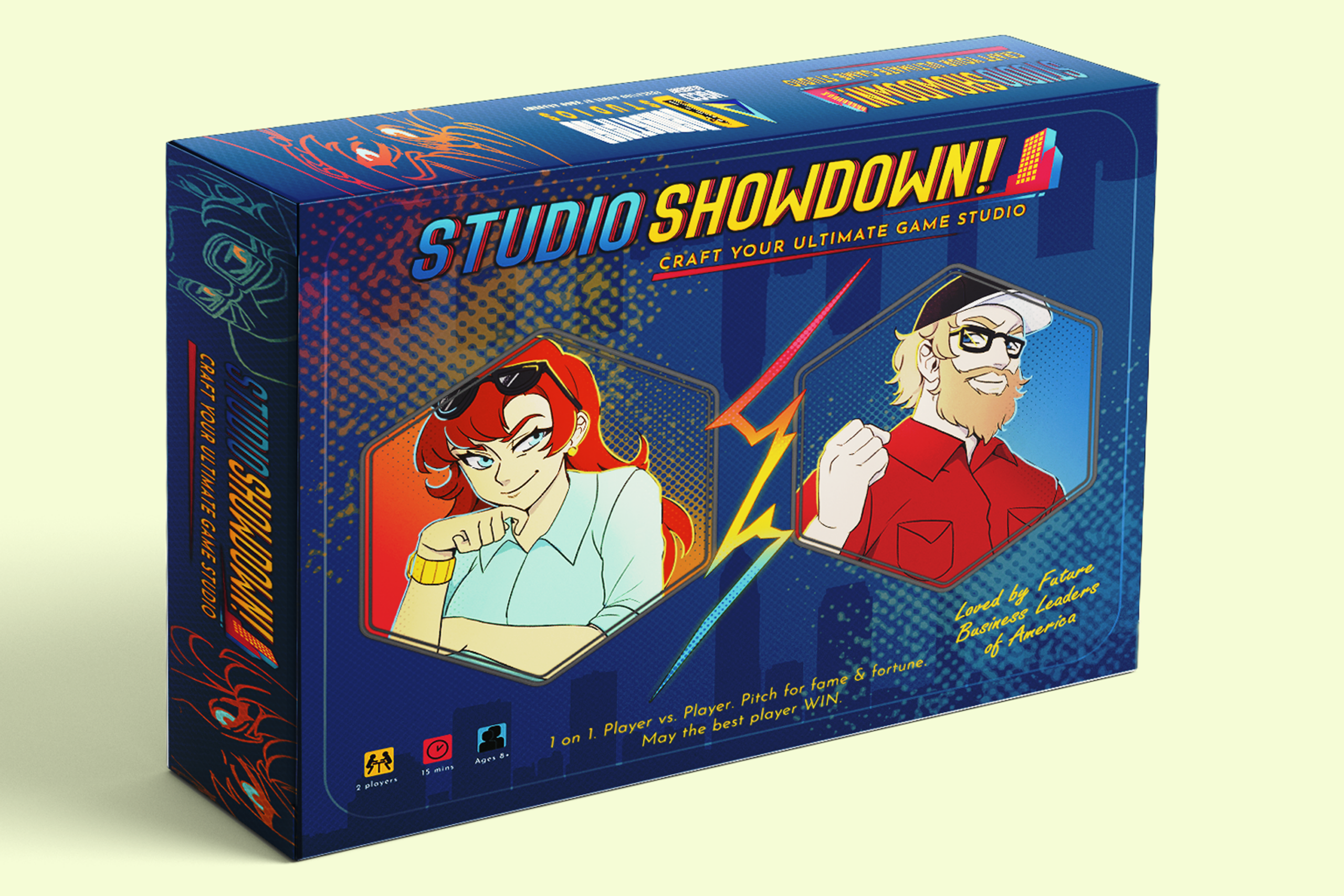
Studio Showdown is the ultimate analog simulator for game development. It strips away abstract theory and replaces it with cold, hard production reality. When you’re building a portfolio for game design school, you need more than just “good ideas.” You need evidence of your strategic depth. This game provides a sandbox where you can test your ability to lead, pivot, and survive a volatile market. Every session is a data set. Every win is a case study in market dominance. It’s a high-stakes environment where your creative vision meets the crushing weight of business logic.
Documenting your experience with this business board game counts as legitimate professional development. It proves you understand the “Studio Founder” role. You aren’t just playing; you’re simulating the financial risks and rewards of a $200 billion industry. Admissions officers look for this level of engagement. They want students who treat the craft with the seriousness of a CEO. By recording your sessions, you can present real-world business decisions as part of your application. Show them how you allocated resources when the market shifted. Show them how you outmanoeuvred a rival studio to secure a launch window. This is the “T-shaped” awareness that secures your spot in a top-tier program.
From Player to Portfolio: Case Study Examples
Treat your Studio Showdown sessions as professional case studies. Write about the narrative of “launching a hit game” within the context of the board game’s mechanics. Document the specific strategy you used to outmanoeuvre rivals for market dominance. Did you focus on rapid prototyping or high-budget polish? Explain why that choice was the right move for the simulated market. This documentation proves you have mastered the “Founder” mindset required for elite schools. You aren’t just a designer; you’re a strategist who understands the synergy between art and profit.
Next Steps: Level Up Your Application
Action is the only thing that separates a dreamer from a founder. Host a “Showdown” night with your peers. Document the results. Photograph the board state, record the “pitch” sessions, and write a post-mortem on your performance. This proactive approach shows you can lead and collaborate under pressure. Before you hit submit on your 2026 applications, ensure your portfolio follows this final checklist: 3-5 polished projects, a clear niche headline, a professional pitch deck, and documented analog logic. The competition is fierce, but your strategy is sharper. Get Studio Showdown and start building your studio founder skills today. Your future in game design starts with your first move.
Secure Your Spot in the 2026 Cohort
The 2026 landscape demands more than technical proficiency. It requires a vision that bridges the gap between creative mechanics and market viability. You’ve learned that building a portfolio for game design school is a strategic exercise in storytelling. It’s about proving you can handle the “Studio Founder” mindset by documenting failed iterations, analog prototypes, and professional pitch decks. This transparency shows admissions tutors that you’re not just a player; you’re a producer in the making who understands the production pipeline from the ground up.
Success in this industry isn’t just about making games. It’s about winning the market. Developed by VGCD Academy and DEMYSTIFIED Studios, Studio Showdown is the essential tool for mastering fundraising, pitching, and market strategy. It’s the perfect addition to any student’s professional portfolio. Don’t just apply. Dominate the admissions process and prove you’re ready to lead the next generation of studios. Your future starts with the first move. Prepare for victory and rise above the noise.
Master the business of game dev with Studio Showdown
Frequently Asked Questions
Do I need to know how to code to build a game design portfolio?
You don’t need to be a master programmer, but you must demonstrate an understanding of logic. Top programs value system design and mechanics over perfect syntax. If you aren’t a coder, prove your logical thinking through detailed flowcharts or complex analog prototypes. Building a portfolio for game design school is about showing how you think, not just how you script. Technical proficiency is a tool; design is the goal.
How many projects should I include in my game design school portfolio?
Quality always beats quantity in a professional review. Aim for three to five polished projects that showcase a range of skills and deep specialty. Admissions officers spend less than five minutes on your initial review, so every piece must be exceptional. Don’t include “filler” work just to reach a higher count. Focus on projects that tell a complete story of a specific problem you solved.
Can I include board games or card games in my portfolio?
Tabletop games are highly valued as proof of your understanding of core mechanics. They strip away technical bugs and reveal your grasp of balance and player interaction. Documenting a physical game shows you can design systems without the crutch of software. Use professional photography and clear rulebooks to ensure these entries look as polished as your digital work. It proves you are a system architect.
What is the best platform to host a game design portfolio?
How do I show “design thinking” in a portfolio piece?
Show your design thinking by including a post-mortem for every project. Explain the specific problem you faced, the iterations you tried, and why you chose the final solution. Include messy sketches and logic diagrams. This transparency proves you can take feedback and pivot. These are essential traits for any studio founder. It shows you value the player experience over your initial assumptions.
Should I include fan games or mods in my application?
Mods are excellent for showing you can work within existing professional constraints. However, ensure the mod reflects your original design work rather than just minor variable tweaks. Fan games can be risky due to intellectual property issues. If you include them, focus entirely on the mechanics you built yourself. Schools want to see your unique voice, not just your ability to copy a hit.
What do game design schools look for in the “About Me” section?
Schools look for a “Founder” persona that suggests leadership and professional intent. Avoid generic statements about your childhood love for games. Instead, focus on your specific design philosophy and where you want to lead the industry. Mention your technical specialties and your long-term production goals. This is your chance to show the person behind the projects. Make it punchy and authoritative.
How much weight do schools put on the business side of game design?
Business acumen is a major differentiator for elite programs in 2026. With the industry reaching $200 billion this year, schools want students who understand production and market viability. Showing you can pitch a game as a business venture proves you have the maturity to succeed. Building a portfolio for game design school that includes business logic sets you apart from thousands of pure hobbyists.