Building a global hit isn’t just about art; it’s a high-stakes tactical operation in a market projected to hit $255 billion this year. Most people look at the credits and see a blur of names. They get lost in the technical jargon or mistake a visionary Game Designer for the person actually writing the C++ code. Understanding the specific roles in a video game studio is the only way to navigate this industry without getting crushed by the competition.
You’ve likely felt the overwhelm of choosing a path or wondered how a studio actually stays profitable while balancing creative risks. We hear you. This guide is your roadmap to the 2026 landscape. We’ll strip away the confusion between technical execution and business strategy to show you exactly how these teams function. From mastering Unreal Engine 5.8 workflows to navigating the latest EU Digital Fairness regulations, you’ll discover the essential creative, technical, and business roles that power a successful studio. We’re mapping out every department so you can identify where your skills fit and how a modern studio turns a bold vision into a premium gaming experience.
Key Takeaways
- Decode the modern studio ecosystem by contrasting agile indie setups with the high-stakes corporate structures of AAA development.
- Clarify the essential roles in a video game studio to bridge the gap between visionary game design and technical engineering.
- Uncover the strategic production layer where producers and marketing leads transform a creative project into a market-ready product.
- Learn to navigate the “Founder’s Dilemma” by balancing artistic ambition with the brutal realities of technical debt and studio budgets.
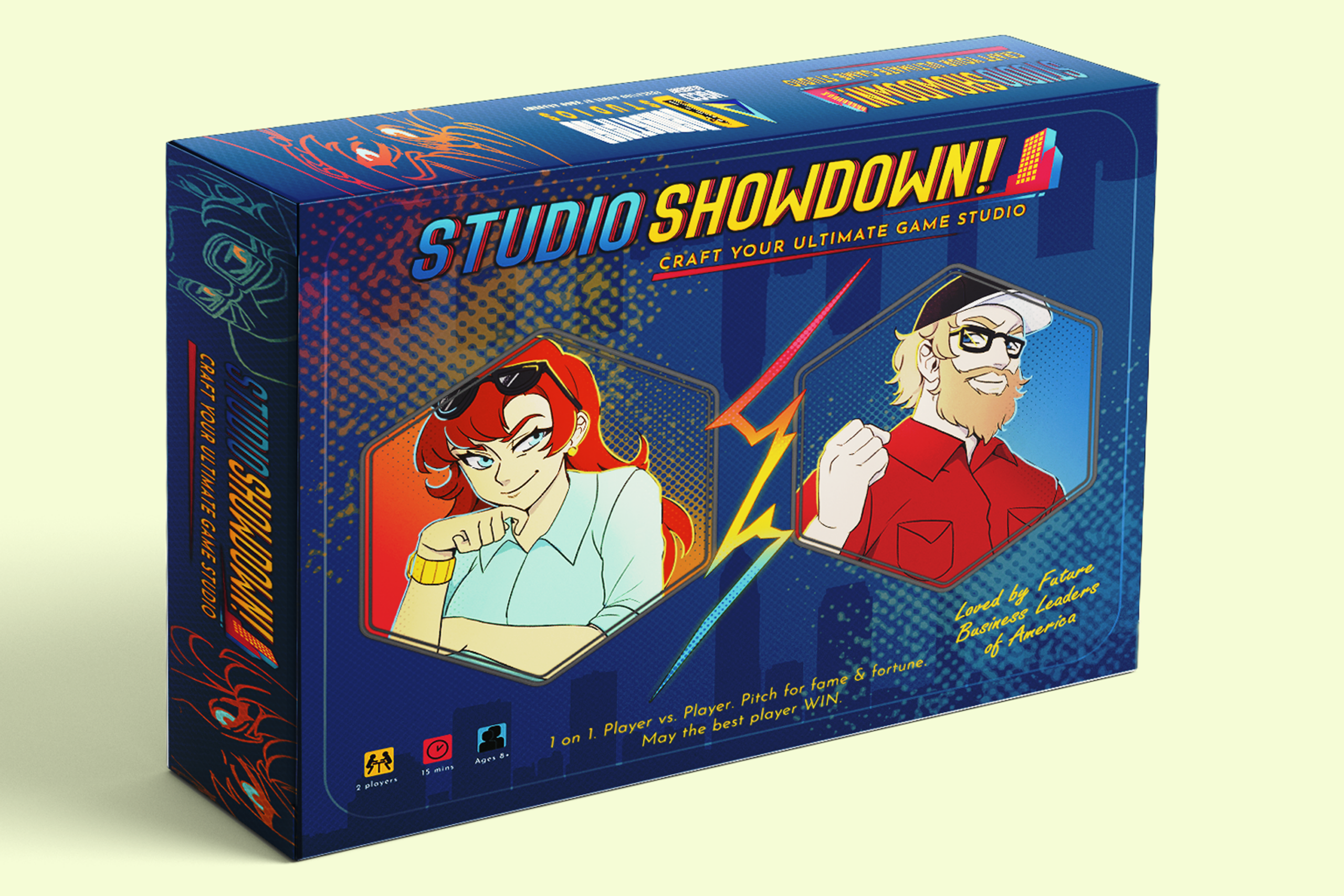
- Discover how the Studio Showdown board game provides a competitive arena to master these complex studio dynamics without writing a single line of code.
The Modern Video Game Studio Ecosystem in 2026
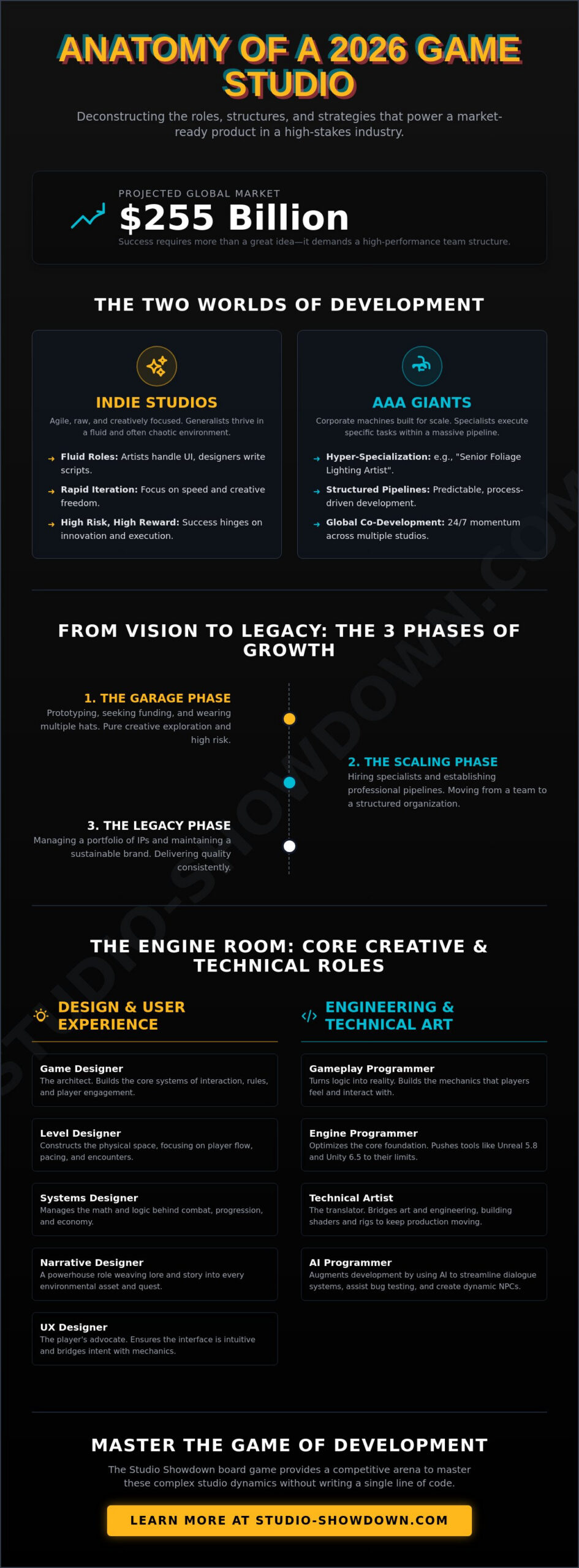
A video game studio is a high-performance engine. It’s a multidisciplinary business entity where art meets engineering in a high-stakes arena. In 2026, a studio is more than the sum of its parts. It’s a brand. It’s an IP holder. It’s a fortress built to protect a creative vision while surviving a global market projected to reach $255.03 billion this year. Success isn’t just about a good idea. It’s about how you structure your team to execute that idea under pressure.
Understanding the various roles in a video game studio is crucial because the industry has shifted. Studio Founders no longer just “make games.” They manage talent, navigate complex legal frameworks like the EU Digital Fairness Act, and build long-term value. In the early stages, these founders must wear every hat. They are the designers, the coders, and the accountants. This complex process of video game development requires a perfect synchronization of talent to move from a prototype to a global launch.
Indie Studios vs. AAA Giants
The scale of your studio dictates the daily reality of your team. In an indie environment, roles are fluid. You’re a generalist. An artist might also handle UI design and basic scripting. It’s agile, raw, and often chaotic. The focus is on creative freedom and rapid iteration. By contrast, AAA giants are corporate machines. They rely on hyper-specialization. You don’t just “make art” in a major studio; you might be the Senior Foliage Lighting Artist for a single biome.
The 2026 landscape has also embraced the remote-first model. Co-development is the new standard. Large projects are often split across multiple smaller studios globally to maintain 24/7 momentum. This shift means communication and technical literacy are now as important as creative talent. Your ability to collaborate across time zones determines your studio’s survival.
The Lifecycle of a Game Studio
Every studio begins in the “garage phase.” It’s a period of pure creative exploration and high risk. As a project gains traction, the studio must scale. This is where the roles in a video game studio become more defined. You move from a group of friends to a structured organization with dedicated leads for art, code, and production.
- The Garage Phase: Prototyping, seeking funding, and wearing multiple hats.
- The Scaling Phase: Hiring specialists and establishing a professional pipeline.
- The Legacy Phase: Managing a portfolio of IPs and maintaining a sustainable brand.
A sustainable studio is one that balances creative risk with financial acumen. It’s not enough to launch one hit. You must build a professional portfolio that proves your studio can deliver quality consistently. Every project is a brick in your brand’s wall. In 2026, the studios that win are the ones that treat their business structure with the same level of innovation as their game mechanics.
The Creative and Technical Core: Building the Game
The core of any studio is where vision meets execution. It’s the engine room. If the studio is a machine, these roles are the high-performance pistons. You can’t just have an idea. You need the architecture to support it. Exploring careers in the video game industry reveals a truth many outsiders miss: creativity is nothing without a pipeline. Every asset must serve the player experience without compromise.
Design and User Experience (UX)
Game Designers are the architects. They don’t just “play games”; they build systems of interaction. Level Designers focus on the physical space and pacing. Systems Designers manage the math behind combat and progression. In 2026, the Narrative Designer has become a powerhouse role, weaving lore into every environmental asset. UX Designers act as the ultimate filter. They ensure the player never fights the interface. They bridge the gap between player intent and game mechanics.
Engineering and Technical Art
Programmers turn logic into reality. In a modern setup, Gameplay Programmers build the mechanics you feel. Engine Programmers optimize the foundation. Unreal Engine 5.8 launched in June 2026, and Unity 6.5 now offers regular supported releases. This requires specialists who can push these tools to their limits. Then there is the Technical Artist. They are the translators. They ensure the artist’s high-poly vision doesn’t crash the engine. They build the shaders and the rigs that keep production moving.
AI tools are no longer a threat; they’re an augmentation. In 2026, programmers use AI to streamline dialogue systems and assist with bug testing. This allows the human talent to focus on high-level creative decisions rather than repetitive tasks. If you want to see how these roles in a video game studio clash and collaborate in a high-pressure environment, you can experience it firsthand through the Studio Showdown board game. It’s a simulation of the professional struggle.
Artists define the soul. Concept artists set the mood. 3D artists build the world. But in 2026, immersion extends beyond sight. Audio Engineers and Composers now work with advanced haptics to create a physical connection to the game world. Every sound is a cue. Every vibration is a narrative beat. These technical roles in a video game studio work in tight loops, iterating daily to ensure the sensory experience is flawless. They turn a digital file into a living, breathing world.
The Business and Production Layer: Ensuring Market Success
A game that never ships is just an expensive hobby. Business and production roles in a video game studio are the guardrails that prevent creative chaos from bankrupting the dream. While artists build worlds, the business layer builds the company. It’s about turning a creative vision into a sustainable, profitable product in a market that doesn’t forgive delays or broken promises.
Production and Project Management
The Producer is the studio’s heartbeat. They don’t just check boxes or manage calendars. They own the “Triple Constraint”: time, cost, and scope. Most modern studios operate on Agile or Scrum frameworks, breaking development into rapid two-week sprints. The Producer’s hardest job is managing “Crunch” while preserving studio culture. It’s a high-stakes balance of human psychology and logistics. You have to know when to cut a feature to save the release date. Mastering these management trade-offs is a core part of the experience in The Ultimate Business Board Game, where you face the same pressures as a real-world studio lead.
Quality Assurance (QA) is the frontline of studio reputation. In 2026, with the EU Digital Fairness Act and increased scrutiny on game launches, a buggy release can kill a studio’s brand overnight. Testers are the elite guard. They don’t just find bugs; they analyze why they happen. Alongside them, the Business Development Manager hunts for the capital. They pitch to publishers, secure platform deals, and manage the fundraising landscape. They ensure the studio has the fuel to keep the engines running.
Marketing, Community, and Publishing
The “hype train” starts years before the first trailer drops. Marketing and PR teams don’t just buy ads. They build ecosystems. In the era of live-service games, the Community Manager is the studio’s voice and its shield. They filter player feedback into actionable insights. This is where Data Analysts become vital. They use player metrics to drive business decisions, telling the designers which features are actually engaging the audience and which are being ignored. It’s a feedback loop of cold data and hot emotion.
- Community Managers: Managing the 24/7 conversation and protecting the brand.
- Data Analysts: Turning player behavior into strategic roadmap adjustments.
- PR Leads: Securing coverage and managing the narrative across global media.
Every successful launch is a victory of coordination. These roles in a video game studio ensure that the technical brilliance of the dev team actually reaches the hands of players. They translate art into commerce.
Studio Strategy: How Roles Collaborate to Win
Strategic success in a modern studio isn’t about peace. It’s about productive friction. The various roles in a video game studio often have conflicting goals that must be reconciled to launch a hit. The Lead Programmer wants a clean, optimized codebase. The Creative Director wants a feature-rich masterpiece. The Producer wants it finished yesterday. This tension is where the “Founder’s Dilemma” lives. You have to decide when to accrue technical debt to hit a marketing milestone and when to stop and polish the foundation. In 2026, with the global market reaching $255 billion, the cost of a wrong strategic choice is higher than ever.
Fundraising is the lifeblood that keeps the lights on during multi-year development cycles. It’s a grueling process of strategic outmaneuvering. You aren’t just competing for player attention; you’re competing for talent and venture capital. Studios that win are those that treat their business strategy with the same level of innovation as their gameplay mechanics. They know that luck is a poor substitute for a well-executed plan. This is why strategy beats luck in the current landscape.
The Art of the Pitch
Investors don’t buy ideas. They buy teams. A successful pitch requires proof of both creative vision and business viability. To secure funding, every major department must contribute to the “Vertical Slice.” This is a fully playable portion of the game that showcases the final quality of art, code, and design. The roles in a video game studio must converge here. The Art Lead provides the visual “wow” factor. The Technical Lead proves the engine can handle the load. The Designer demonstrates that the core loop is addictive. If one pillar fails, the pitch dies.
Entrepreneurship in Gaming
Building a studio requires more than just technical skill. It requires raw business acumen. You have to manage rival studios, protect your IP, and fight for market dominance. The 2026 landscape is crowded. Standing out requires a proactive attitude and a willingness to make high-stakes decisions. You aren’t just a developer anymore; you’re an entrepreneur in a high-velocity industry. You need to understand the “Business of Games” to survive the scaling phase.
If you’re ready to test your ability to lead a team through these high-pressure scenarios, explore the Studio Showdown board game to master the art of studio leadership. It’s the ultimate training ground for future founders.
- Strategic Hiring: Poaching the right talent to fill critical gaps.
- Resource Allocation: Deciding whether to fund a new marketing campaign or hire another QA lead.
- Market Timing: Launching in a window that avoids being buried by AAA blockbusters.
Collaboration isn’t just about working together. It’s about aligning every specialist toward a singular, profitable goal. The studios that master this alignment are the ones that define the next generation of gaming.
Mastering Studio Roles with Studio Showdown
Reading about the various roles in a video game studio is the first step toward a career. Experiencing those roles under pressure is the second. Theory provides the map, but execution requires a different kind of muscle. Studio Showdown isn’t just a board game. It’s a high-fidelity business simulation designed to strip away the abstractions of development. It puts you in the hot seat of a Studio Founder. You aren’t just looking at a flowchart; you’re making the high-stakes calls that determine if your studio survives the quarter. It’s a raw, tactile look at the industry’s engine room.
The game mirrors the professional struggle of 2026. You have to manage the same friction between art, code, and design that we’ve discussed throughout this guide. Pitching isn’t a hypothetical exercise here. You must convince stakeholders and outmaneuver rivals with limited resources. This tactile approach builds a mental portfolio of strategic decisions. You learn the weight of a bad hire. You feel the sting of a failed pitch. It’s about developing the instincts that a textbook cannot provide.
A Hands-On Learning Experience
Mastering skills like fundraising, pitching, and team management happens best through play. Studio Showdown forces you to prioritize. Do you invest in a Senior Gameplay Programmer or a Community Manager? Every choice has a ripple effect. Engaging in screen-free activities like this sharpens critical thinking in a way digital tutorials can’t. It forces you to look your collaborators and competitors in the eye. You learn to read the room, not just the data. This is how you bridge the gap between being a student and becoming an industry professional.
- Fundraising: Secure the capital needed to keep your project alive.
- Team Management: Balance the specialized roles in a video game studio to maximize output.
- Market Strategy: Outperform rival studios in a simulated global market.
Get Started with Studio Showdown
Educators are increasingly turning to tabletop simulations to teach complex STEM and business concepts. The Studio Showdown: Educator Edition and Classroom Bundle are built for this. They turn a standard lecture into a high-stakes war room. Students don’t just learn about roles; they inhabit them. They face the “Founder’s Dilemma” firsthand. They learn that a great game idea is worthless without the business acumen to fund and ship it. This is about building the next generation of industry leaders who understand that strategy is a creative act. It’s about preparing for the reality of the 2026 market before you ever step into a real office.
Ready to lead your own team to victory? Bring Studio Showdown to your next game night or classroom. It’s time to stop watching the credits and start building the studio that earns them.
Lead the Next Generation of Gaming
The 2026 gaming landscape is a brutal, high-velocity arena where creative passion alone isn’t enough to survive. Success depends on your ability to synchronize the diverse roles in a video game studio into a single, profitable engine. You’ve mapped the creative core, the technical hurdles, and the strategic business layer. Now, you need the instincts to lead them. Whether you’re navigating the “Founder’s Dilemma” or pitching for venture capital, the difference between a global hit and a silent failure is strategy. Don’t just watch the industry from the sidelines.
It’s time to step into the war room. Developed by VGCD Academy and DEMYSTIFIED Studios, the Studio Showdown Board Game provides an immersive strategy experience for aspiring entrepreneurs. Educators across the globe use this simulation to build real-world business acumen in their classrooms, bridging the gap between theory and the high-stakes reality of production. Master the business of games with the Studio Showdown Board Game and transform your vision into a premium gaming experience. The industry is waiting for its next visionary leader. Go build something legendary.
Frequently Asked Questions
What is the most important role in a video game studio?
There is no single most important role. A studio is a multidisciplinary machine. However, the Producer or Founder often carries the most weight because they align the creative, technical, and business layers. Without this central coordination, even the most talented artists and coders will fail to ship a finished product. Every role is a critical link in the chain.
Do I need a degree to get a job in a game studio in 2026?
What is the difference between a game developer and a game designer?
A Game Designer is the architect who creates the rules, systems, and mechanics. They define the player experience. A Game Developer is a broader term, usually referring to the programmers and engineers who write the code to make those designs functional. Think of the designer as the person who writes the blueprint and the developer as the one who builds the structure.
How do game studios make money and stay in business?
Studios generate revenue through various monetization models. This includes direct sales, in-app purchases, and live-service subscriptions. Many also secure funding through publisher deals, venture capital, or government grants. Successful studios balance these revenue streams with strategic cost management to ensure they remain profitable during long development cycles and market fluctuations.
What role does a producer play in game development?
The Producer acts as the project manager for the entire development team. They manage the schedule, budget, and scope to ensure the game actually launches. They are the primary problem solvers who remove roadblocks for the creative and technical teams. A good producer keeps the production on track while preventing team burnout and managing technical debt.
Can I start my own game studio without knowing how to code?
Yes, you can start a studio without being a coder. Many successful founders come from production, art, or business backgrounds. Your job as a founder is to hire the right talent to fill the technical gaps and manage the overall studio strategy. You must focus on fundraising, pitching, and building a brand while your engineering leads handle the codebase.
How does the Studio Showdown board game teach game development roles?
The Studio Showdown board game uses immersive simulation to teach the complex roles in a video game studio. Players take on the responsibilities of founders, managing resources and making high-stakes business decisions. It strips away the screen to focus on the human interactions, pitching strategies, and team dynamics required to run a successful studio. It’s a tactile, hands-on masterclass in game dev entrepreneurship.
What are the entry-level roles for someone new to the gaming industry?
Common entry-level positions include Quality Assurance (QA) testers, Junior Artists, and Junior Programmers. Many professionals also start as Community Moderators or Customer Support representatives to learn the business from the player’s perspective. These roles provide a foot in the door and allow you to see how different departments collaborate before you specialize in a specific career path.