Luck is a lie. If you’re waiting for a favorable roll to save your strategy, you’ve already conceded the table. In the world of competitive board games, victory is a product of design, not chance. You’re looking for more than a distraction; you’re seeking a crucible. You want mechanics that bite back. You want systems that reward genuine skill. It’s time to move past the generic and embrace the pressure of a true strategic showdown.
We agree that a game should be a masterclass in business acumen, not a boring lecture. This guide promises to teach you the art of outmaneuvering rivals and building empires through high-stakes tabletop play. We’ll break down the elite strategies for 2026, analyze the shift toward entrepreneurial simulations, and show you exactly how to host a night that feels like a hostile takeover. We’ll even explore how tools like the Studio Showdown Board Game turn fundraising and pitching into a brutal, beautiful competition. Get ready to turn your living room into a war room where only the most tactical studio survives.
Key Takeaways
- Eliminate the luck factor. Focus on player agency and direct interaction to dominate the table every time.
- Optimize your engine. Learn to manage resources with surgical precision to outpace and outmaneuver every opponent.
- Sharpen your professional edge. Use competitive board games to cultivate a founder mindset and master real-world business tactics.
- Select with purpose. Find the ideal complexity and “sweet spot” to ensure every game night feels like a high-stakes arena.
- Experience the ultimate duel. Step into the shoes of a studio founder in Studio Showdown to master the art of the pitch and fundraising.
The Anatomy of Competitive Board Games: Beyond the Dice
Competition is a craft. It’s a calculated sequence of moves designed to dismantle an opponent’s position. In 2026, we’re seeing the rise of the “Professional Player.” These aren’t casual rollers. They’re tacticians who treat competitive board games as a training ground for real-world dominance. True depth comes from agency. If you lose, it’s because you were outplayed, not because the dice betrayed you. This shift toward high-stakes tabletop systems reflects a broader desire for meaningful, skill-based entertainment that rewards the sharpest mind at the table.
The “Showdown” element is what separates a solo puzzle from a true game. Direct interaction means your board state is never safe. Rival interference isn’t just a mechanic; it’s the core of the experience. You need to pivot. You need to anticipate. Success requires a long-term vision that survives a sudden market shift or a rival’s aggressive expansion. Winning isn’t about a single lucky turn. It’s about maintaining a superior trajectory across the entire session while under constant fire from your peers.
Skill vs. Luck: The Competitive Spectrum
Low-luck games dominate the scene for a reason. They reward deep study. They demand replayability. When you remove the safety net of randomness, you’re left with pure strategy. High-stakes gaming often relies on “perfect information.” Every resource is visible. Every move is telegraphed. In this environment, your only edge is your ability to process data faster and more creatively than the person across the table. It’s about out-thinking the room and executing a plan with surgical precision.
Zero-Sum Dynamics and Market Dominance
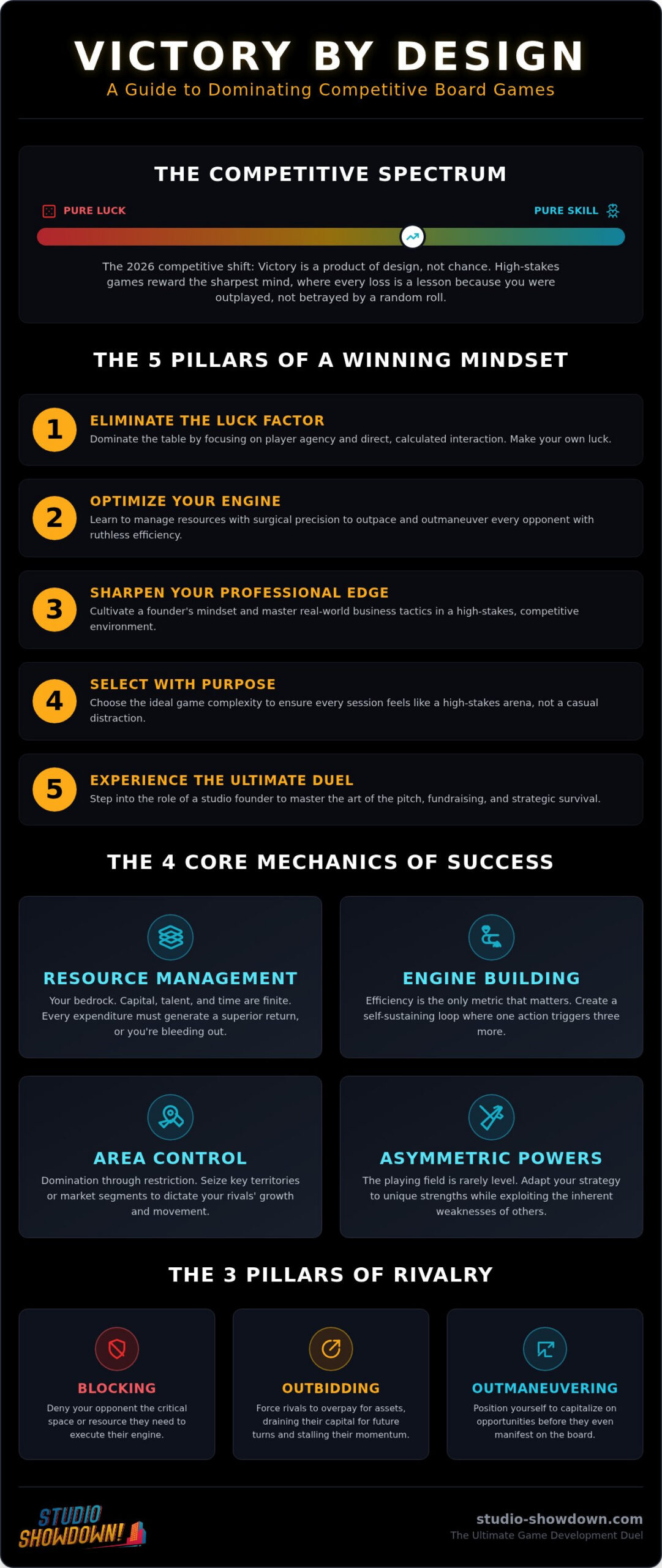
Modern strategy often operates on zero-sum logic. For you to gain a lead, someone else must lose ground. This isn’t about being mean; it’s about simulating real-world scarcity. In competitive board games, your rivals are the primary obstacles to your growth. The three pillars of rivalry keep the tension high:
- Blocking: Denying your opponent the critical space or resource they need to execute their engine.
- Outbidding: Forcing rivals to overpay for assets, draining their capital for future turns.
- Outmaneuvering: Positioning yourself to capitalize on opportunities before they even manifest on the board.
These games don’t just mimic business; they are business. They force you to manage finite resources while under constant threat. It’s a high-pressure environment where every decision has a cascading effect on your empire’s survival. You aren’t just playing a game. You’re stress-testing your ability to lead, adapt, and conquer in a controlled, visual arena where only the most strategic studio survives.
Mastering Strategy Board Games: Mechanics of Success
Success in competitive board games isn’t accidental. It’s engineered. To dominate the table, you must move beyond reactionary play and start thinking in systems. You’re not just playing a game; you’re building an empire. This requires a mastery of four core pillars: resource management, engine building, area control, and asymmetric powers. Each mechanic serves as a lever you can pull to exert pressure on your rivals and secure market dominance.
- Resource Management: This is your bedrock. Capital, talent, and time are finite. Every piece you spend must return a higher yield, or you’re just bleeding out.
- Engine Building: Efficiency is the only metric that matters. You need to create a self-sustaining loop where one action triggers three more, allowing you to outpace opponents who are still playing turn-by-turn.
- Area Control: Dominating the board is about restriction. By seizing key territories or market segments, you dictate where your rivals can move and how they can grow.
- Asymmetric Powers: Competition is rarely a level playing field. Different starting points and unique abilities force you to adapt your strategy to your specific strengths while exploiting the inherent weaknesses of others.
Economic Engines and Fundraising
Managing capital is a high-wire act. You need enough to fuel your expansion, but hoarding cash is a death sentence for your momentum. Over-leveraging is a common trap in a cutthroat environment. If you sink all your resources into a single high-risk project without a safety net, one bad turn can wipe you off the board. Economic engines are the heartbeat of business board games. You must learn to balance aggressive fundraising with sustainable growth to ensure your studio remains the last one standing.
Strategic Pitching and Negotiation
The board is only half the battle. The other half happens through the art of the “Table Talk.” Negotiation is a tactical tool, not a social grace. You need to know when to form a temporary alliance to take down a leader and exactly when to break that alliance for your own gain. Social engineering allows you to mask your true strategy, leading rivals to believe you’re a minor threat until it’s too late for them to pivot. If you’re ready to test these skills in a high-stakes arena, you can master entrepreneurship by stepping into a world where pitching and fundraising are the keys to victory. Competitive board games reward the player who can manipulate both the pieces and the people around the table.
Competitive Play as a Professional Development Tool
Tabletop gaming isn’t just a hobby. It’s a high-fidelity simulator for entrepreneurial warfare. When you engage with competitive board games, you’re practicing the same decision-making loops used by CEOs and venture capitalists. You’re analyzing market shifts. You’re managing scarce resources. You’re dealing with the visceral consequences of a failed pivot. These games don’t just entertain; they sharpen the mind for the visual noise and pressure of the modern marketplace.
Integrating business simulation games into your routine builds a strategic layer that textbooks can’t touch. It’s about the “Founder Mindset.” You learn to embrace failure as a data point rather than a disaster. Tabletop trial and error allows you to burn through bad ideas in sixty minutes rather than a fiscal year. This intersection of game design and entrepreneurial strategy is why modern competitive board games function as a laboratory for leadership.
The academic world is noticing. Educators are ditching static lectures in favor of strategy board games to bridge the gap between theory and execution. It’s active learning. It’s visceral. It’s effective. The goal isn’t just to play; it’s to master the mechanics of success in a controlled, high-stakes arena.
Building Portfolios Through Play
Winning at the table is a proof of concept. It demonstrates critical thinking. It shows you can handle crisis management under intense pressure. These are resume-worthy skills. Studio Showdown, developed by VGCD Academy and DEMYSTIFIED Studios, specifically prepares students for the game industry by immersing them in the realities of development. You aren’t just moving pieces. You’re building a mental portfolio of tactical successes. Every victory is a testament to your ability to outmaneuver rivals and execute a vision.
Financial Literacy and Risk Assessment
Cash flow is king. Tabletop systems teach you the financial risks of development without the real-world bankruptcy. You learn to calculate ROI on the fly. You understand when to double down on a project and when to pivot your entire business model. Strategic spending becomes second nature. It’s a training ground where every coin spent is a lesson in market dominance. You’ll learn to manage fundraising and pitching with the confidence of a seasoned pro, ensuring your studio survives the showdown.
Choosing the Right Competitive Experience for Your Group
Selection is your first tactical move. Don’t just pick a box; pick a challenge. To host a high-stakes night, you must match the player count and time commitment to your group’s appetite for friction. If the game is too short, the strategy doesn’t have room to breathe. If it’s too long, the tension evaporates. You’re looking for the “sweet spot” where mechanics become second nature and pure strategy takes over the room. This is where competitive board games transform from simple entertainment into a crucible for skill and grit.
Complexity ratings are your roadmap. High-complexity games reward the deep-thinker but can alienate the newcomer. Low-complexity games risk the “generic” tag. The goal is to find a system that offers depth without unnecessary bloat. Theme plays a critical role here. A game development theme isn’t just window dressing; it’s the perfect backdrop for competition. It mirrors the fast-paced, high-stakes reality of the creative industry. It gives every move a sense of professional purpose and urgency.
Screen-Free Strategy for Families and Teens
Digital fatigue is a silent killer of focus. Screens create silos; boards create showdowns. Tactile play forces you to look your opponent in the eye when you block their path or outbid their studio. It builds a different kind of mental muscle. These screen-free activities foster a sharper competitive spirit than any app ever could. In a classroom or home setting, this encourages healthy rivalry. It turns a lesson in entrepreneurship into a memorable, high-energy event where everyone is fully present and engaged.
The “Easy Money” Trap vs. Strategic Depth
Avoid the shallow end of the market. An easy money game relies on handouts and random luck. It fails to challenge anyone looking for a professional edge. These games lack the “skill ceiling” required for long-term replayability. If you can master a game in one sitting, it’s not a competitive tool; it’s a distraction. True strategic depth requires the possibility of a total loss. Losing isn’t a failure. It’s a lesson in resilience and crisis management. It’s the only way to build the mental toughness required for real-world market dominance.
Ready to bring a professional edge to your table? Elevate your next game night and master the art of the deal with the Studio Showdown Board Game. Competitive board games are the ultimate training ground for those who refuse to settle for mediocrity.
Studio Showdown: The Ultimate Game Development Duel
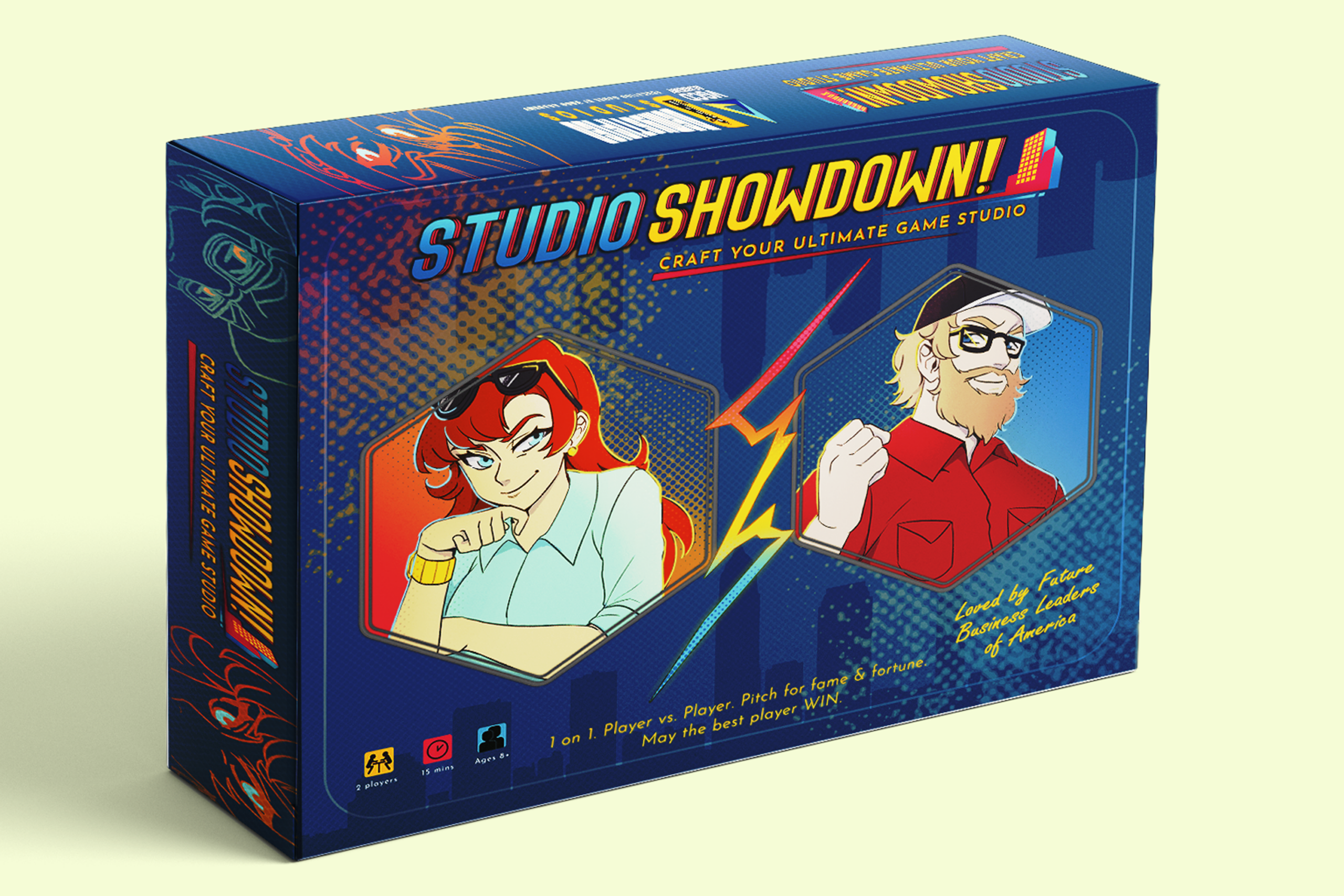
The marketplace is a battlefield. In the world of competitive board games, Studio Showdown stands as the definitive simulation of creative entrepreneurship. You don’t just play; you found. You don’t just move; you dominate. This game, developed by VGCD Academy and DEMYSTIFIED Studios, strips away the fluff and puts you in the high-pressure seat of a studio lead. Every decision is a gamble with your reputation and your capital. It’s a visual, visceral, decisive experience where the “Showdown” isn’t just a name. It’s a survival requirement.
Success requires a brutal balance. You must manage the technical development of your titles while simultaneously hunting for the next round of funding. If your pitch fails, your project dies. If your development lags, your rivals will seize your market share. This is the cutthroat reality of the industry distilled into a tabletop format. It’s why serious strategists and industry professionals use this system to test their tactical limits. You aren’t just playing for points. You’re playing for dominance in a market that doesn’t forgive mediocrity.
Strategic Pitching and Fundraising Mechanics
Securing vital resources is an art form. In Studio Showdown, the pitching mechanic forces you to communicate value under pressure. You aren’t just rolling for success; you’re navigating the complex challenges of launching a hit title in a crowded room. This is where direct competition becomes personal. Sabotage is a valid strategy. If a rival studio is gaining too much momentum, you have the tools to disrupt their launch and claim their market share for yourself. It’s a high-stakes duel where only the most aggressive and adaptable founder comes out on top.
The Educator Edition and Classroom Bundles
Education needs a production upgrade. The Studio Showdown: Educator Edition is designed to integrate seamlessly into STEM and business curricula. It turns abstract concepts like ROI and market scarcity into tangible, competitive hurdles. Schools and professional workshops can utilize the Classroom Bundle to facilitate large-scale strategic sessions. This isn’t a boring simulation. It’s a training ground. It builds a classroom environment where strategy wins the day and students learn the “Founder Mindset” through direct, competitive experience. This is the future of professional development. The board is the classroom. The game is the career.
Step Into the Arena: Your Strategic Evolution Starts Now
Tabletop gaming has evolved. It’s no longer just about passing time; it’s about mastering a complex system. Throughout this guide, we’ve explored how competitive board games bridge the gap between simple entertainment and professional excellence. You now understand that victory belongs to those who build superior engines and manage resources with surgical precision. Luck is a relic of the past. Tactical agency is the future. You’ve learned to identify the “sweet spot” of complexity and reject the shallow nature of easy money titles.
Real-world dominance requires a training ground that bites back. Studio Showdown provides that crucible. Developed by industry experts at VGCD Academy and used in classrooms nationwide, it’s an immersive game development simulation that rewards the bold. It’s time to stop playing generic titles and start building real-world acumen. Launch your studio and dominate the market with Studio Showdown. The board is set. The market is waiting. Your rivals are already making their move. Claim your victory today.
Frequently Asked Questions
What are the best competitive board games for teaching business?
Studio Showdown leads the field by simulating the high-stakes world of game development and fundraising. You should look for titles that prioritize resource management, capital allocation, and direct market competition. These competitive board games replace abstract theories with visceral, tactical experiences that reward sharp business acumen. They force players to make tough financial decisions under pressure to ensure their studio survives the final showdown.
How do competitive board games improve critical thinking?
Competitive board games function as a mental gymnasium. They demand constant analysis of shifting board states and opponent behaviors. You aren’t just reacting to a roll; you’re anticipating a move. This process sharpens your ability to evaluate multiple outcomes and pivot your strategy instantly when a rival disrupts your plan. It’s a high-speed loop of data processing and decisive action that translates directly to real-world problem-solving.
Can competitive board games be used in the classroom?
Educators are increasingly swapping static lectures for interactive strategy sessions. Board games provide a low-risk environment to test high-level concepts like ROI and supply chain logistics. Using tools like the Studio Showdown: Educator Edition allows teachers to gamify STEM and business curricula effectively. This approach increases student engagement and ensures that complex theories are understood through direct, hands-on application rather than passive observation.
What is the difference between strategy games and competitive games?
Strategy is the plan, while competition is the friction. A strategy game focuses on the complexity of the puzzle. A competitive game focuses on outmaneuvering a live opponent. While most competitive board games require deep strategy, the defining factor is the direct interaction. You aren’t just building an empire; you’re building it faster and more efficiently than the rival across the table who is actively trying to stop you.
How do I host a competitive board game night?
Start by matching the game’s complexity to your group’s experience level. You need a clear schedule and a zero-distraction environment to maintain the tension. Focus on titles that reward skill over luck to ensure the results feel earned. Setting small, non-monetary stakes can increase the pressure and make every tactical pivot feel significant. It’s about creating a professional arena where the best strategist can truly shine.
Are competitive board games good for teens?
High-stakes tabletop gaming is an essential tool for teen development. It builds resilience and teaches them to handle failure as a learning opportunity. These games encourage healthy rivalry and strategic thinking away from digital distractions. By navigating complex systems and competing for market dominance, teens develop a “Founder Mindset” that prepares them for the challenges of higher education and the modern workforce.
How does Studio Showdown teach entrepreneurship?
Studio Showdown immerses you in the full lifecycle of a creative startup. You’ll master the art of the pitch to secure funding while balancing technical development and market timing. It’s not a generic simulation; it forces you to navigate direct rival interference and resource scarcity. You’ll learn to manage capital and talent with the same intensity required to launch a real-world hit game.
What skills do you learn from competitive strategy games?
You’ll develop a suite of professional skills including financial literacy, tactical negotiation, and advanced risk assessment. Competitive strategy games reward the ability to manage finite resources while under constant threat. You’ll learn to calculate ROI on the fly and understand when to double down or pivot your model. These aren’t just game mechanics; they’re the building blocks of market dominance and long-term success.