Your project management textbook is a paperweight in a real-world crisis. It offers the theory but fails to simulate the adrenaline of a collapsing budget or a team on the brink of burnout. We’ve all felt that crushing screen fatigue; staring at cold spreadsheets while trying to grasp the volatile nature of risk versus reward. Integrating board games for project management skills isn’t just a clever team-building exercise. It’s a high-stakes, tactical rehearsal for the chaos of modern production. These games strip away the fluff and force you to make decisions that carry immediate consequences.
You already know that hands-on experience beats a dry lecture every single time. This strategy guide promises to show you exactly how strategic board games transform abstract theories into visceral leadership skills that stick. We’ll explore the most effective titles for 2026, focusing on games that teach you how to fundraise, pitch, and allocate resources under pressure. From mastering Agile sprints to building a portfolio of strategic thinking, you’re about to discover how to elevate your team’s performance above the noise. Let’s dive into the simulations that turn theorists into battle-tested leaders.
Key Takeaways
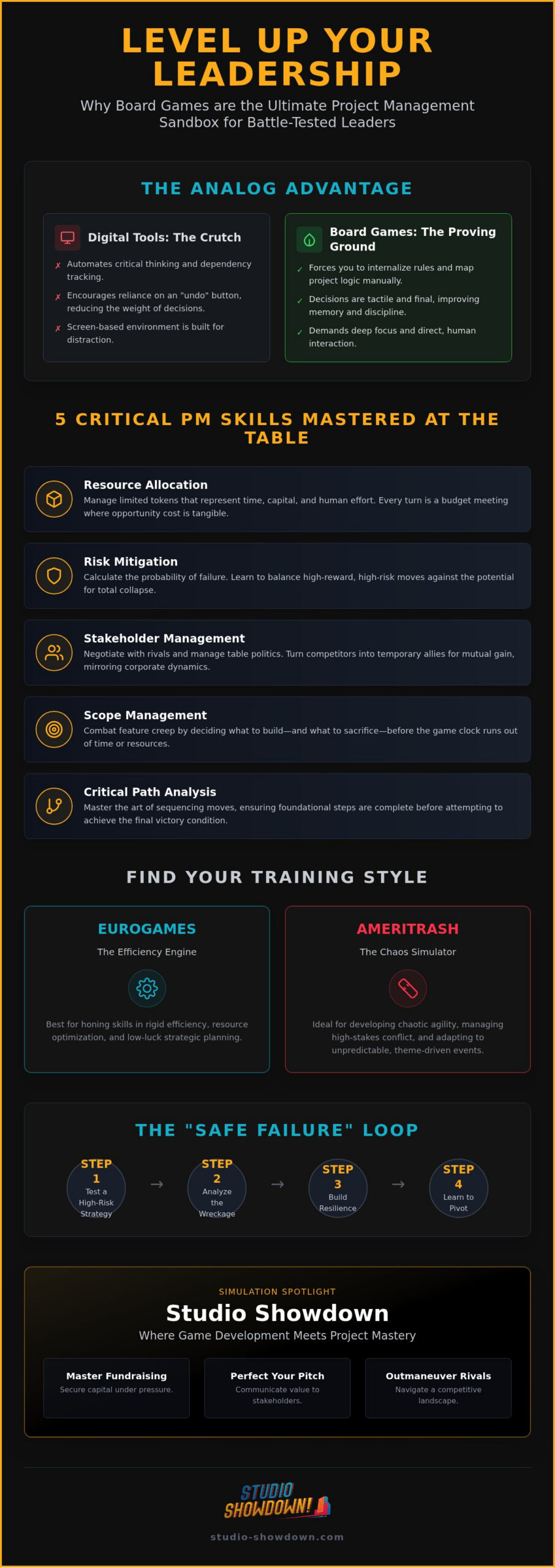
- Master complex project management mechanics in a safe, analog environment that forces you to internalize rules without software assistance.
- Discover how specific board games for project management skills sharpen your ability to balance high-stakes risk mitigation with precise resource allocation.
- Identify the right gaming genre for your specific methodology, whether you require the rigid efficiency of Eurogames or the chaotic agility of Ameritrash simulations.
- Build a high-performance culture by using strategic play to uncover natural leadership and observe how team members react to competitive friction.
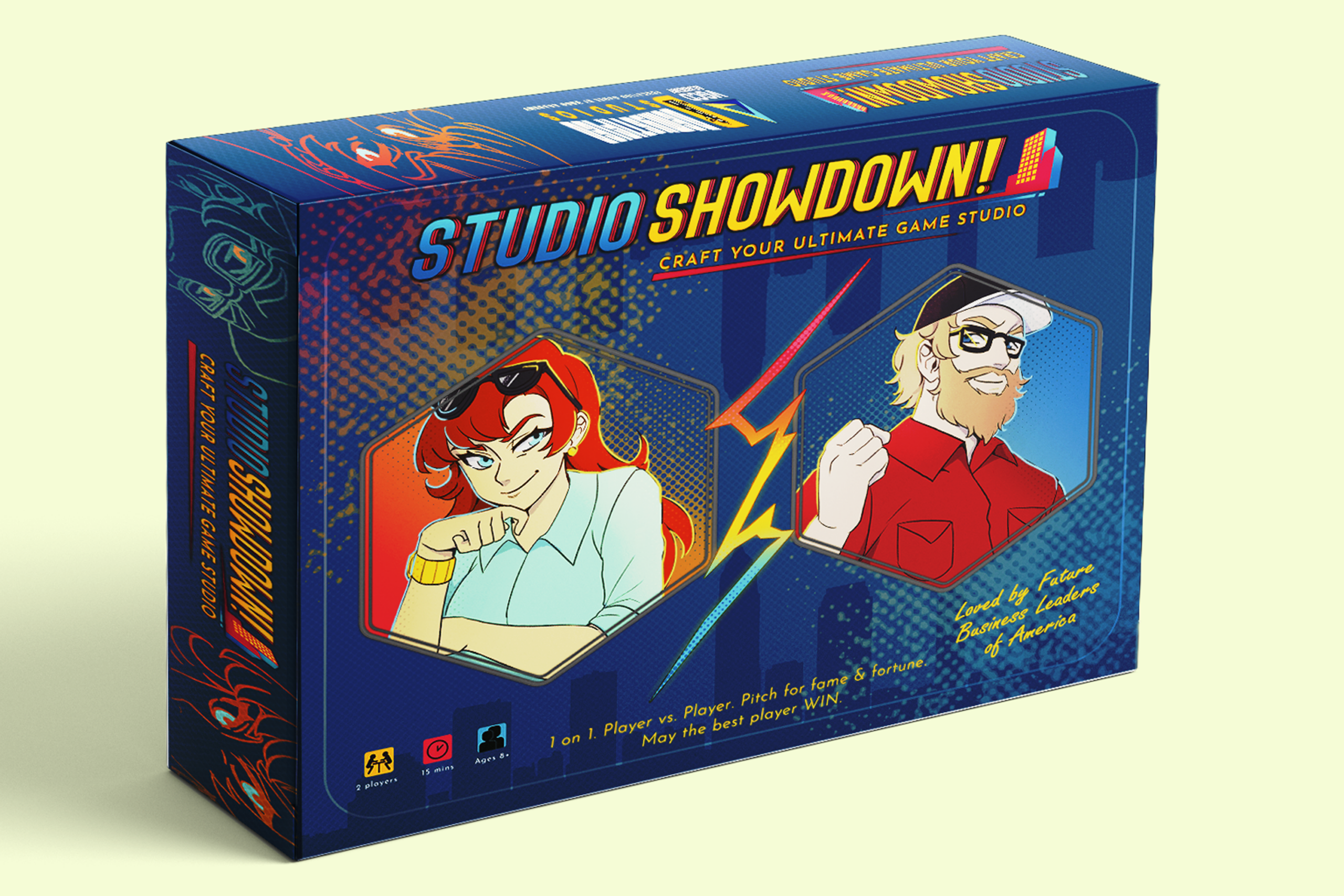
- Step into the role of a studio founder with Studio Showdown to master the art of fundraising, pitching, and outmaneuvering rivals in a pacy simulation.
Why Board Games are the Ultimate Project Management Sandbox
Stop treating professional development like a chore. The “sandbox” isn’t a playground; it’s a high-velocity training ground for elite decision-makers. In a sandbox, you have the freedom to fail, burn your budget, and lose your team without real-world litigation or financial ruin. This is the core of understanding what are serious games and how they bridge the gap between theory and execution. When you engage with board games for project management skills, you aren’t just playing. You’re stress-testing your leadership under pressure.
Software is a crutch. It calculates your critical path and manages your dependencies automatically. Analog games strip that away. You have to internalize the rules yourself. You have to track the tokens. This manual process forces your brain to map the logic of project flow at a deeper level. It’s the reason elite business schools now favor these physical simulations over dry digital modules. They know that you can’t teach “grit” or “negotiation” via a slide deck. You need a live opponent and a shifting board state to truly learn.
The Analog Advantage: Why Screens Can’t Compete
Screens are built for distraction. Board games are built for focus. The tactile feedback of a heavy resource token or a well-placed card creates a physical memory of the decision. When you physically hand over a “funding” token, the loss feels real. This sensory engagement improves memory retention and forces you to confront the weight of every resource move. Without the “undo” button of a digital interface, you’re forced to live with your choices. This builds a mental discipline that software simply cannot replicate. It’s pure, unadulterated logic.
Iterative Thinking and the “Safe Failure” Loop
Real projects rarely allow for a “do-over” after a catastrophic risk materializes. Board games offer a rapid prototyping environment for your leadership style. You can test a high-risk strategy in one hour and analyze the wreckage immediately. This “safe failure” loop is essential. It builds the psychological resilience needed for real-world project pivots. You learn to recognize the early warning signs of a failing strategy before the stakes involve real capital. It’s about developing the intuition to pivot when the board state shifts against you. You don’t just learn the rules; you learn how to win within them.
5 Critical PM Skills You Can Master at the Table
Abstract strategy is for theorists. Real leaders need friction. Unlike traditional games like Chess that lack resource management or hidden variables, modern board games for project management skills introduce scarcity, competition, and chaos. They force you to manage the messy, human parts of a project. You aren’t just moving pieces; you’re managing a lifecycle. Success requires more than just a plan. It requires the ability to adapt when the board state shifts.
- Resource Allocation: Managing limited tokens. Every move costs capital. Every turn is a budget meeting.
- Risk Mitigation: Calculating the probability of failure. Balancing the high-reward move against total collapse.
- Stakeholder Management: Negotiating with rivals. Turning competitors into temporary allies for mutual gain.
- Scope Management: Killing feature creep. Deciding what to build before the game clock runs out.
- Critical Path Analysis: Sequencing moves. Ensuring the foundation is laid before the victory condition is triggered.
Resource Management and the Art of the Trade-Off
Turn-based games are a masterclass in opportunity cost. If you spend your action on research, you can’t spend it on production. This mirrors the findings in a project management training case study that highlights how gamification embeds these logical trade-offs into a player’s intuition. You learn to manage human capital, player actions, and financial tokens in a single loop. You learn when to scale operations. You learn when to pivot. Every turn is a micro-lesson in efficiency.
Strategic Negotiation and Pitching
Every game with player interaction is a lesson in table politics. You aren’t just playing the board; you’re playing the people. You must persuade others to align with your project goals. Clear communication under time pressure is the only way to survive. This acts as a proxy for corporate stakeholders. You manage egos, build alliances, and execute trades. If you’re ready to test these skills in a high-stakes environment, exploring a video game founder simulation like Studio Showdown is the next logical step. It forces you to pitch, fundraise, and outmaneuver rivals in a pacy, competitive setting. You don’t just learn the theory. You win the war.
Top Board Games for Project Management Skills: A 2026 Comparison
Stop playing Chess. It’s a binary struggle with no resource scarcity or hidden variables. To build elite board games for project management skills, you need systems that simulate the friction of modern production. We categorize these into two primary camps: Eurogames and Ameritrash. Eurogames represent the Waterfall methodology. They are predictable, resource-heavy, and reward optimization. Ameritrash titles lean into the chaos of Agile. They prioritize high variance, conflict, and rapid pivots. Choosing the right game depends on whether you want to master the spreadsheet or the boardroom. You must evaluate games based on the “Time to Learn” versus the “Skill Depth” they offer. A simple game might teach basic trade-offs, but a true business simulation prepares you for the cutthroat reality of fundraising and pitching. The goal is to move beyond mere strategy and enter the world of functional project mastery.
The Classics: Monopoly vs. Settlers of Catan
Monopoly is a relic. It rewards passive rent-seeking and luck, failing to teach modern finance. Catan is the true entry point for project leaders. It forces you to understand supply chains, trade-offs, and social engineering. You don’t just build roads; you manage expectations. For a deeper dive into why these old models are failing, check out Beyond the Easy Money Game. Strategy wins. Luck is just a variable you manage.
Modern Masterpieces: Terraforming Mars and Project Management
Terraforming Mars is the gold standard for those seeking board games for project management skills that simulate resource-heavy environments. You manage global parameters and build an engine. Every card is a milestone. It teaches you to handle competing priorities in a multi-year timeline. Unforeseen event cards mirror real-world risks. You learn to build corporate infrastructure while outmaneuvering rivals. It is a masterpiece of scaling operations under intense pressure. Depth meets complexity.
Studio Showdown: The Founder’s Edge
Studio Showdown moves beyond general strategy into true business simulation. Designed as a “Founder Simulation” for the video game industry, it targets the fundraising and pitching loop. You don’t just manage tokens; you build the specific business acumen required to lead a studio. It forces you to outmaneuver rivals in a pacy, competitive environment. This is surgical, goal-oriented play. It bridges the gap between theory and professional execution. This is where leaders are forged.
Building a High-Performance Culture Through Strategic Play
Culture isn’t a slogan on a breakroom wall. It’s the collective instinct of your team under fire. Traditional “team building” often feels forced and hollow. A “Strategy Night” reframes professional development as a high-stakes challenge. By integrating board games for project management skills into your routine, you create a laboratory for human behavior. You see who folds when resources get tight. You identify who has the vision to pivot. It’s a diagnostic tool that reveals natural leadership and risk-aversion more accurately than any personality test. The game provides the friction. Your team provides the solution.
The game itself is only half the battle. The real growth happens during the debrief. This is where you connect the mechanics of the table to the mechanics of the boardroom. Discuss the failed negotiations. Analyze the budget collapses. For a comprehensive breakdown of the most effective titles for this purpose, explore Mastering the Board: The 2026 Guide to Strategy Board Games. Turning play into a professional asset requires intentionality and a sharp eye for detail. It’s about building a shared language of success.
Integrating Games into the Classroom
Modern educators are moving beyond the textbook. Mapping game mechanics to STEM and business curriculum standards turns a classroom into a production studio. You can create assessment rubrics based on in-game performance. Did the student maintain the critical path? Did they manage their tokens effectively? Encourage student-led “Post-Mortems” after each session. This practice mirrors the iterative cycles of the 2026 tech industry. It builds the business acumen needed to survive a competitive market. It turns abstract theory into a tangible portfolio of strategic wins.
Team Building: Cooperative vs. Competitive Play
You need to know when to collaborate and when to compete. Cooperative games build the trust required for tight-knit production teams. They force players to align their goals against a common threat. Competitive games are different. They sharpen market instincts. They teach you how to outmaneuver rivals without burning bridges. Watch for the “Alpha Player” syndrome during these sessions. It’s a perfect proxy for a micromanaging project manager. Use the game state to address these dynamics in a safe, controlled environment. If you’re ready to bring this level of strategic depth to your organization, the Studio Showdown: Educator Edition offers the perfect framework for institutional growth. Master the game. Lead the team.
Studio Showdown: Where Game Development Meets Project Mastery
Theory is a starting point. Execution is everything. Studio Showdown isn’t a typical strategy title; it’s a “Founder Simulation.” It strips away the abstract and replaces it with the high-stakes reality of the video game industry. Most board games for project management skills focus on simple optimization. This game focuses on the fight. You are a studio founder. You have to navigate the volatile landscape of production while outmaneuvering rivals who want your market share. It’s a pacy, aggressive environment where every decision carries the weight of your studio’s survival.
The video game industry is the perfect setting for project management training. It’s an industry defined by rigid deadlines, shifting consumer tastes, and intense technical constraints. By simulating this environment, Studio Showdown forces you to master the core loop of fundraising, pitching, and production. You aren’t just learning to manage a project. You’re learning to lead a business. This is where the “Sandbox” concept we discussed earlier becomes a professional asset. You fail safely here so you can win in the real world.
Mastering the Pitch and the Raise
Launching a hit game requires more than just a talented team. It requires capital. Studio Showdown places you in the middle of the fundraising cycle. You have to pitch your vision and secure the resources needed to scale. This tabletop mechanic builds real-world business acumen that textbooks cannot provide. You learn to allocate limited actions and tokens with surgical precision. Strategic resource allocation becomes second nature when you’re competing in a crowded market. You don’t just build a game; you build a strategy to dominate the industry. It’s a hands-on learning experience for aspiring developers.
From Tabletop to Tech Career
The gaming industry is a $200B powerhouse in 2026. Bridging the gap between being a “player” and a “producer” is a massive hurdle for many students. Studio Showdown: Educator Edition is designed to bridge that gap. Educators use the game to build professional portfolios and sharpen the business acumen of their students. It provides a hands-on learning experience that translates directly to a tech career. You move from the tabletop to the boardroom with the confidence of someone who has already faced the chaos. For a deeper look at the mechanics of success, explore The Ultimate Business Board Game. It’s time to elevate your project management skills above the visual noise.
Elevate Your Leadership Above the Visual Noise
Moving from theory to practice isn’t a suggestion; it’s a requirement for survival in the 2026 market. We’ve explored how analog systems force you to internalize the logic of resource scarcity and risk mitigation. Integrating board games for project management skills turns dry textbooks into visceral, competitive experiences. You don’t just learn the rules. You master the friction of a shifting market. Whether you’re in a classroom or a boardroom, the goal is to build a portfolio of strategic wins that software can’t simulate.
It’s time to stop playing and start producing. Master the high-stakes world of game development with Studio Showdown. Developed by industry experts at VGCD Academy, this simulation is already being used in classrooms to build real-world business acumen in the high-growth video game sector. Don’t settle for mediocre solutions when you can train for artistic success and market dominance. The board is set. Your move.
Frequently Asked Questions
Can board games really help with PMP certification?
Board games provide a visceral way to practice the knowledge areas required for PMP certification. While they don’t replace the PMBOK Guide, they reinforce concepts like critical path analysis and resource scarcity. Playing board games for project management skills allows you to see the immediate consequences of a poorly managed budget. This practical application turns abstract formulas into intuitive leadership instincts that help during high-pressure exams and real-world project crises.
What are the best board games for teaching Agile and Scrum?
Studio Showdown is a premier choice for Agile training because it mirrors iterative development cycles and rapid pivots. Other verified options include AGILEOCITY, which is a physical training tool specifically focused on Scrum methodologies. These games force teams to manage sprints, handle changing requirements, and pivot their strategy based on market feedback. They replace boring lectures with a pacy, competitive simulation that mirrors the 2026 tech landscape perfectly.
How do I choose a board game for a professional development workshop?
Choosing the right game requires balancing “Time to Learn” with “Skill Depth.” If your workshop is short, avoid overly complex Eurogames that require hours of setup. Look for titles that offer clear mechanics for negotiation and resource allocation. The goal is to find a simulation that creates enough friction to reveal natural team dynamics. Ensure the game’s victory conditions align with the specific leadership goals you want to emphasize during the session.
Are strategy board games effective for middle school students?
Strategy games are highly effective for middle schoolers as they bridge the gap between STEM standards and creative play. The Studio Showdown: Educator Edition is specifically designed to be used in classroom settings to build portfolios and business acumen. These games teach students how to manage limited actions and think three steps ahead. It’s a brawny approach to education that prepares them for the $200B gaming industry through hands-on, competitive learning.
How long does a typical session of Studio Showdown take?
A typical session of Studio Showdown is designed to fit within a standard educational block or professional workshop period. Most games conclude within 60 to 90 minutes depending on the number of players and their experience level. This pacy rhythm ensures that the energy remains high and the competitive friction doesn’t stall. It allows enough time for a deep strategic dive followed by a critical post-mortem debrief to cement the learning outcomes.
Can board games help reduce screen time for aspiring game developers?
Analog games are a powerful antidote to screen fatigue. For aspiring developers, board games for project management skills offer a way to master core logic and engine-building metaphors without staring at a monitor. This tactile experience improves memory retention and forces you to track variables manually. It strips away the digital crutches, requiring you to internalize the business mechanics that drive the production process in a physical, focused environment without digital distractions.
What skills does Studio Showdown teach that Monopoly doesn’t?
Monopoly is a relic that focuses on passive luck and rent-seeking. Studio Showdown is a founder simulation that targets the specific hurdles of the modern tech sector. It teaches you how to fundraise, pitch your vision, and outmaneuver rivals in a competitive market. You aren’t just rolling dice to buy property. You’re building a studio, managing a professional portfolio, and executing high-stakes business strategies that mirror the real-world complexities of game development and production.
Do I need prior game design knowledge to play business board games?
You don’t need any prior game design or production knowledge to start playing. These business board games are built to be intuitive entry points into the industry. The rules are designed to guide you through the complexities of fundraising and pitching as you play. Whether you’re a student or a seasoned professional, the game provides the framework. You just need the competitive drive to win and the willingness to learn as the simulation unfolds.